I run a puppy kindergarten out of a church basement in Denver, and roughly 30 puppies a month come through it. Seven years of professional training and four years of that class have taught me that the tool is about 10 percent of the outcome. Timing, consistency, and an owner who actually practices are the other 90. So when someone asks me to compare a puppy training clicker and leash against a potty training book, my honest first answer is that these four items do three different jobs, and only two of them are the ones I would hand a first-time owner on day one.
Here is the short version before the details.
For most first-time puppy owners, the best starting pair is the Dog Training Clicker with Wrist Strap and Keyring plus the Max and Neo Reflective Nylon Dog Leash. The clicker with the target stick is the upgrade you buy once your timing is reliable, and the potty training book is for the human who needs a written schedule on the fridge.
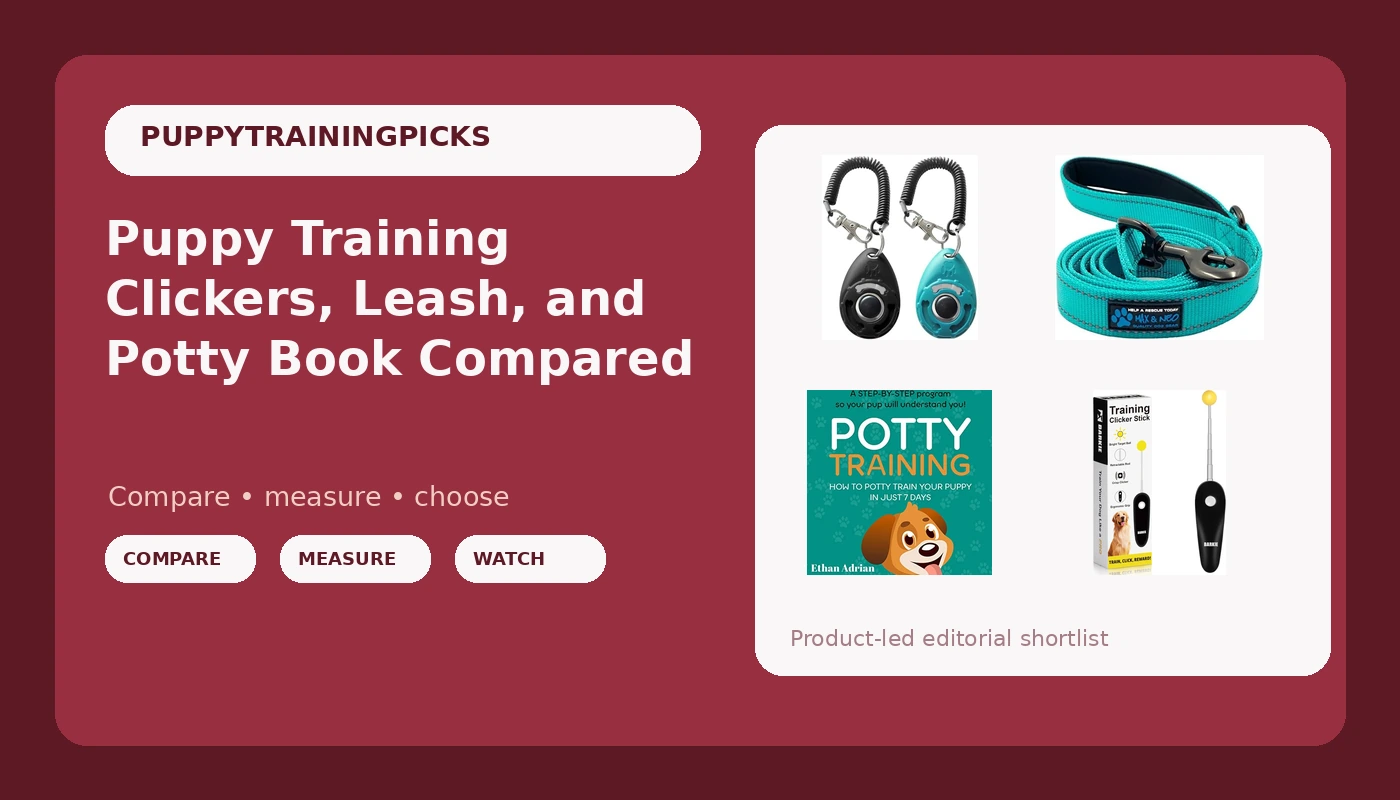
Dog Training Clicker with Target Stick
Two tools in one: a clicker plus a retractable target stick with a bright target ball, which makes teaching touch and send-to-place much easier on a puppy that will not hold still
More parts to lose, and a beginner can get so busy aiming the stick that the click lands late, which teaches the wrong thing
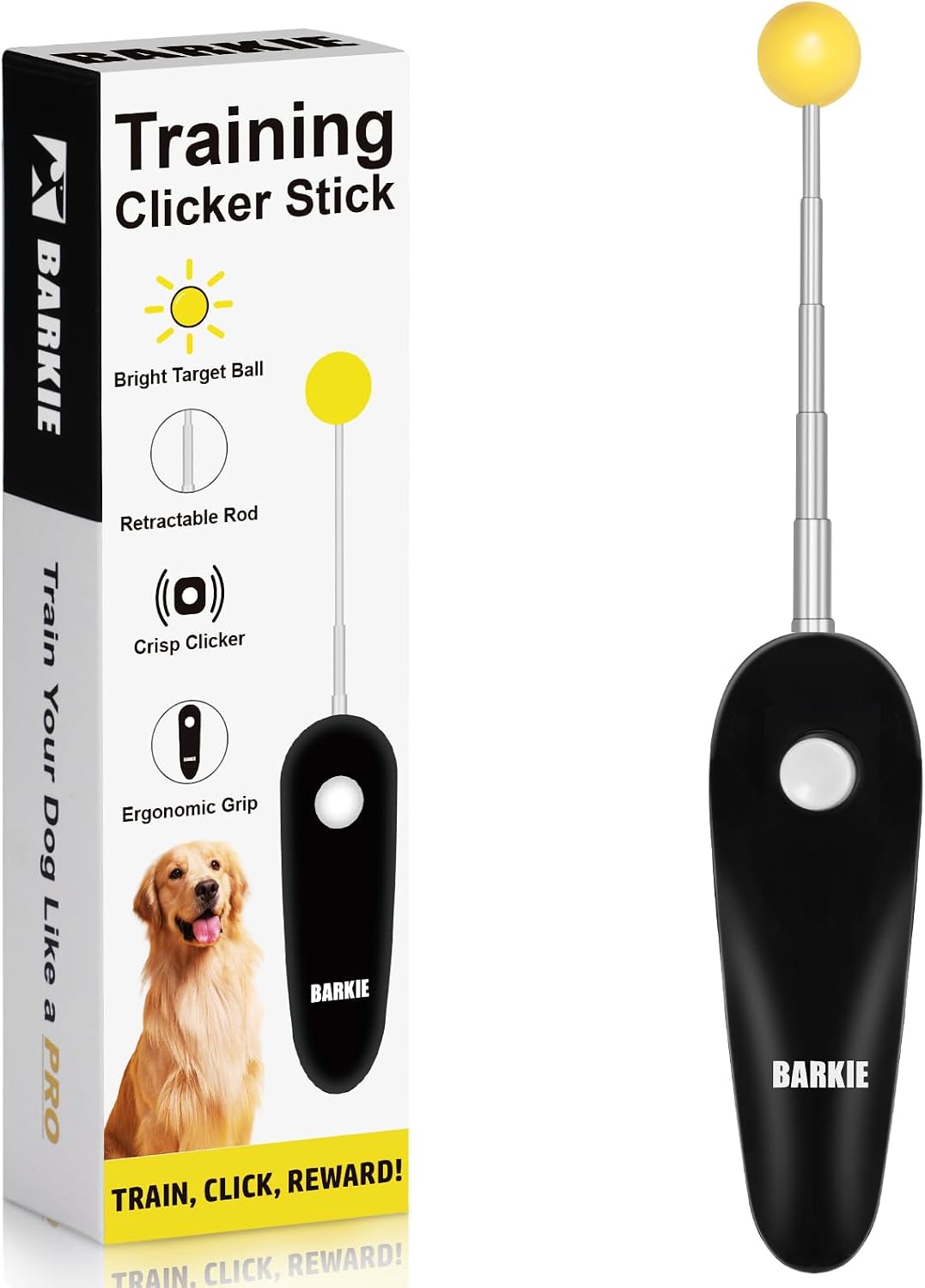
Dog Training Clicker with Wrist Strap and Keyring
The simplest version of the tool that works: a wrist strap so it stays on your hand, a keyring so it clips to the leash, and nothing else to think about while you mark behavior
No target stick, and like almost every clicker on the market it arrives without instructions, which is my single biggest complaint about this category
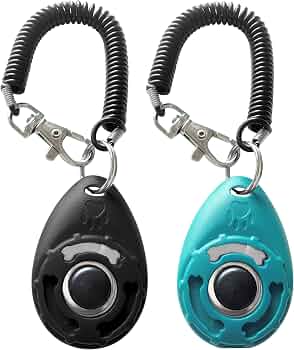
Max and Neo Reflective Nylon Dog Leash (Teal, 6x1)
A 6-foot reflective nylon leash in a color you can actually see, and the company donates a leash to a rescue for every one sold
It is a plain flat leash, so there is no traffic handle and no bungee, and 6 feet is a lot of slack in the hands of an owner who has not learned leash mechanics
Potty Training: How to Potty Train Your Puppy in Just 7 Days
Gives a nervous owner a step-by-step written program, which is often the difference between a plan and a vague hope
The "7 days" in the title is marketing, not biology. No book can promise a timeline, and puppies do not read chapters
Prices and availability were captured from Amazon Creators API and may change.
How I judge puppy training gear
Every product that walks into my class gets run through four questions before I say a word about it.
First, does it rely on pain or fear? If yes, it is out, at any age, for any reason. Second, can a first-time owner use it correctly without me standing over their shoulder? A tool that requires a certification to operate is not a tool for a household with a nine-week-old puppy and two tired adults. Third, does it survive week six, when the puppy has teeth, opinions, and a sudden interest in the neighbor's cat? Fourth, would I actually use it in my own class, in front of paying clients, without apologizing for it?
Two of these four products pass all four questions cleanly. One passes with a caveat about timing. One is not really gear at all, it is a plan, and I grade plans differently.
The clicker, and why it is still the best money in training
A clicker is a marker. It makes one identical sound at the exact moment the puppy does the thing you want, and then you pay. Treats are not bribes, they are payment for work performed, and the click is the receipt that tells the dog which behavior earned the paycheck. If you have ever wondered why your puppy looks confused when you praise him three seconds after he sits, it is because three seconds is an eternity to a dog. The click solves that.
The Dog Training Clicker with Wrist Strap and Keyring is the version I hand to new owners. The wrist strap is not a gimmick. It means the clicker is already on your hand when the behavior happens, instead of in your pocket while you fumble. The keyring means it clips to the leash loop and stays with your walking gear. There is nothing to configure and nothing to charge. You can Visit on Amazon → and be done deciding.
My complaint is the one I have about this entire product category: clickers ship without instructions. Owners get a plastic noisemaker and no explanation of charging the clicker, timing, or how to fade the food reward later. If you buy one, do yourself a favor and spend twenty minutes learning the sequence first: capture, then shape, then fade, in that order. The clicker itself is fine. The missing manual is the problem.
The Dog Training Clicker with Target Stick takes the same idea and adds a second tool. The stick is retractable, the handle is comfortable enough for a long session, and the target ball on the end is bright enough that a puppy can track it across a lawn. Targeting is how you teach a dog to touch something on cue, and once a puppy understands "touch," you can use that to move him onto a scale at the vet, into a crate, or onto a grooming table without a single wrestle. It is also the cleanest way to teach send-to-place, which is the behavior that eventually becomes "go to your bed and lie down" while you eat dinner.
The caveat is real: the stick gives you more to manage, and beginners who are still learning click timing tend to aim the stick and click late. Buy this one if you already have the rhythm, or if you are working with a trainer who can watch your hands.
The leash, and why 6 feet is the right length
The Max and Neo Reflective Nylon Dog Leash is a 6-foot, 1-inch-wide nylon leash in teal, with a reflective weave running through it. Those numbers matter more than the color, though the teal is genuinely useful. A dark leash on a dark dog at 6 a.m. in a Denver winter is invisible to drivers, and reflective thread is not a marketing feature, it is the reason a car sees you at the curb.
Six feet is the standard for a reason. It is long enough that your puppy can sniff, circle, and make small choices, which is how a walk becomes enrichment instead of a forced march. It is short enough that you can still gather the slack and keep him out of the street. A leash that is too short turns every walk into a tug of war, and a leash that is too long turns your puppy into a kite.
Where it loses points: it is a plain flat leash with a single handle. There is no traffic handle near the clip, so if you are walking a puppy through a busy intersection, you will be doing the hand-over-hand gather yourself. That is a skill, and it is one I teach in week five of class, but it is not built into the product. Nylon also gets slick when your hands are wet, and a puppy in full land-shark mode can still get his teeth on it. No leash fixes that. Only the fading of that behavior does, and that comes from consistency, not hardware.
The rescue donation is a nice bonus, though I would not buy a leash for that reason alone. Buy it because a reflective 6-footer is the right tool and this one is priced where you would expect for a leash that will outlast your puppy's chewing phase.
The potty training book and the seven-day claim
Here is where I have to be honest with you, because I have a rule about this. I do not make guaranteed-in-seven-days claims, and I do not let clients make them either. Training is a timeline, not a promise. So when a book arrives titled "Potty Train Your Puppy in Just 7 Days," my first reaction is skepticism about the cover and my second reaction is curiosity about the pages.
What this book actually is, based on how it presents itself, is a step-by-step program: a written sequence an owner can follow instead of inventing a schedule at 11 p.m. while standing in the yard in the rain. That has real value, because the number one reason potty training fails in my class is not the puppy. It is the human. Owners who do not have a written plan default to reacting, and reacting means the puppy is learning from accidents instead of from successes.
The honest limits: seven days is not a promise any book can keep, and the timeline depends on your puppy's age, bladder, and how many people in the house are following the same routine. The usual rule of thumb is that a young puppy needs a potty break roughly every hour he is awake, plus after every meal, nap, and play session, and that window stretches as he grows. That is a schedule problem, and a book that hands you a schedule is useful. A book that promises a deadline is overselling. Read it for the structure, not the number on the cover.
One related note, because it comes up constantly: if your goal is outdoor potty training, skip pee pads entirely. They teach a puppy that peeing indoors on a soft surface is correct, and then you have to un-teach it. That is not a knock on this book. It is a knock on the pads.
How the four fit together in the first eight weeks
This is the part most buying guides skip, and it is the part that decides whether your money was well spent.
Weeks one and two are about charging the clicker and naming the behaviors you already get for free. The clicker with the wrist strap does all the work here. You click, you pay, you repeat, and your puppy learns that the sound predicts a treat. Keep sessions to two or three minutes. A puppy's attention span is short, and ending early is how you keep him wanting more.
Weeks three and four are where the target stick earns its place. You teach touch on the target ball, then use that to move your puppy onto a crate mat, into a car, or onto the vet's scale. At the same time, potty training is running on a schedule, and this is where the book is doing its job: it is a checklist for the humans in the house, not a trick for the dog.
Weeks five and six are leash mechanics. This is where the Max and Neo leash comes in, and where most owners discover that a 6-foot leash is a skill, not an accessory. You practice gathering slack, rewarding your puppy for staying on a loose line, and turning before the leash goes tight. My class rule is simple: a tight leash is information, and the information is that you were too slow.
Weeks seven and eight are about fading. This is the step everyone skips, and then they wonder why the dog stops listening when the treats disappear. You thin the food reward, keep the click, and add praise and life rewards. If your puppy will sit for a door to open instead of for a liver bite, you did it right.
Trade-offs and what I would skip
The target stick clicker is the more capable tool and the harder one to use well. If you are choosing between the two clickers and you have never trained a dog before, start with the wrist strap version and add the stick later. Buying capability you cannot yet use is how training drawers fill up with gadgets.
The leash is the least exciting product here and probably the one you will use every single day for the next decade. That is worth weighing. A clicker is a tool you will use hard for eight weeks and then intermittently forever. A leash is a tool you will touch twice a day for years. If your budget only stretches to one of these right now, I would think hard about which one that is.
The book is the one I would call optional, with one exception: if you have already failed at potty training once, or if two people in your house disagree about the routine, a written program ends the argument. That is worth the price of a paperback.
What I would skip entirely: pee pads for an outdoor-trained puppy, and anything marketed to puppies that vibrates, shocks, or "corrects." There is no version of that I am comfortable with, and no puppy needs it.
The verdict
Start with the wrist strap clicker, because a marker is the foundation of everything else and it costs less than lunch. Add the reflective 6-foot leash when you start walking in the real world, ideally before your puppy's first evening walk in the dark. Buy the target stick version when your click timing is solid and you want to teach touch, place, and cooperative vet handling. Buy the book if you are the kind of person who follows a written plan better than a mental one.
None of these four will train your puppy. Ten minutes a day, every day, will. These just make those ten minutes count.