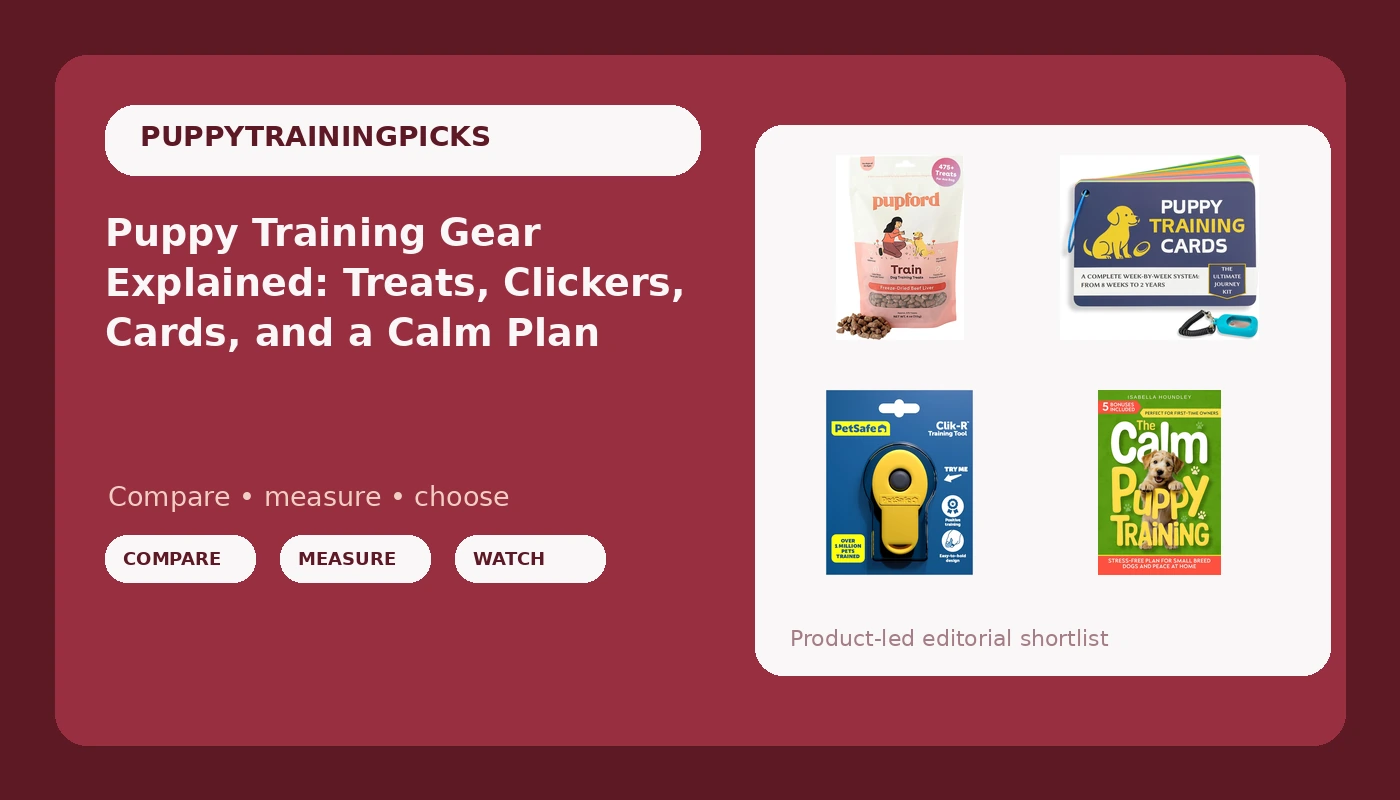
Most puppy training gear fails for the same boring reason: nobody explained what it is for. You buy a clicker, click it a few times, the puppy stares at you, and it ends up in a drawer next to the leash you never sized properly. Treats get handed out like popcorn until the puppy only listens when your hand is in the bag. A card set or a training book gets read once and never opened again. This explainer treats puppy training gear as a system instead of a shopping list: one reward, one marker, one sequence to follow, and one source of calm-household advice for the weeks when your home feels like a wind tunnel. None of these items trains the puppy. You do. The right gear just makes the work you are already doing land harder.
Related: How to Fade Training Treats Without Losing Your Puppy's Attention →
Quick answer
There is no single must-have item, because these four things do different jobs. Treats pay for behavior you like. A clicker marks the exact instant the puppy got it right. A structured card set keeps a first-time owner on a timeline instead of guessing what to teach next. A calm-focused training book covers the household side of raising a small breed puppy. If you own nothing at all, start with the marker and a plan, because those are the two pieces owners abandon first.
Four useful options
| Model | Best fit | What stands out |
|---|---|---|
| Pupford Freeze Dried Training Treats for Dogs & Puppies (Beef Liver, 4 oz) | Owners who want one reward reserved for training sessions | Freeze dried beef liver recipe in a 4 oz bag, labeled for dogs and puppies |
| Puppy Training Cards - Complete Raising Dog Kit with Clicker - Replaces Dog Training Book & Journal - 50 Stage by Stage Guide Cards (8 Weeks to 2 Years) | First-time owners who need a week-by-week sequence | 50 stage by stage cards spanning 8 weeks to 2 years, packaged with a clicker |
| PetSafe Clik-R Dog Training Clicker | Anyone who has never used a marker before | A dedicated handheld clicker built for marking behavior |
| The Calm Puppy Training: Stress-Free Plan for Small Breed Dogs and Peace at Home (The Calm Dog Training Series Book 2) | Small breed households dealing with whining, crate stress, and general chaos | Written specifically around small breed dogs, second in The Calm Dog Training Series |
The reward: Pupford Freeze Dried Training Treats for Dogs & Puppies (Beef Liver, 4 oz)
The reason trainers nag about treat size is that a training session is a calorie event. If every reward is the size of a grape, a fifteen-rep sit practice is a meal, and you will either overfeed the puppy or start skipping sessions to compensate. Freeze dried liver breaks or crumbles easily, which is what you want: pea-sized pieces, delivered fast, gone in a second so the puppy is ready for the next rep. Keep these in the pouch and keep the regular kibble in the bowl. A puppy who learns that the pouch food only appears during work is a puppy who shows up for work.
The plan: Puppy Training Cards - Complete Raising Dog Kit with Clicker - Replaces Dog Training Book & Journal - 50 Stage by Stage Guide Cards (8 Weeks to 2 Years)
Most owners do not fail at puppy training because they lack motivation. They fail because they do not know what comes next, so they practice sit forever and never touch impulse control, crate manners, or loose-leash walking until the puppy is forty pounds and pulling them down the block. A staged deck solves that by putting one task in front of you at a time. The timeline matters too: a 9-week-old puppy and a 9-month-old adolescent need completely different sessions, and the card set is built around that spread. What cards cannot do is practice for you. Treat the deck as the syllabus, not the class.
The marker: PetSafe Clik-R Dog Training Clicker
Here is my honest read on clickers: they are the piece of puppy training gear most likely to be bought and abandoned inside a week, and it is almost never the clicker's fault. A clicker without a plan is a noise maker. The tool earns its keep the moment you understand that the click is not praise, it is a timestamp. Praise arrives a beat late and sounds different every time. A click is identical on rep one and rep four hundred, which is exactly what a puppy needs to figure out which part of what he just did earned the liver. Buy it, load it, and use it for new behaviors only.
The calm-down read: The Calm Puppy Training: Stress-Free Plan for Small Breed Dogs and Peace at Home (The Calm Dog Training Series Book 2)
Small breed puppies are not just scaled-down versions of big ones, and owners who follow generic large-breed advice often end up with a dog who is carried everywhere, never learns to settle, and barks at the mail carrier from a sofa cushion. The calm angle is the right one for this stage, because a puppy who cannot switch off is a puppy who cannot learn. Use a book like this as reference material for the household problems (crate whining, night waking, over-arousal, the doorbell) rather than as a page-a-day curriculum. Read the section that matches the problem in front of you tonight.
Prices and availability may change. Product images, names, and retailer links must be matched by verified ASIN. Do not state a current price, rating, stock status, or measured result without current evidence.
Why a marker beats your voice for timing
Dogs learn from consequences, and the consequence has to land close enough in time to the behavior for the puppy to connect the two. That window is short. If your puppy sits, then stands, then sniffs your shoe, and only then gets the treat, you have just paid for sniffing your shoe. This is the single most common mechanical error I see in first-time owners, and it is not a discipline problem. It is a timing problem.
A marker closes that gap. You click the instant the rear end touches the floor, then deliver the food. The click tells the puppy "that, right there, is the thing," and the food that follows confirms it. Once a puppy understands that the click always means food is coming, the click itself becomes reinforcing, which means you can mark a behavior at a distance, mid-motion, or from across the yard.
Two rules keep the marker honest. First, load it before you use it: click, treat, repeat about ten times with no behavior required, so the puppy learns the sound predicts food. Second, only click behaviors you intend to pay for. Every click is a promise, and a promise you do not keep teaches the puppy that the sound is noise.
Markers are also how you move from luring to shaping. Luring (cookie on the nose, hand guides the puppy into position) gets a behavior started fast but creates a puppy who only works when food is visible. Shaping, where you mark small approximations toward the final behavior, builds a puppy who offers behavior instead of waiting to be led. That is the difference between a dog who sits when you happen to be holding a treat and a dog who sits because sitting works.
Treats are payment, not bribery
Owners get squeamish about food rewards because they worry about creating a dog who only listens for food. The fix is not to use fewer treats. The fix is to fade them correctly, which is the step almost everyone skips.
Think of it as a paycheck. When an employee is learning a new job, you pay them for every correct task. Once the job is mastered, you do not stop paying, you pay on a schedule they cannot predict. Training works the same way. New behavior gets paid every single time. A behavior your puppy knows well moves to a variable schedule: three reps paid, two reps marked with a click and a "yes" and no food, then paid again. The behavior gets stronger, not weaker, because the puppy learns that the work itself is worth doing.
A few practical guardrails. Keep rewards small, because a training session is a series of payments and the calorie math adds up fast. Use part of the daily ration or a dedicated training treat rather than stacking treats on top of full meals. And keep the reward food separate from the bowl, so the pouch keeps its value.
The other half of fading is building a second currency. Praise, a quick game of tug, a release to go sniff, all of these can become payment for a puppy who has been taught that they matter. If the only thing your puppy has ever been paid with is food, you have a puppy with one employer. Give him two or three.
How to run a session that actually sticks
- Load the marker first. Ten reps of click then treat, no behavior required, before you ask for anything.
- Pick one behavior per session. Two behaviors in one three-minute block means the puppy learns neither.
- Start in a low-distraction room. Add one new location per week, and work outside your puppy's threshold, meaning far enough away from the distraction that he can still think.
- Mark the instant, then pay within a second or two. If you are clicking late, shorten the behavior, do not speed up the treat hand.
- End on a success, then fade the food to a variable schedule over the following weeks.
Practical guidance for the first eight weeks
- Keep sessions to three to five minutes, two or three times a day. Short and frequent beats long and rare every time.
- Cut or break rewards into pea-sized pieces. A payment is a taste, not a snack.
- Budget training treats against the puppy's daily calories so you are not overfeeding a dog you are also trying to housetrain.
- Keep the training pouch separate from the food bowl, and put the pouch away between sessions so it keeps its meaning.
- Change one variable at a time. New place, same behavior, or new behavior, same place. Never both at once.
Which option should you choose?
Choose the Pupford Freeze Dried Training Treats for Dogs & Puppies (Beef Liver, 4 oz) when you want one reward reserved for training sessions and a format that breaks down into small, fast payments. Choose the Puppy Training Cards - Complete Raising Dog Kit with Clicker - Replaces Dog Training Book & Journal - 50 Stage by Stage Guide Cards (8 Weeks to 2 Years) when you need a sequence to follow from the first week home through adolescence and you would rather have one task in front of you than a whole book. Choose the PetSafe Clik-R Dog Training Clicker when you want clean timing and a marker that sounds the same on every rep. Choose The Calm Puppy Training: Stress-Free Plan for Small Breed Dogs and Peace at Home (The Calm Dog Training Series Book 2) when the problems are happening in the house rather than in the training session, and you want small breed specific guidance on settling, whining, and crate stress.
No product here fixes timing, and none of them practice for you. A card set and a book are only as good as the sessions you actually run, and no gear choice substitutes for a qualified trainer when the issue involves fear, aggression, or a puppy who is genuinely shutting down.
The bottom line
Build the system in the order that matches your gap. If you have no marker, buy the clicker and load it before the week is out. If you have no idea what to teach next, the staged card deck gives you the order. If your rewards are the size of golf balls and your puppy loses interest halfway through a session, fix the treat first. And if the problem is the noise and chaos of your own living room, start with the calm-household book and work backwards into the training mechanics. The gear is the ten percent. The other ninety percent is a puppy who gets paid promptly, consistently, and then gradually less often, by an owner who actually runs the reps.