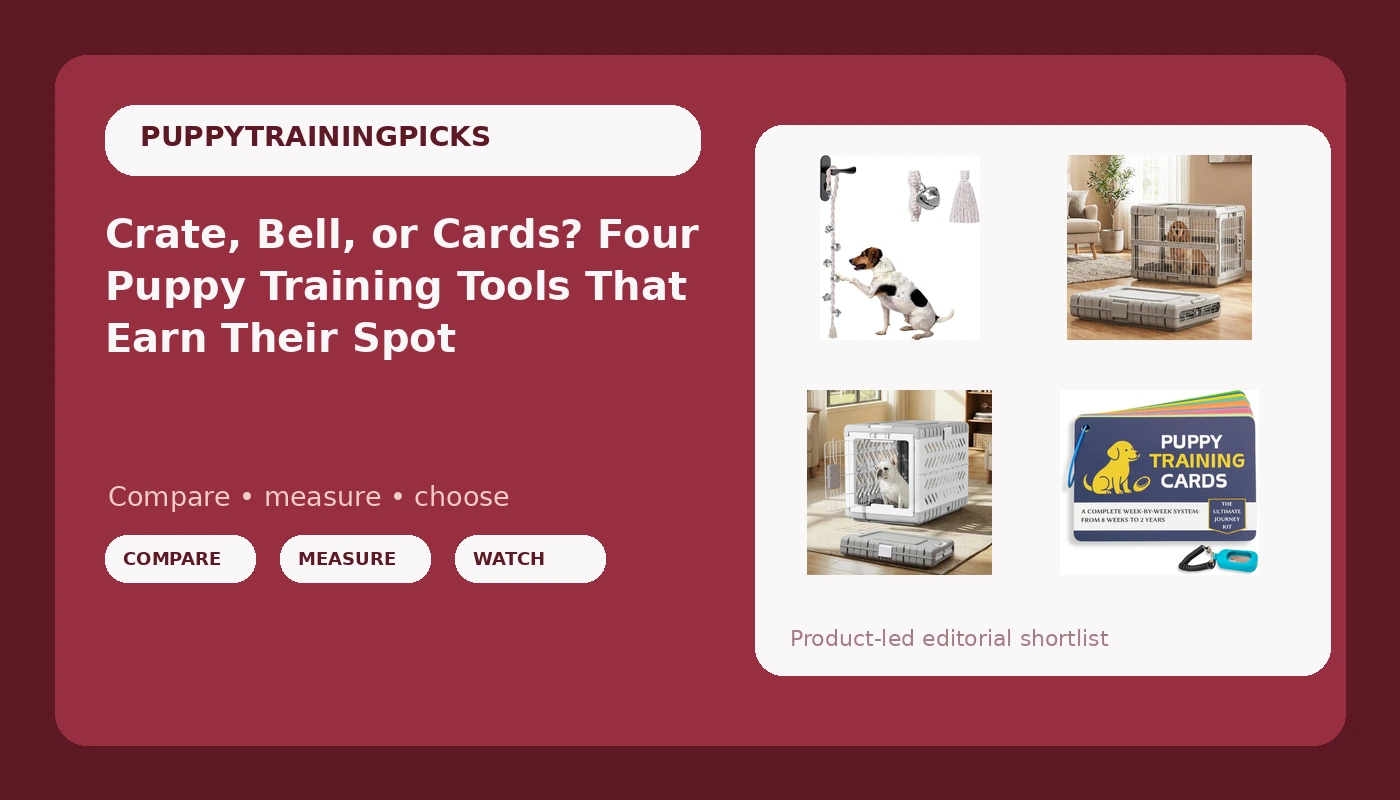
Most questions I get about puppy crate and potty training gear are really questions about sequence. Owners buy a crate, a bell, a clicker, and a bag of treats in one weekend, then wonder which one to use first and why the puppy is still peeing by the front door. Here is the honest version: gear is maybe 10 percent of the job. The other 90 percent is timing, repetition, and an owner who shows up on the boring days. But the wrong 10 percent can make the other 90 nearly impossible, so it is worth picking tools that match how puppies actually learn.
Related: How to Start Crate Training a Puppy Without the Whining →
Quick answer
For a puppy under six months, three working pieces cover almost everything: a crate sized so the puppy can stand, turn, and lie flat; a way for the puppy to ask to go outside; and a plan simple enough that you will still follow it after a bad night's sleep. A door-mounted bell handles the asking. A collapsible kennel handles sleeping and the hours when you cannot watch the puppy. A card-based program handles the order of operations, which is the part most owners skip. Which crate you pick depends less on breed and more on whether the crate lives in one room or rides in a car twice a week.
Four useful options
| Model | Best fit | What stands out |
|---|---|---|
| Dog Bells to Go Outside, Potty Training Bell, Handmade, Adjustable | Owners teaching a puppy to signal potty breaks | Adjustable handmade strap that hangs from a door handle at nose height |
| ZOMISIA 28" L Collapsible Dog Crate for Dogs, Heavy Duty Dog Kennel Indoor | Puppies who need a kennel that stays put indoors | 28-inch collapsible kennel described as heavy duty and built for indoor use |
| Collapsible Dog Crate for Medium/Small Dogs - 28" L Foldable Dog Cage No-Tool Assembly, Travel Dog Crate with 2 Wheels - Easy to Carry, Space-Saving, Indoor Outdoor Use, 27.96"(L) X18.3(W) X20.87(H) | Owners who move the crate between rooms, cars, and hotels | No-tool assembly, two wheels, and listed dimensions of 27.96 by 18.3 by 20.87 inches |
| Puppy Training Cards - Complete Raising Dog Kit with Clicker - Replaces Dog Training Book & Journal - 50 Stage by Stage Guide Cards (8 Weeks to 2 Years) | First-time owners who want a sequence to follow | 50 stage-by-stage cards covering 8 weeks to 2 years, bundled with a clicker |
The potty signal: Dog Bells to Go Outside, Potty Training Bell, Handmade, Adjustable
A bell only works if the sound predicts one thing: the door opens and you walk outside. Ring it yourself every single time you take the puppy out, then wait for the puppy to bump it by accident and reward that accident like it was planned. The failure mode is familiar. The puppy rings, you open the door, the puppy plays in the yard for ten minutes, and within a week the bell means "let me out to sniff things." Keep potty trips boring, on a leash, in the same spot, and the bell keeps its meaning. If your puppy is ringing every twenty minutes to test you, that is a sign the trips have become fun rather than a sign the bell is broken.
The stay-put crate: ZOMISIA 28" L Collapsible Dog Crate for Dogs, Heavy Duty Dog Kennel Indoor
Crate sizing is the mistake I see most often, in both directions. Too big, and a young puppy can potty in one corner and sleep in the other, which undercuts the whole point of the crate. Too small, and the puppy cannot stand without ducking or turn around without scraping the sides, and you get whining that has nothing to do with training. The rule is simple: stand, turn, lie flat. A 28-inch crate is a reasonable starting size for many medium puppies, but a small-breed puppy will rattle around in it for months. That is the trade-off with any fixed size. If your puppy is at the small end, either block off part of the crate or start smaller and size up later. The kennel is described as indoor use, so treat it as furniture rather than something you fold into a trunk every weekend.
The crate on the move: Collapsible Dog Crate for Medium/Small Dogs - 28" L Foldable Dog Cage No-Tool Assembly, Travel Dog Crate with 2 Wheels - Easy to Carry, Space-Saving, Indoor Outdoor Use, 27.96"(L) X18.3(W) X20.87(H)
Here is the trap with travel crates: if the crate only appears when the puppy is about to get a vaccine, the crate predicts the vet, and you get a dog who fights the door. Set the travel crate up at home first, feed meals in it for a week, and let the puppy nap in it before it ever goes in the car. Then the folding and the wheels are a convenience for you, not a surprise for the puppy. The wheels are also worth thinking about honestly. They help on a smooth floor or a paved path. They do not make a crate easy to carry up stairs, and the listed dimensions are the crate's exterior footprint, so measure your vehicle before assuming a 28-inch crate slides behind the seats. If you already keep an indoor kennel, this one earns its space as the second crate.
The plan: Puppy Training Cards - Complete Raising Dog Kit with Clicker - Replaces Dog Training Book & Journal - 50 Stage by Stage Guide Cards (8 Weeks to 2 Years)
A clicker is the cheapest piece of training equipment that actually changes outcomes, and it is also the one people abandon fastest. The reason is not the clicker. It is that nobody told them what to do with it past day three, so they click a few sits, feel silly, and stop. Cards fix that problem better than a book does, because you pull one card, do the thing on it for five minutes, and put it back. That is a realistic session for a puppy with a nine-second attention span. The card set is described as covering 8 weeks to 2 years, which matters more than it sounds, since most puppy programs stop right around the age when the dog becomes a teenager and starts ignoring everything you taught. Whatever plan you use, the click still has to be followed by a reward, and the rewards still have to fade.
Prices and availability may change. Product images, names, and retailer links are matched to verified listings. No current price, rating, stock status, or measured result is stated here without current evidence.
How a puppy learns to ask, sit, and settle
Puppies learn by consequence, and the consequence has to arrive within about a second of the behavior. That is the entire reason a clicker exists. The click marks the exact moment the puppy did the thing, and the treat arrives afterward. Without a marker, you are usually rewarding the wrong half of the behavior, like the moment the puppy stood up after sitting.
Three terms cover most of what you will do in the first three months. Capturing means marking a behavior the puppy offers on its own, like a sit, and paying for it. Shaping means rewarding small steps toward something bigger, which is how a nose touch becomes a hand target and a hand target becomes a recall. Fading means slowly trading food for praise, so the behavior does not depend on your pocket. Most owners do the first two and skip the third, then wonder why the dog stops listening once the treats disappear. The bell fits into the same framework. You are capturing a nose bump, marking it with the door opening, and paying with a trip outside.
Sizing the crate and matching it to your week
Measure before you buy. A crate should let your puppy stand without crouching, turn around, and stretch out flat. If you can fit two puppies in it, it is too big for a young one, because the extra space becomes a bathroom. The listed footprint of a 28-inch crate is a starting number, not a guarantee, since dogs are built differently even at the same weight.
Then match the crate to your week. If the crate stays in one room and doubles as the puppy's bedroom, an indoor kennel with a sturdy frame is the right call. If the crate travels to a sitter, a hotel, or a training class, a folding crate with wheels saves you ten minutes of assembly every trip. A puppy who sleeps in a crate at home and rides in the same style of crate in the car generalizes faster than one who only sees a crate in strange places.
- Set the crate up two weeks before you need it, with the door open and a treat inside.
- Feed every meal in the crate for the first week, door open, no pressure.
- Hang the bell, ring it yourself, and walk the puppy straight outside to the same spot.
- Mark and reward the second the puppy finishes potty, then go back inside.
- Close the crate door for short absences first, and build up before trying a full workday.
What to set up in the first week
- Pick one potty spot and use it every single time, including at 2 a.m.
- Take the puppy out after every meal, nap, play session, and drink of water.
- Keep potty trips boring: leash on, no talking, no wandering, straight back inside.
- Practice five-minute sessions twice a day rather than one long session nobody enjoys.
- Write down what you worked on, even one line, so you can see progress on the days it feels like there is none.
Which option should you choose?
Choose the Dog Bells to Go Outside, Potty Training Bell, Handmade, Adjustable when your puppy already gives some signal, even a weak one, and you want to turn it into a clear request. Choose the ZOMISIA 28" L Collapsible Dog Crate for Dogs, Heavy Duty Dog Kennel Indoor when the crate is staying in one room and you want a kennel that can be put away between puppies or between houses. Choose the Collapsible Dog Crate for Medium/Small Dogs - 28" L Foldable Dog Cage No-Tool Assembly, Travel Dog Crate with 2 Wheels - Easy to Carry, Space-Saving, Indoor Outdoor Use, 27.96"(L) X18.3(W) X20.87(H) when the crate needs to move, whether that is a weekly class or a car trip to a sitter. Choose the Puppy Training Cards - Complete Raising Dog Kit with Clicker - Replaces Dog Training Book & Journal - 50 Stage by Stage Guide Cards (8 Weeks to 2 Years) when you have never raised a puppy before and want a sequence handed to you instead of assembled from forum posts.
One caveat worth stating plainly. Every puppy is a different size at the same age, and every household has a different schedule, so the right answer for a 12-pound puppy in a quiet apartment may be wrong for a 30-pound puppy in a busy house. Measure your dog, measure your car, and buy the crate that fits the dog you have now, not the dog you expect in eight months.
The bottom line
The gear matters less than the routine, but the routine is easier with the right gear. A bell, a properly sized crate, and a plan you will actually follow cover potty training, crate training, and basic manners, which is most of what the first six months ask of you. Everything else, the extra toys and the specialty leashes and the gadgets that promise results in a week, can wait until the basics are boring and automatic. Pick your three tools, set a schedule, and put in the reps. The puppy is not the variable here.