Most puppies do not need a fancier schedule. They need a way to tell you they have to go before it lands on the rug. That is the entire job of a puppy potty training bell, and it is the one piece of gear I hand new owners in my classes without hedging.
I run a puppy kindergarten out of a church basement in Denver. Thirty-plus puppies a month, eight weeks per group, real distracted sidewalks, and real owners who forget to practice between sessions. In that environment a bell either works beautifully or fails loudly, and the difference almost never comes down to the bell.
It comes down to whether you answer it. Every time. Including at 2 a.m. in January when the sidewalk is ice and you are standing there in socks.
Here is the sequence I teach, in order, plus the mistakes that stall it.
Why you should trust me
I have been a professional trainer for seven years, and four of those years have been spent running the kindergarten program. That program graduates over thirty puppies a month, which means I have watched several hundred puppies learn to ask for the door, and I have watched several hundred owners get in their own way while they did it.
I keep a running list of which tools survive week six of a puppy's life. The list is short. Bells are on it. Most of the gadgets that get marketed to new owners are not.
My bias, stated up front: the tool is about 10% of training. Timing, consistency, and an owner who actually practices are the other 90%. Nobody pays me to say nice things about anything, and if a product on this page is doing less work than the routine around it, I will tell you that too.
How I picked and how I tested
This is a how-to, not a gear roundup, so the list is deliberately short. You need a bell on the door and you need something on your feet, because you are about to spend six weeks standing in wet grass at strange hours.
When I evaluate any training product, I run it through four questions. Does it rely on pain or fear? Can a first-time owner use it correctly without taking a class? Does it survive week six with a teenage puppy who has opinions? Would I use it in my own program? Anything that fails the first question is out permanently, no matter how well it sells.
For a door bell specifically, the bar is practical. It has to hang on the door you actually use, not the decorative door at the front of the house. It has to be loud enough to hear from the kitchen with the dishwasher running. And it has to tolerate being nosed, pawed, and occasionally mouthed by a puppy who is still figuring out what his face is for.
I do not review gear off one session with one puppy. I do not do guaranteed-in-seven-days claims either. House training is a timeline, not a promise, and anyone selling you a seven-day version is selling you a story.
The two things you need before session one
Everything else is optional. Treats, a crate, and a leash are assumed. These two items are the ones that specifically support bell training and the outdoor trips it creates.
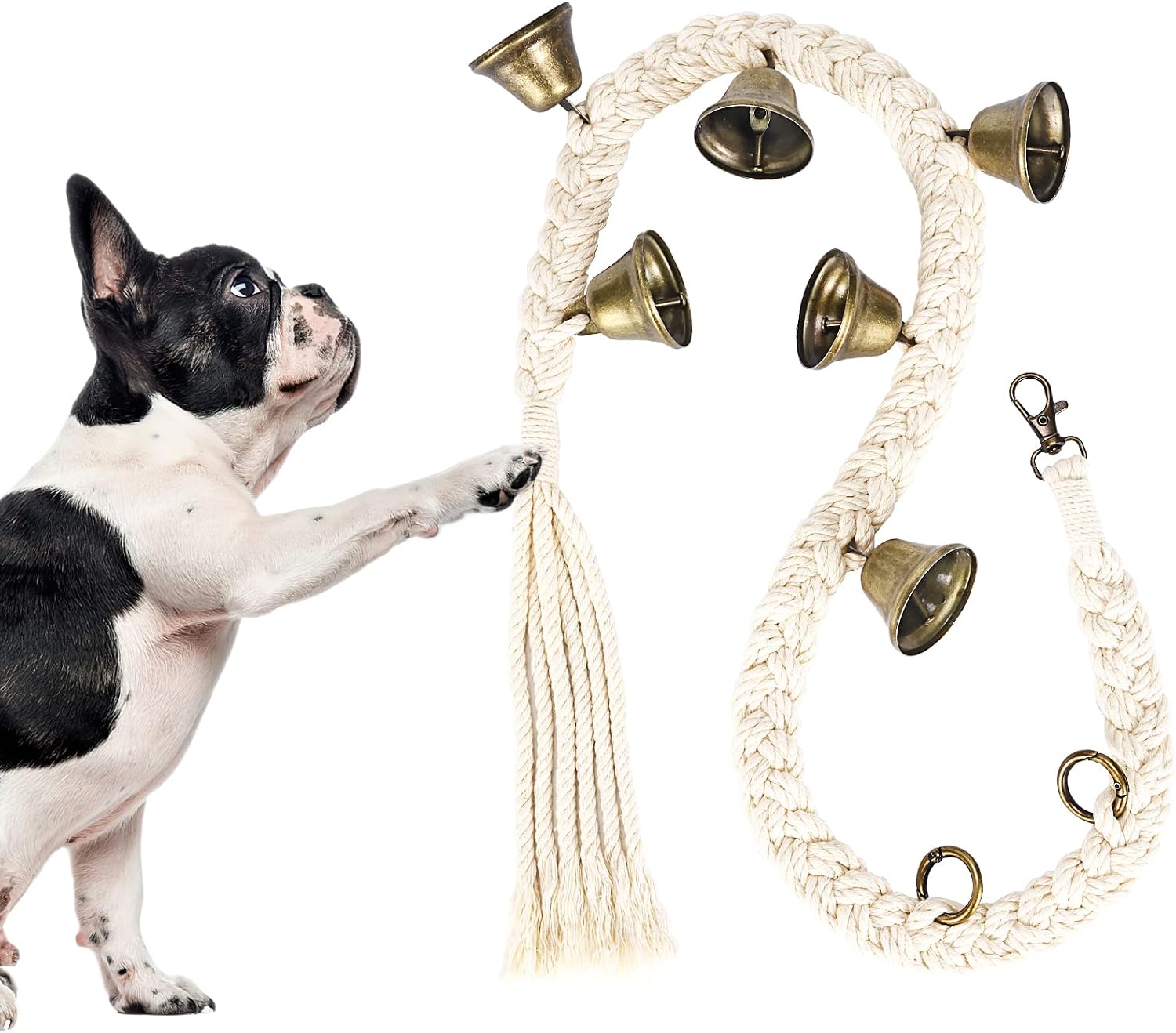
Our pick: KLOGTSIND Dog Bells to Go Outside, Cotton Handwoven Potty Training Bell
 Visit on Amazon →
This is a handwoven cotton strap with bells on it, and that is the whole design. You hang the strap over a door handle or a hook next to the door, and when your puppy bumps it with his nose, the bells ring. That is the entire mechanism, which is exactly why it works. There is nothing to charge, nothing to pair over Bluetooth, and nothing that breaks in a way you cannot fix with a knot.
The cotton matters more than it sounds like it should. A puppy is going to nose this thing a few hundred times over the next month, and a soft handwoven strap is a much friendlier texture against a young muzzle than stiff nylon webbing or a plastic housing. It is also quiet when it is not being hit, which matters, because you do not want a jingling door confusing your puppy while he is napping in the next room.
The other thing I like about a strap-style bell over a mounted one is that it travels. If you are house training in a rental, or visiting your parents for a week, you pull the strap off the handle and take it with you. Your puppy's cue for "I need out" comes along, and that alone can save you a regression during the holidays.
Flaws but not dealbreakers: The flaw with any strap bell is that it is only as good as the door you hang it on. If your puppy cannot reach the door handle, he cannot reach the bell, and a puppy who cannot reach the bell will find another way to tell you. Hang it low enough that he can nose it without jumping, and tie off the extra length.
This is for the owner who wants one clear, mechanical signal on one door and is willing to answer it. If you want a training setup with electronics and buttons, this is not that product.
For the human end of the leash: KEEN Women's Roam Trail Running Shoes
 Visit on Amazon →
This is the half of the gear list that nobody writes about, and it is the half that decides whether you actually follow through at 5 a.m. Bell training means dozens of quick trips outside per week, on wet grass, gravel, mulch, and the kind of slick wooden deck steps that get genuinely dangerous in Colorado in February.
A trail running shoe is the right category for that job. You want tread that bites into damp ground and a closed toe that does not care about mud, and you want to be able to slide them on without bending down, because you will be holding a leash and a squirming puppy in the other hand. KEEN builds this shoe for women on trails, and a yard in early spring asks roughly the same thing of a shoe that a trail does.
The practical reason to buy a dedicated pair for this: your indoor shoes stay indoors, which means the mud, the mulch, and whatever the neighbor's dog left behind stay outside where they belong. Puppies explore the ground with their mouths. You do not want to be the one tracking that back across the kitchen floor.
Flaws but not dealbreakers: A trail shoe is heavier than a road running shoe and more shoe than you need if your only outdoor surface is a paved sidewalk in a dry climate. It is also not a slipper. If you want something you can shove on with one hand in the dark, that is a different purchase.
This is for the owner in a house with a yard, a wet climate, or four real seasons, and for anyone whose 2 a.m. potty spot involves stairs.
The actual bell training workflow
Now the part you came for. This works with any hanging bell, and it works fastest with a puppy between eight and sixteen weeks old.
Step one: Pick one door and only one door. Choose the door you will actually use for every single potty trip, including the night ones. A puppy learning a new signal cannot generalize across three exits. One door, one bell, one routine for at least the first three weeks.
Step two: Hang the bell at nose height. Not at your hand height. Your puppy has to be able to reach it without jumping or scratching, so hang it low, tie off the excess strap, and check that a nudge actually makes noise.
Step three: Pair the bell with the trip, not with a command. Before you open the door, guide your puppy's nose into the bells so they ring, then open the door immediately. Do not say a word. The order is ring, then door, every time, and the door opening within a second or two is the reward for the ring.
Step four: Go to the same boring spot. Same patch of grass, no walking, no sniffing tour, no chatting with the neighbors. Stand still and wait. Puppies need to learn that outside at potty time means one thing.
Step five: Pay the second he finishes. Mark it with a calm "yes" and deliver a soft, pea-sized treat within a second or two of the last drop. If you wait until you are back inside, you are paying for coming inside, not for going potty. This is the step owners rush, and it is the step that decides everything.
Step six: Repeat for every trip, including the night ones. This is the part that breaks people. If you skip the nose-to-bell step at 2 a.m. because you are tired, you are teaching your puppy that the bell matters sometimes. Sometimes is the same as never for a puppy.
Step seven: Add a word cue late, not early. Once your puppy is nosing the bell on his own most trips, add a quiet "outside?" as you walk toward the door. Now you have a verbal cue you can use anywhere, including at your mother-in-law's house where there is no bell.
Step eight: Fade your hand prompt. Somewhere in week two or three, stop guiding his nose. Wait at the door with your hand near the bell and give him a chance to offer the behavior. If he does not, help him once, then open the door. This is capturing, then shaping, then fading, in that order, and skipping the fade is why some puppies ring the bell only when a human is standing right next to it.
Most puppies I work with are ringing on their own somewhere between day ten and day twenty-one. If you are past three weeks with zero voluntary rings, the problem is almost always step six.
When it goes wrong
He rings the bell constantly. This is the most common complaint and it is a routine problem, not a bell problem. Your puppy figured out that the bell opens the door, which means the bell also opens the door to play, to sniff, to eat mulch, and to visit the neighbor's dog. Fix it by making every bell trip boring: out on a leash, straight to the potty spot, thirty seconds of standing, then back inside. If he rings and does not go, you go back in anyway. The bell stops being a magic portal within a week or so.
He rings, you go out, he pees inside two minutes later. That usually means he was too distracted outside to finish. Give him the full three minutes at the spot, and if nothing happens, bring him back in and either crate him or keep him on a leash attached to you for ten minutes, then try again. Do not let him free-roam the house after an unsuccessful trip.
He is scared of the bell sound. Some puppies startle at the first jingle. Do not force it. Ring it softly yourself while feeding him dinner a few feet away, then closer, then let him bump it while you hold a treat on the other side. Two or three days of that and the sound becomes a predictor of good things.
He rings, then pees right at the door. That is a timing miss on your part, not defiance. He asked, and the answer took too long. Set the bell closer to the door and move faster.
He regresses at five or six months. Very normal. Adolescent puppies get more confident and more distracted, and the routine that worked at twelve weeks gets sloppy. Go back to step three for a week and it usually snaps back.
The competition and why it lost
Pee pads are the biggest one, and I will be blunt about them: they teach a puppy that peeing indoors is a legitimate option. If your goal is outdoor house training, pads work against you, and the puppy who learns both surfaces is the puppy who pees on the bath mat at eight months.
Electronic button doorbells are the other category people ask about. A button that plays a chime is fine in principle, but it adds batteries, a mounting decision, and one more thing to break, and a puppy cannot nose a flat button as easily as he can swing a strap. I have not seen a version of that setup that beats a plain hanging bell for a young puppy.
Potty training sprays and attractant pads are a different tool for a different problem. They can help you designate a spot outdoors, and they do nothing for communication, which is the actual problem this article solves.
Clickers belong in your pocket for everything else, but a clicker does not open a door. The bell does.
What this all costs
You can spend a lot of money on puppy gear and still be scrubbing the stairs at week eight. The two items here are the cheapest possible version of the right answer: one hanging bell and one pair of shoes you are willing to get muddy.
The real cost is time, and it is front-loaded. Expect ten to twenty trips outside per day for the first two weeks, which sounds absurd until you remember that a young puppy's bladder is roughly the size of a walnut. Those trips shrink fast once the bell is working, because your puppy starts telling you when he needs out instead of you guessing on a timer.
Do the math over five years of a dog's life. Two weeks of annoying frequency buys you a decade of a dog who asks politely at the door instead of standing silently in the hallway. That is the trade, and it is a good one.
Do the eight steps in order, answer the bell every time, and keep your shoes by the door. Your puppy will do the rest.