Most puppies are not stubborn. They are confused, and the confusion is usually ours. We stand by the back door waiting for the puppy to announce that he needs to go, then act surprised when he does not. The fix is not more willpower. It is a signal the puppy can send and a signal you can send back, which is exactly what puppy training bells and clicker work is for.
The bell gives a puppy a way to tell you something you cannot see from the kitchen. The clicker gives you a way to tell the puppy exactly which thing he did right, inside the second it happened. Neither tool trains the dog. You train the dog. But both of them make your timing better, and timing is most of the job.
I run a puppy kindergarten that graduates about thirty puppies a month, and these are the two items I would put in front of almost every owner in week one. Here is how to use them, what order to teach them in, and what to do when your puppy starts ringing the bell purely because he wants you to stand up.
Why you should trust me
I have been training dogs professionally for seven years and running a puppy kindergarten for the last four. That is a lot of puppies learning to ask for the door in a church basement with bad acoustics and a coffee maker that runs during class. I do not sell gear, I do not take a cut from anyone's product line, and I keep a short list of what survives week six with a teenage puppy.
My bias, stated up front: nothing that works by startling or hurting a puppy belongs in a training plan, at any age. That eliminates a large share of what gets marketed to new owners. A bell and a clicker are both positive, both simple, and both completely useless if you do not practice. That last sentence is the actual article.
The gear that carries the plan
You need two things and a schedule. The schedule is free and it is the part people skip.
A door bell gives the puppy a way to initiate. A clicker gives you a way to mark the exact moment something good happened. Together they cover both directions of communication: puppy to owner, owner to puppy.
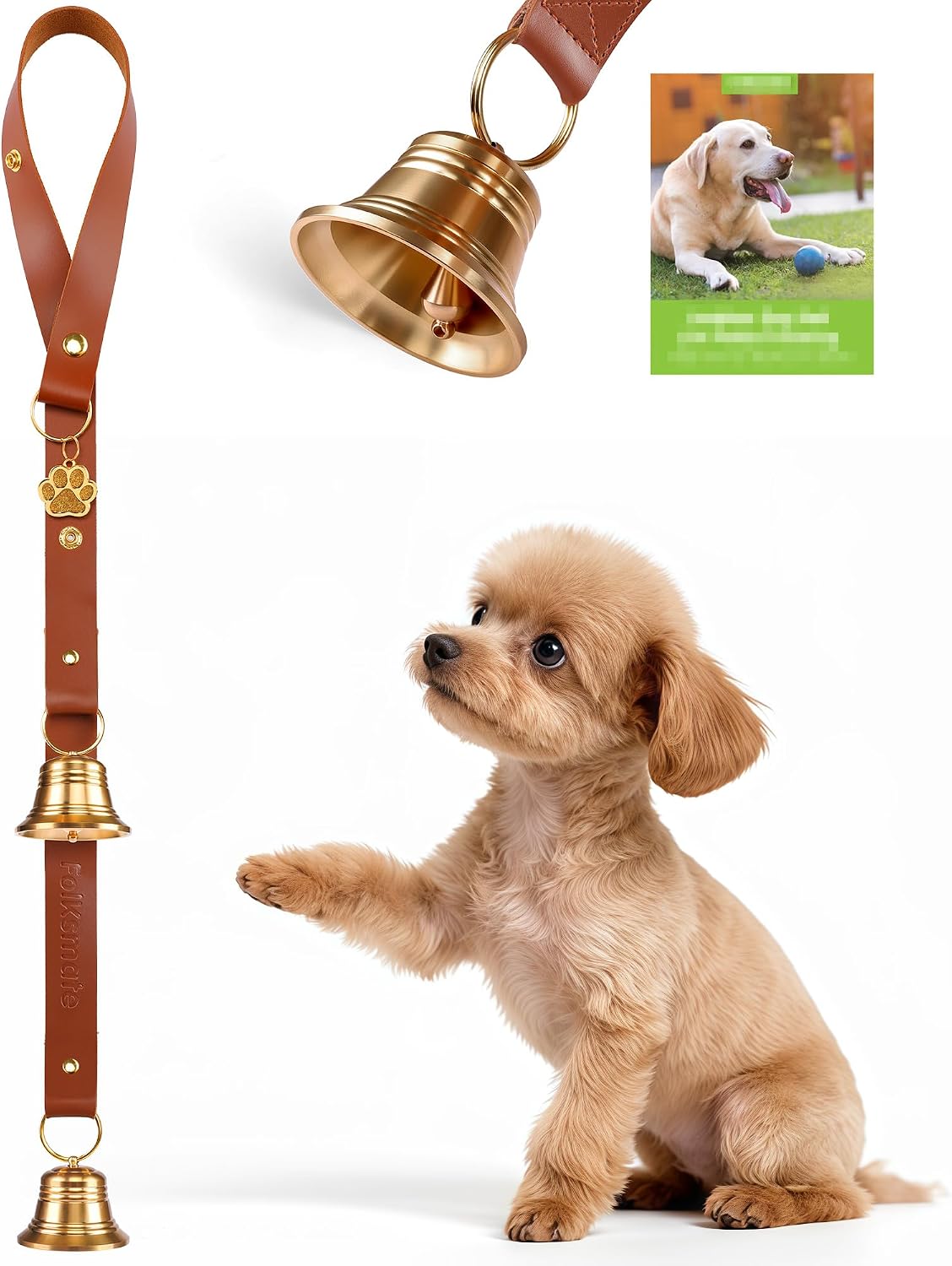
The potty signal: FOLKSMATE Leather Dog Door Bells for Potty Training, Nail-Safe Puppy Dog Door Bells Extra Loud for Dogs Training, Housebreaking, Door Knob, Dog Bell to Ring to Go Outside Puppy Pet Supplies Leather
 Visit on Amazon →
The design that works for housebreaking is leather, hung from the door knob, and loud enough to hear from the back of the house with the dishwasher running. That volume is not a gimmick. If you cannot hear the ring from another room, you cannot respond inside the two seconds that teach the puppy the bell works.
What matters about the leather build is the part the puppy touches. Puppies swat bells with a paw and mouth them with teeth, and a strap with soft edges and no exposed wire is the difference between a training tool and a vet visit. The nail-safe construction matters for the same reason. A puppy who catches a claw on cheap hardware learns to avoid the bell entirely, and you have trained the opposite of what you wanted.
The door knob loop means no tools and no wall damage, which matters if you rent. It also means the bell sits at whatever height your door knob sits at, so check that it hangs low enough for a small puppy to reach with his nose without jumping.
Flaws but not dealbreakers: Any hanging bell is a chew toy when you are not watching. Take it off the door or fold it up during unsupervised time until your puppy stops treating it as a snack.
Anyone who wants a puppy to ask for the door instead of standing silently beside it will get the most out of this.
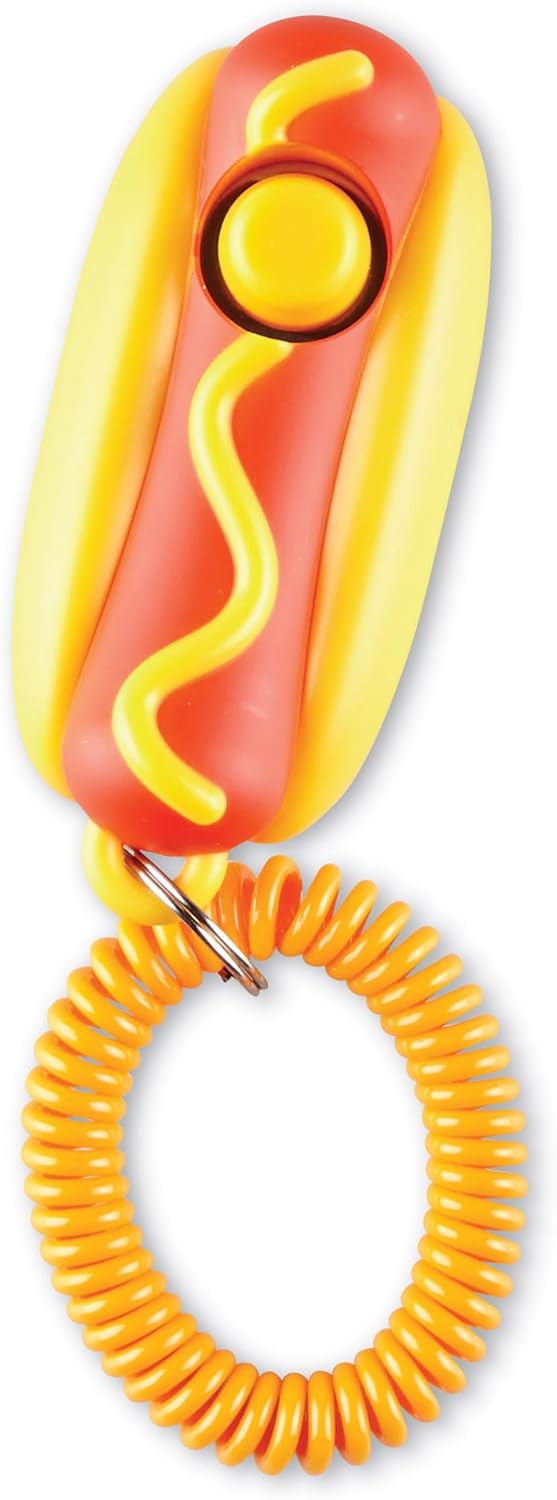
The marker: Learning Resources Training Clicker: Hot Dog
 Visit on Amazon →
A clicker is the best few dollars you will spend on training, and almost nobody uses it past day three. The hot dog styling on this one is more useful than it sounds. A clicker you enjoy picking up is a clicker you actually use, and consistency is the entire point of the tool.
Two things matter in a clicker. The sound has to be sharp and identical every time, because the click is a marker and markers only work when they are consistent. And the mechanism has to be light enough to press with one hand while you are holding a leash, a treat pouch, and a six-pound puppy.
Flaws but not dealbreakers: It is a clicker, not a remote control. It does nothing on its own. If you do not charge it with food first, your puppy hears a random noise and learns nothing.
First-time owners who want a cheap, consistent marker for name recognition, sit, and bell training will do fine here.
How to teach the door bells
This takes about a week of normal life, not a week of extra sessions. The whole method is one rule: the bell rings, the door opens, every single time.
Step one: hang it on one door. The door you actually use for potty trips. If you rotate between the front door, the back door, and the garage, the puppy never learns which one matters.
Step two: ring it yourself before every trip. Every trip, for three or four days. Touch the bell, let it ring, then open the door and take the puppy out. You are building the association between the sound and the thing the puppy wants, which is outside.
Step three: let the puppy bump it. Once he is interested, hold the door closed a second longer and let him nose or paw the bell on his own. Do not grab his paw and press it. That teaches a puppy to avoid the bell. Wait for the accidental touch, then open the door the instant it happens.
Step four: mark and pay. The moment the puppy touches the bell, click, then treat. The click marks the touch. The treat pays for it. Then open the door anyway, because outside is the bigger reward.
Step five: go out and wait. Take the puppy to the same spot, stand still, and give him three to five minutes. If he goes, click, treat, and head back in. If he does not, go back inside and watch him or crate him and try again in fifteen minutes.
Step six: make the trip boring. This is the step that saves the whole system. A puppy rings, you open the door, and he gets a walk, a sniff fest, and twenty minutes of your attention. Congratulations, you have taught a puppy to ring a bell for entertainment. Potty trips are short, quiet, and on leash. Fun happens afterward, separately.
Step seven: keep the schedule honest. Bells do not teach bladder control. A young puppy needs out every one to two hours, plus after every nap, every meal, every play session, and every training session. The bell is the puppy's voice, not his bladder.
How to charge and use the clicker
Step one: charge it. Ten clicks, ten treats, twice a day for two days. No behavior required. Click, treat, click, treat. You are teaching one rule: click means food is coming.
Step two: one click per moment. The click marks a single instant. Machine-gunning the clicker through a sit tells the puppy nothing about which part earned the reward.
Step three: keep the gap under a second. The treat can take three seconds to arrive. The click cannot. If the click lands late, you marked the wrong thing, and the puppy learned the wrong thing.
Step four: click the bell touch. Once the clicker is charged, use it for the bell. Nose hits bell, click, treat, door opens. Now the puppy has two reasons to touch it.
Step five: cue first, mark second. Say the word, wait for the behavior, click the instant it happens, then treat. The click ends the behavior. The treat follows the click.
Step six: fade, or the whole thing falls apart. Once a behavior is reliable, replace the click with a spoken marker like "yes" and move treats to a variable schedule, some reps paid and some praised. Owners skip this step and then wonder why a four-month-old who was perfect at ten weeks has stopped listening. He has not stopped listening. He has stopped working for free.
Where owners go wrong
The bell goes up before the puppy has any bladder control, and the owner blames the tool. Bells are a communication device, not a housebreaking shortcut.
The puppy rings constantly for attention, and the owner opens the door every time. Fix it by making trips boring, not by taking the bell down.
The clicker gets used without charging, so it is just a noise. Fix it with two days of click-treat reps before you ask for anything.
Treats are the size of a thumbnail, and the puppy is full after four reps. Training treats should be pea-sized or smaller, soft, and eaten in one bite.
Somebody in the house punishes the ring because it was a false alarm. Now the puppy has learned that telling you he needs to go is dangerous. Never punish the bell, even when it is wrong.
One person trains and three people do not. Puppies do not generalize well. If the whole household is not ringing the bell before trips, the puppy is being taught two different sets of rules.
What this all costs
The bell and the clicker both sit at Check current Amazon price, and that is the entire gear budget. There is no app, no subscription, and no replacement cartridge.
Compare that to what a housebreaking failure costs: carpet cleaning, a chewed baseboard, a replacement crate pad, and another month of an owner who is frustrated with a puppy who was never given a clear way to ask. The tools are the cheap part. The eight weeks of consistency is the expensive part, and it costs time, not money.
If you only buy one, buy the clicker, because it improves every behavior you will ever teach. If you only train one thing this month, train the bell, because a puppy who asks for the door is a puppy you can trust in the house.
Hang it on the door. Ring it every time. Click the second his nose touches it. That is the whole method, and it works on the same timeline as everything else in dog training: as long as it takes, one repetition at a time.