Most puppies meet a clicker for about ninety seconds before it disappears into a drawer. I have watched it happen in hundreds of classes. An owner clicks the little box a few times, the puppy blinks, nothing obvious happens, and the clicker joins the leash that never gets used. Clicker training for puppies fails at exactly that point, and it fails for one reason. The click is not a command and it is not a reward. It is a photograph of the exact moment your puppy did the thing you wanted to pay for.
Your voice arrives about a second after a behavior. A click arrives in a fraction of that, and it sounds identical every single time. That consistency is what lets a puppy sort out which of the forty things he did in the last two seconds earned the treat. Get the timing right and a sit takes one session. Get it wrong and you teach your puppy that clicks are random noise.
This is the version I hand to new owners in week one of my kindergarten program: how to charge the clicker, how to mark a behavior, how to deliver the treat, and how to fade the click before your puppy hits six months. You need one clicker, a pouch of small soft treats, and about five minutes a day.
Why you should trust me
I have been a professional trainer for seven years, and I have spent the last four running a puppy kindergarten program that graduates more than thirty puppies a month. Before that I bought every gadget on the market and threw most of them away. I keep one prong collar from my early career on a shelf as a reminder, and I do not recommend anything that works through pain or fear, at any age.
What I keep is a short list of tools that survive week six, when the novelty wears off and the real dog shows up. A clicker is on that list. Almost nothing else that cheap is.
How I tested these clickers
I run everything through the same eight week structure my classes use: real puppies, real distracted sidewalks, and real owners who forget to practice between sessions. That last part matters. A tool that only works when a trainer is holding it is a prop, not a tool.
For a clicker I want four things. Can a first time owner use it correctly without a class? Does the click stay distinct from the dishwasher beep and the squeaky toy? Does it survive a drop on a February sidewalk? And does it still get used in week six?
There is a fifth thing nobody markets: how easy it is to carry. A clicker in a drawer marks nothing. If it is not on your wrist or in your pocket when the puppy does something great, you missed the rep.
The clickers I use in class
Both of these are simple mechanical clickers, which is what you want. A clicker with batteries, an app, or a subscription will fail you at the exact moment you need it.
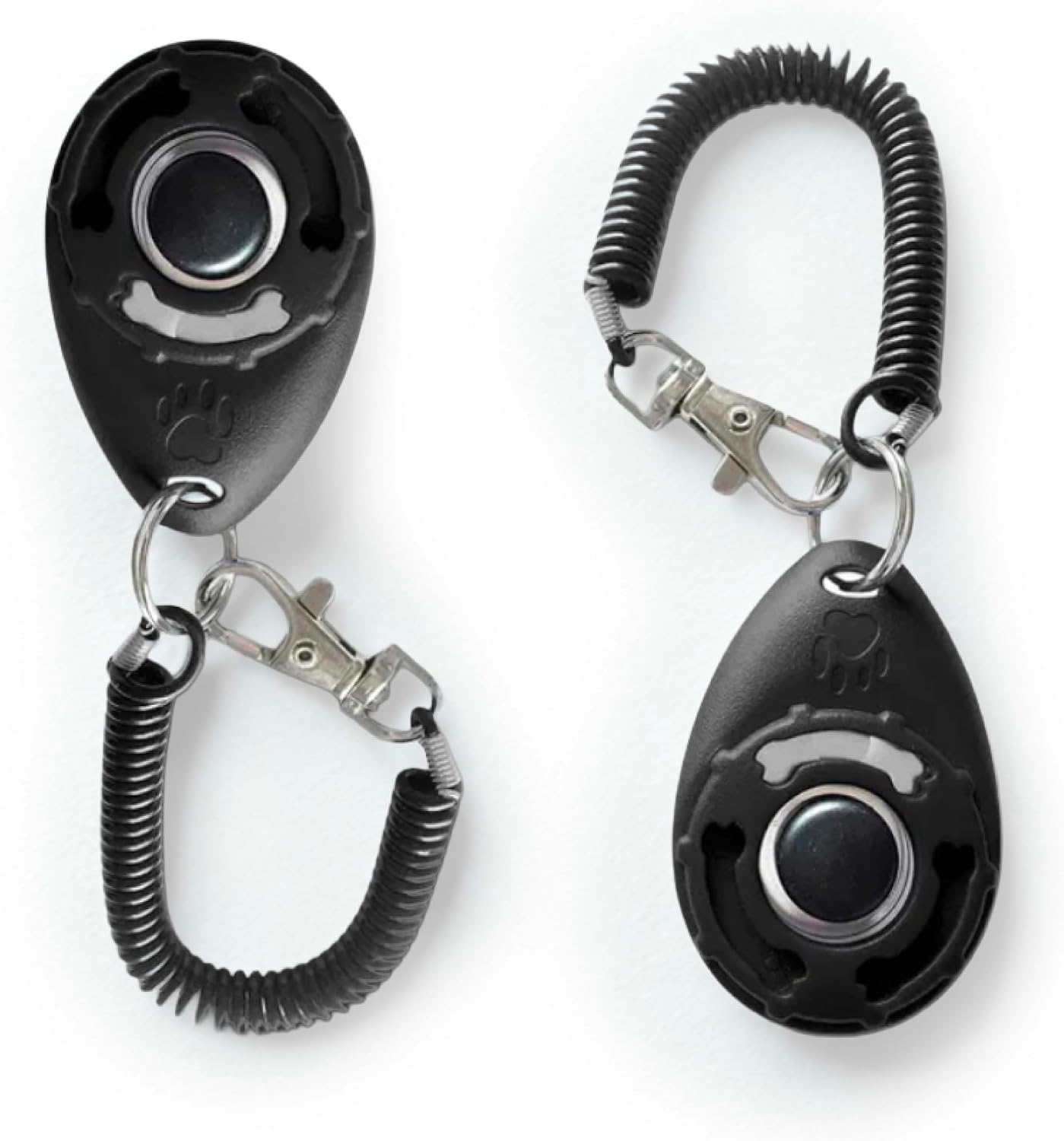
Our pick: Dog Training Clicker - Essential Clickers for Obedience Training, Positive Reinforcement for Puppies and Adult Dogs - For Owners and Professional Trainers - Safe for Pets - Two Pack
 Visit on Amazon →
This is the one in my class bag, and the two pack is the reason. The single biggest reason clicker training dies at home is that the clicker is in the other room when the puppy finally offers a sit at the back door. Two clickers solves that. One goes in the treat pouch, one lives on the kitchen counter or in the car, and you stop losing reps to a trip down the hall.
It is built for the job you actually have: obedience work, positive reinforcement, puppies and adult dogs, owners and professional trainers. No batteries, no settings, no learning curve.
Flaws but not dealbreakers: You are buying a spare whether you want one or not. If you only ever train in one room, the second clicker is a paperweight. I have never regretted having it.
First time owners who train in more than one place get the most out of this one.
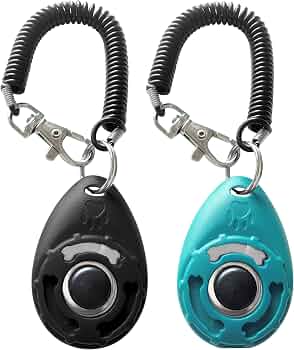
Also in my bag: Dog Training Clicker with Sring Wrist and Keyring - Pet Dog Training Clickers for Puppy, Cat, Potty, Bird, Horse, Pet, Trainer Training Tools, Behavior Aids
 Visit on Amazon →
Check current Amazon price on this one and you will see why it ends up on so many leashes. The wrist string and the keyring are the features that matter, because they answer the carry question. Clip it to a belt loop, hook it to your keys, or wear it on your wrist during a walk where you are already holding a leash, a treat pouch, and a bag of poop.
That strap is why I keep one on my own leash. During leash work you need a hand free and you need the clicker findable without looking down. It is also marketed for cats, birds, and horses, which tells you the maker built a general purpose marker rather than a puppy specific gadget.
Flaws but not dealbreakers: A clicker on a string swings into your leg while you walk, and if you let it dangle it will click at moments you did not choose. Tuck it into your palm between reps.
Anyone who trains on walks or in a yard will appreciate the strap.
Charge the clicker before you teach anything
A click means nothing to a puppy until you build the association. Charging takes two sessions of about ninety seconds, and skipping it is the reason most clickers feel broken.
Step one: Sit on the floor with your puppy in a quiet room. No other dogs, no television, no kids running through.
Step two: Click once, then immediately hand over a small soft treat. Ask for nothing. He does not have to sit, look at you, or do anything at all.
Step three: Repeat. Click, treat, pause two seconds, click, treat. Ten to fifteen reps per session.
Step four: Watch for the head turn. When your puppy hears the click and swings toward your treat hand before the food appears, the association is built. That is the whole goal.
Step five: Stop while it is still fun. Two short sessions a day for a couple of days is plenty. A puppy who is bored of the clicker will not work for it.
The mechanics: the one second rule
Everything in clicker training comes down to one window of time.
Click the instant the behavior happens, then treat within one to two seconds. Not the other way around. If you treat first and click after, you marked the eating, not the sit.
Click once. One crisp click per behavior. A burst of clicks is a different signal and it muddies the marker.
Never click to get your puppy's attention. Use his name for that. A click that sometimes means "look at me" and sometimes means "that was right" means nothing.
Do not click a behavior you did not want. This is the hard one. If your puppy barks at the door and you click because you panic, you just paid for barking. Marking is a paycheck and you are the one signing it.
Keep the treats tiny, pea sized and soft. Big crunchy biscuits slow the session down and fill your puppy up before ten reps.
Step by step: how to teach sit with a clicker
This is the first behavior I teach in class, and it takes most puppies one or two sessions once the clicker is charged.
Step one: Load a pocket or pouch with small soft treats and stand in front of your puppy in a quiet room.
Step two: Wait. Say nothing, do not push his rear down, do not repeat a word. Puppies sit on their own constantly. You are capturing a behavior that already happens.
Step three: The instant his rear touches the floor, click, then deliver the treat at your knee so he does not jump for it.
Step four: Reset. Take a step, let him move, then wait again. Five to eight reps is a full set for a young puppy.
Step five: Once he offers the sit quickly and repeatedly, add the word. Say "sit" once, just before his rear hits the floor, then click and treat. The word comes before the behavior, the click comes after. That order never changes.
Step six: Change rooms. A sit that only works in the kitchen is not a sit. Move to the hallway, the porch, the sidewalk, and rebuild the reps in each new place.
Step seven: Add duration and distance in tiny increments. One extra second of sitting, then two. One step away, then two. Click and treat for each small success instead of waiting for a five second sit that never comes.
Step by step: how to build a name response
A name is not a command. It is a cue that means "look at me, something good is about to happen," and it is the fastest thing you can fix in a puppy who ignores you.
Say your puppy's name one time in a normal happy voice. The instant his head turns toward you, click, then treat. One name, one click, one treat.
Never repeat the name. "Rex, Rex, Rex, Rex" teaches him that his name means nothing until the fourth try. If he does not respond, you are too far away or there are too many distractions. That distance is his threshold, and training starts outside it, not inside it.
Practice five reps at a time, three times a day. Add distance across a room, then across a yard, then on a quiet sidewalk. Add a distraction only once the current version is nearly automatic.
Where clicker training goes wrong
The clicker is rarely the problem in a failed attempt. These are the actual failure points.
Clicking late. If the click lands after your puppy has stood up, you marked standing. It is the number one reason a behavior looks sloppy by week three.
Clicking as a command. If you click to make your puppy do something, you turned a marker into noise.
Skipping the treat. Every click gets paid. Click and do not treat, and your puppy learns the click is unreliable.
Training inside threshold. If he is lunging at a squirrel, he cannot learn. Back up until he can notice the squirrel and still eat, then work there.
Sessions that run long. Ninety seconds of focused work beats twenty minutes of a puppy losing interest.
Different rules from different people. If one person clicks a sit and another clicks a jump, the puppy gets a mixed paycheck and quits trying.
Never fading. This is the one that catches everyone, and it has its own section below.
How to fade the clicker
A clicker is a teaching tool, not a lifetime accessory. Once a behavior is solid in several places, replace the click with a marker word like "yes" and move the food onto a variable schedule.
The order is capture, shape, then fade. You mark the behavior, reward small steps toward the finished version, then thin the payments. Fading the click does not mean cutting the treats overnight. The treat stops arriving after every rep and starts arriving after a good rep, then a great one, with praise filling the gaps.
This is the step everyone skips, and it is why so many owners end up with a dog who only listens when food is visible. Treats are payment, not bribery. The mistake is never turning off the automatic payout.
What this costs
The clicker is the cheapest item in your training kit, which is exactly why it gets abandoned. No subscription, no app, no replacement parts. Check current Amazon price on either one and you will see the whole investment.
The real cost is the five minutes a day. Thirty puppies a month come through my classes, and the ones who graduate on time are not the ones with the most gear. They are the ones whose owners clicked for one more week than they felt like it.
Charge the clicker, pick one behavior, and work in a quiet room. Then take it outside and see what survives.