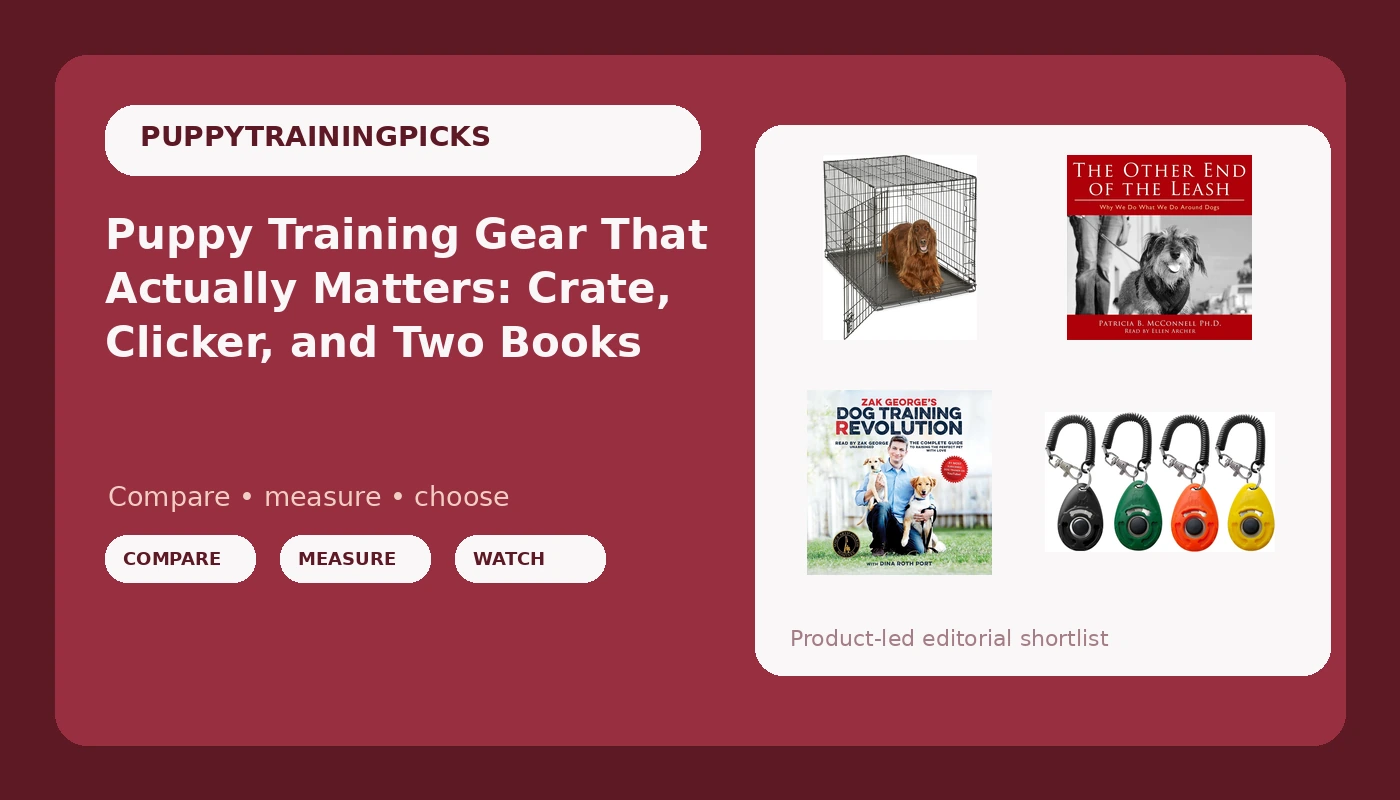
Puppy training gear is a strange category. Half of it is a piece of plastic small enough to lose in a couch cushion, and the other half is a crate big enough to park a bicycle in. New owners usually buy both in one panicked trip, then discover that the gear was never the hard part. The hard part is timing: marking the exact second your puppy does the thing you want, then repeating it often enough that the behavior sticks. Good puppy training gear makes that timing easier. Bad gear promises to do the timing for you. What follows is a plain explanation of which items earn their place in the first few months, and why the order you buy them in matters more than the brand names.
Related: Crate Training a Puppy: The First Two Weeks →
Quick answer
A correctly sized crate, a clicker you keep within reach, and one training plan you actually follow cover almost everything a puppy needs in the first four months. The clicker set below is the smallest item on the list and the one most owners abandon too early. The 42-inch New World crate is sized for a large-breed puppy that will finish somewhere between 71 and 90 pounds. The two books split the job neatly: one gives you a step-by-step positive-reinforcement plan, and the other explains why your dog behaves the way it does around people.
Four useful options
| Model | Best fit | What stands out |
|---|---|---|
| Pet Training Clicker with Wrist Strap - Dog Training Clickers for Puppy, Cat, Potty, Bird, Horse, Pet, Trainer Training Tools, Behavior Aids (Black +Deep Green + Tangerine + Yellow) | Marking a behavior at the exact moment it happens | A four-pack with wrist straps, so a clicker can live in a pocket, on a leash hook, and in a training bag at the same time |
| New World by Midwest 42-Inch Single Door Crate, for Large Breeds, 71-90 lbs | Large-breed puppies with a year of growing left | A 42-inch single-door crate from the New World by Midwest line, listed for dogs that finish in the 71 to 90 pound range |
| Zak George’s Dog Training Revolution: The Complete Guide to Raising the Perfect Pet with Love | First-time owners who want one plan to follow from start to finish | A complete guide to raising and training a pet with love, rather than a narrow book about one problem behavior |
| The Other End of the Leash: Why We Do What We Do Around Dogs | Owners who want to understand the human half of the relationship | A book about why people behave the way they do around dogs, which is a different question from how to train one |
The marker: Pet Training Clicker with Wrist Strap - Dog Training Clickers for Puppy, Cat, Potty, Bird, Horse, Pet, Trainer Training Tools, Behavior Aids (Black +Deep Green + Tangerine + Yellow)
The reason most clickers end up in a drawer is not that they fail. It is that nobody charges them. A clicker means nothing to a puppy until it has been paired with food a few dozen times, and that pairing step feels so basic that owners skip it. Buy a set rather than a single clicker for one unglamorous reason: the tool only works if it is in your hand when the moment arrives, and the moment never arrives when you are digging through a closet. The trade-off is that a clicker does not teach anything by itself. It is a marker, not a curriculum, and it still needs a plan behind it and a treat budget in front of it.
The crate: New World by Midwest 42-Inch Single Door Crate, for Large Breeds, 71-90 lbs
Crate sizing is where first-time owners lose the most money. The instinct is to buy small for the puppy in front of you, then buy again at six months, then again at a year. If your puppy is a breed that finishes in the 71 to 90 pound range, a 42-inch crate is the size that outlasts all three of those purchases. The catch is the early weeks. A 42-inch crate gives an eight-week-old puppy far more floor space than it needs, and extra space is where accidents happen, so plan on blocking off part of the interior with a divider panel or a sturdy box until the puppy grows into the full footprint. Remember what the crate is for, too: it is management, not training. It prevents the puppy from rehearsing the wrong behavior while you are not watching. That is a real job, and it is the reason crate training is not a cruel shortcut.
The playbook: Zak George’s Dog Training Revolution: The Complete Guide to Raising the Perfect Pet with Love
The value of a book like this is not information. You can find every individual technique in it for free in a hundred places online. The value is order. Puppy training fails most often because owners collect tips from twelve sources, apply them in the wrong sequence, and quit when the puppy gets confused. A single guide gives you one sequence and one voice, which is what a puppy actually needs. The trade-off is that no book knows your dog. Treat the chapters as a plan to adapt, not a script to execute, and expect to move faster through some sections than others depending on the puppy in front of you.
The behavior book: The Other End of the Leash: Why We Do What We Do Around Dogs
Most training problems that reach a professional are not dog problems. They are timing problems, posture problems, and consistency problems, all of them on the human end of the leash. A book that examines why people hug dogs, lean over them, and repeat a cue four times in a rising voice explains more failed recalls than any dog behavior manual. Read it after you have a training plan in place, not before. It is the book that makes you a clearer handler, and clearer handling is what makes the other three items on this list work.
Prices and availability may change. Product images, names, and retailer links must be matched by verified ASIN. Do not state a current price, rating, stock status, or measured result without current evidence.
What training gear can and cannot do
The tool is roughly ten percent of the outcome. The other ninety percent is timing, consistency, and an owner who practices on the days when nothing is going well. Gear earns its place by making those three things easier, and it earns a spot in the trash when it claims to replace them.
A clicker is the clearest example. Its entire job is to shrink the gap between a behavior and the reward that follows it. A human saying "good boy" takes a beat and sounds slightly different every time. A click is instant and identical every time. That precision is why markers work, and it is also why a marker is useless if you have not charged it. Charging means clicking and treating, over and over, with no behavior required. Do that before you ask the puppy for anything, and the click starts carrying information.
Crates are management. They do not teach a puppy to hold its bladder; they prevent the puppy from practicing the wrong surface while you build a schedule around potty breaks. Owners who understand that distinction stop expecting the crate to do the training and start using it as a tool that buys them time to train.
Books are owner education, and they matter more than most gear because they fix the part of the equation that is hardest to change. Nobody needs a special collar to be consistent. They need to understand why consistency works.
Buying order for the first four months
- Buy the crate first, and size it for the adult weight of your breed, not for the puppy standing in front of you. If that means blocking off part of the interior for a few months, that is a smaller problem than replacing the crate twice.
- Buy the clicker set second, and spread the clickers across the places you actually spend time: a coat pocket, the leash hook by the door, the car.
- Charge the clicker before you ask for a single behavior. Click, treat, pause, repeat, until the puppy visibly perks up at the sound.
- Pick one training plan and follow it for at least thirty days before adding a second source. Mixing methods mid-month is how puppies end up with a cue that means three different things.
- Add the behavior book once you have a routine running, so that the "why" questions have something to attach to.
Setting up a kit that survives week six
- Keep a clicker in the pocket of the coat you actually wear in bad weather, not in the training bag that stays in the car.
- Cut or break treats small enough to swallow in one bite, because a training session is a series of repetitions and large treats end it early.
- Put the crate where the family already spends its evenings, so the puppy is in the room with you rather than isolated in a laundry room.
- Block off the extra floor space inside an oversized crate for a young puppy, then open it up as the dog grows into the full 42 inches.
- Write down what you worked on each day, because the pattern you will notice after two weeks is usually more useful than how any single session felt.
Which option should you choose?
Choose the Pet Training Clicker with Wrist Strap set when you want to sharpen your timing and you are willing to charge the marker before you use it. Choose the New World by Midwest 42-Inch Single Door Crate when you have a large-breed puppy that will finish in the 71 to 90 pound range and you would rather buy one crate than three. Choose Zak George’s Dog Training Revolution when you want a single positive-reinforcement plan to follow from the first week home. Choose The Other End of the Leash when your dog is doing what you asked but the two of you still seem to be speaking different languages.
One caveat that applies to all four: none of these items produces a trained dog on its own, and none of them should be bought as a substitute for daily practice. A crate that stays in the garage, a clicker that never gets charged, and a book that never gets opened are three ways to spend money without changing anything. Buy the gear you will actually use this week, and add the rest as the training progresses.
The bottom line
If you are starting from zero with a large-breed puppy, the sensible order is a correctly sized crate, a clicker set you keep within reach, and one training plan you commit to for a month. That covers confinement, communication, and curriculum, which is most of what the first four months require. The behavior book comes last, because it answers the questions you will only start asking once you have been training for a few weeks. Everything else in the puppy aisle is optional, and a good amount of it is best left on the shelf.