Related: Best Puppy Training Treats for a Distracted Puppy
Puppy training essentials get sold like a starter kit. Buy the bag, the bells, the pads, the clicker, and the puppy will somehow train himself by Tuesday. I run a puppy kindergarten out of a church basement in Denver, and I have watched eight week old puppies arrive with more equipment than most adult dogs will ever need.
The puppy training essentials that survive to week six are almost boring. A bowl the puppy will actually drink from on a sidewalk. A treat that beats a squirrel. A second bag of that treat so you stop rationing it. And a way for the puppy to tell you he needs to go out, instead of you guessing from the circling.
The honest part first: the tool is ten percent of training. The other ninety is timing, consistency, and an owner who practices on Tuesday instead of only in class on Saturday. Gear makes a good habit easier or a bad habit harder. It does not train the dog for you. One rule I do not bend on: nothing on this list works by causing pain or fear. If a product needs a correction to function, it does not go in my bag.
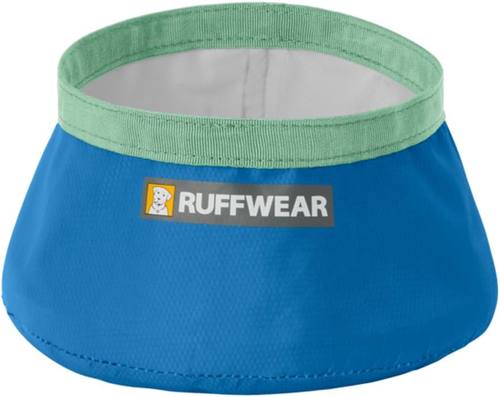
Best for Water Breaks: Ruffwear Trail Runner Collapsible Dog Bowl
Training sessions fall apart for boring reasons, and thirst is near the top of the list. A puppy who is hot and thirsty stops offering behavior and starts hunting for a place to lie down. The Trail Runner collapses flat when you are done with it and holds 4.2 cups (1 liter) when it is open, which is more water than one puppy needs in a single session and about right for a class of six taking turns.
I use it three ways. Water breaks during outdoor sessions, so a thirsty puppy gets a reset instead of an early exit. Water on a walk, because puppies are terrible at drinking from a bottle and a lot of them refuse to try. And water in the car on the way home from class, which is the difference between a puppy who sleeps and a puppy who screams.
Blue Pool is a bright color, which sounds like a marketing detail until you are the person scanning a park for the bowl you set down twenty minutes ago. The one habit I drill into owners: rinse it and dry it before you fold it back into the bag. A collapsible bowl that lives damp inside a training bag is a bowl you will throw away in a month.
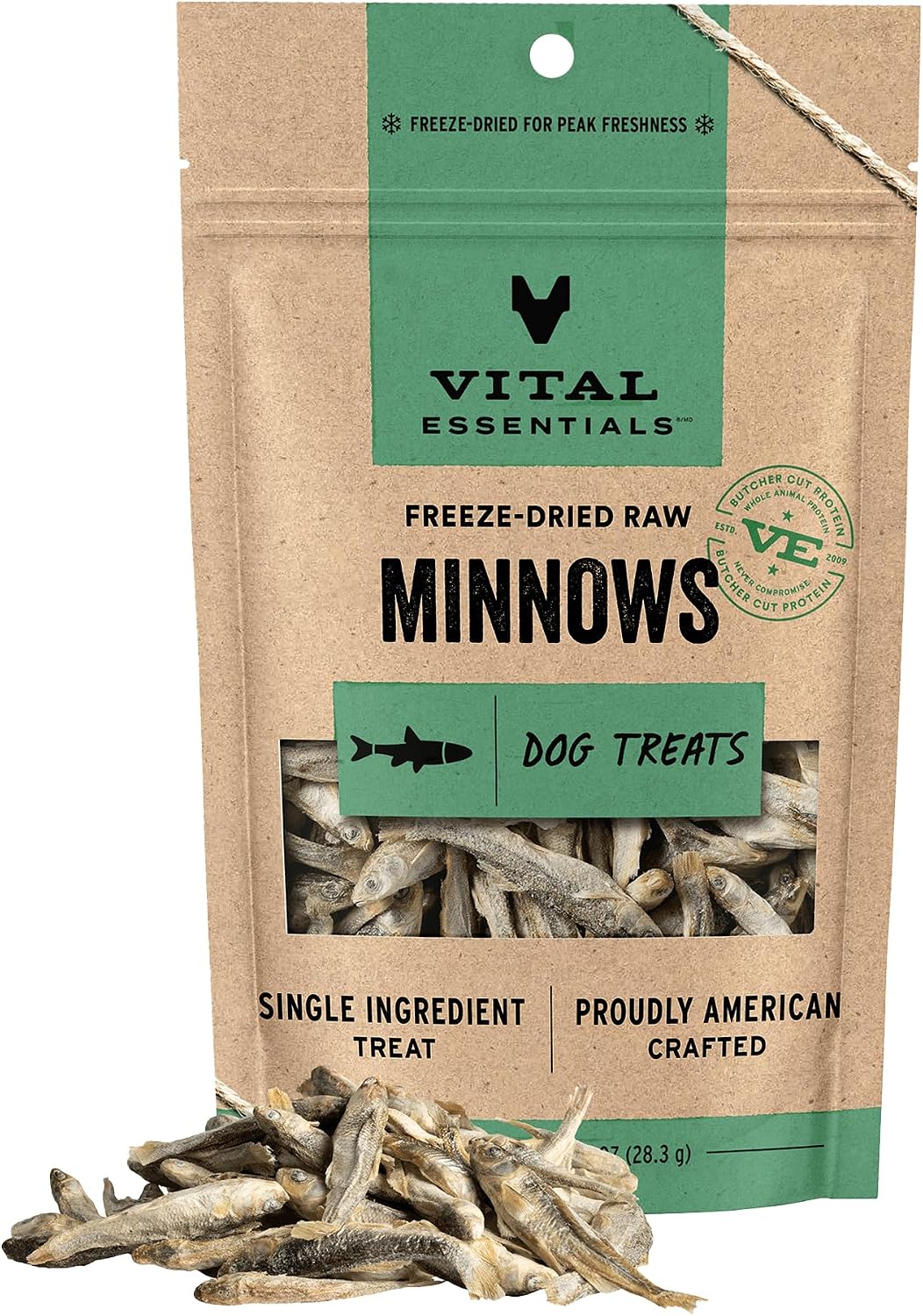
Best Training Treat: Vital Essentials Freeze Dried Minnows, 1 oz Bag
Treats are payment, not bribery. The problem is never that you used food. The problem is that you never faded it, so the dog learns to work only when a bag is visible. You start with something the puppy will work for in a distracting place, then you make the payment less predictable until the behavior stands on its own.
Freeze dried minnows are about as simple as a dog treat gets: whole dried fish, and they smell like a fishing dock. That smell is the entire point. It is what makes them work when kibble does not, on the reps that matter most, like the first recall in a park with geese. The 1 ounce bag is the size I hand to an owner who has never used a high value treat, because it answers one question cheaply: does my puppy care about fish?
Reach for these for name games, first recalls, and any work near a busy sidewalk, where the puppy is close to his threshold and you need his attention back fast. One minnow per rep. Every treat you hand out is a meal you have to account for, which is why the small, stinky reward beats the biscuit you have to break into four pieces.
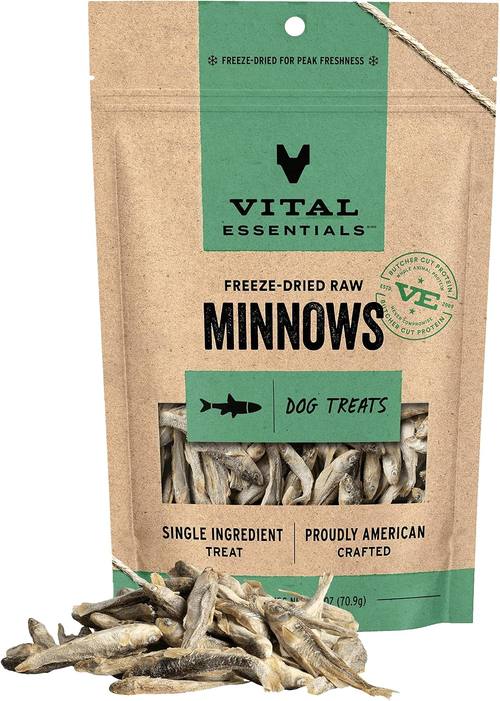
The Same Treat in a Bigger Bag: Vital Essentials Freeze Dried Minnows, 2.5 oz Bag
This is the same treat in a larger bag, and it exists for one reason: the 1 ounce bag does not last. High value treats get used most in the first three weeks, when your puppy is learning everything at once and you are paying for every single correct decision. Buying the small bag first is not wasted money. It is a test. Buying the big bag first is a gamble on a puppy's palate.
Once you know the answer is yes, keep the big bag in the car or in the training bag and stop rationing. Owners who ration their best treats end up saving them for a special occasion that never comes, then wondering why the puppy will not recall off a scent. The good treat is for the hard reps, and the hard reps happen every day.
If your puppy turns out not to care about fish, that is useful information, and it cost you one small bag instead of a pantry full of food he will not touch. Fish is not universal. Nothing is. Find the one your puppy would follow you across a parking lot for, and buy that one in the bigger size.
Best Potty Signal: 2 Pcs Dog Door Bells
Bell training is not a potty training shortcut. It is a communication system. The puppy learns that touching the bells makes a human appear and open the door. Pair that with going outside and getting paid for peeing in the grass, and you have a puppy who can tell you he needs out instead of circling the rug while you finish an email.
The set comes with two bells, which matters more than it sounds. One hangs on the door your puppy actually uses, and the second is the spare that saves you when the first one gets chewed, or the one you hang at the other door if your house has two exits and your puppy is expected to use both. They hang from a door knob, which is where a puppy can reach them without you building anything. The color is pink. That is a color, not a training variable.
The failure modes are predictable. The puppy rings for fun, or rings to go outside and play instead of potty. The fix is boring on purpose: every ring gets a leashed trip outside, five minutes, no play, no walk, back in. The other failure is on your end. Ignore one ring and the system dies, because the whole lesson is that the bell works.
How I evaluate gear for a puppy class
Every product that comes through my class answers the same four questions, and it either answers them or it does not.
First, does it rely on pain or fear? If yes, it is out, for any age of dog. Second, can a first time owner use it correctly without me standing over their shoulder? Third, does it still work in week six, when the puppy is bigger, faster, and far less impressed by you? Fourth, would I use it in my own class, in front of paying clients?
I do not review anything from one session with one puppy. A tool that looks great with a sleepy nine week old can fall apart with a four month old who just discovered squirrels. So everything on this list has to hold up with a distracted adolescent, and it has to hold up with an owner who forgot to practice on Tuesday, which is most owners.
Analysis: what still works in week six
Three patterns show up over and over in class.
Anything that requires the owner to remember a schedule quietly dies. Anything that lives in the bag and gets used automatically survives. That is why a collapsible bowl and a bag of treats make this list and pee pads do not. Pads teach a puppy to pee indoors, and if your goal is outdoor potty training, you have just created a habit you will spend a month undoing.
Treat value has to scale with distraction. Kibble works in your kitchen. It does not work at a park with geese, and it does not work on the sidewalk where the neighbor's cat lives. Keep the high value reward for the hard reps and use boring food for the easy ones. This is also how you protect the value of the good stuff.
Communication tools only survive if the human end is consistent. The bell is not the hard part. Answering the bell is the hard part. Same with the bowl, honestly. The gear is easy. The Tuesday practice is not.
The single biggest reason training gear fails is that the owner stops using it once the puppy gets it. That is backwards. Getting it is when you start fading the prop, not when you throw it in a drawer.
The puppy training gear reference table
This is the table I keep inside my training bag. One row per item, what it is for, and when to reach for it. I am not printing prices, because they move and I would rather you check than trust me.
| Item | Best for | When to reach for it | Price |
|---|---|---|---|
 Visit on Amazon → Visit on Amazon →Ruffwear Trail Runner collapsible bowl |
Water breaks | Sessions longer than fifteen minutes, warm days, car rides | $19.99 |
 Visit on Amazon → Visit on Amazon →Vital Essentials minnows, 1 oz bag |
First high value treat | Testing whether your puppy works for fish | $10.28 |
 Visit on Amazon → Visit on Amazon →Vital Essentials minnows, 2.5 oz bag |
Refill bag | Once you know the answer is yes | Check current Amazon price |
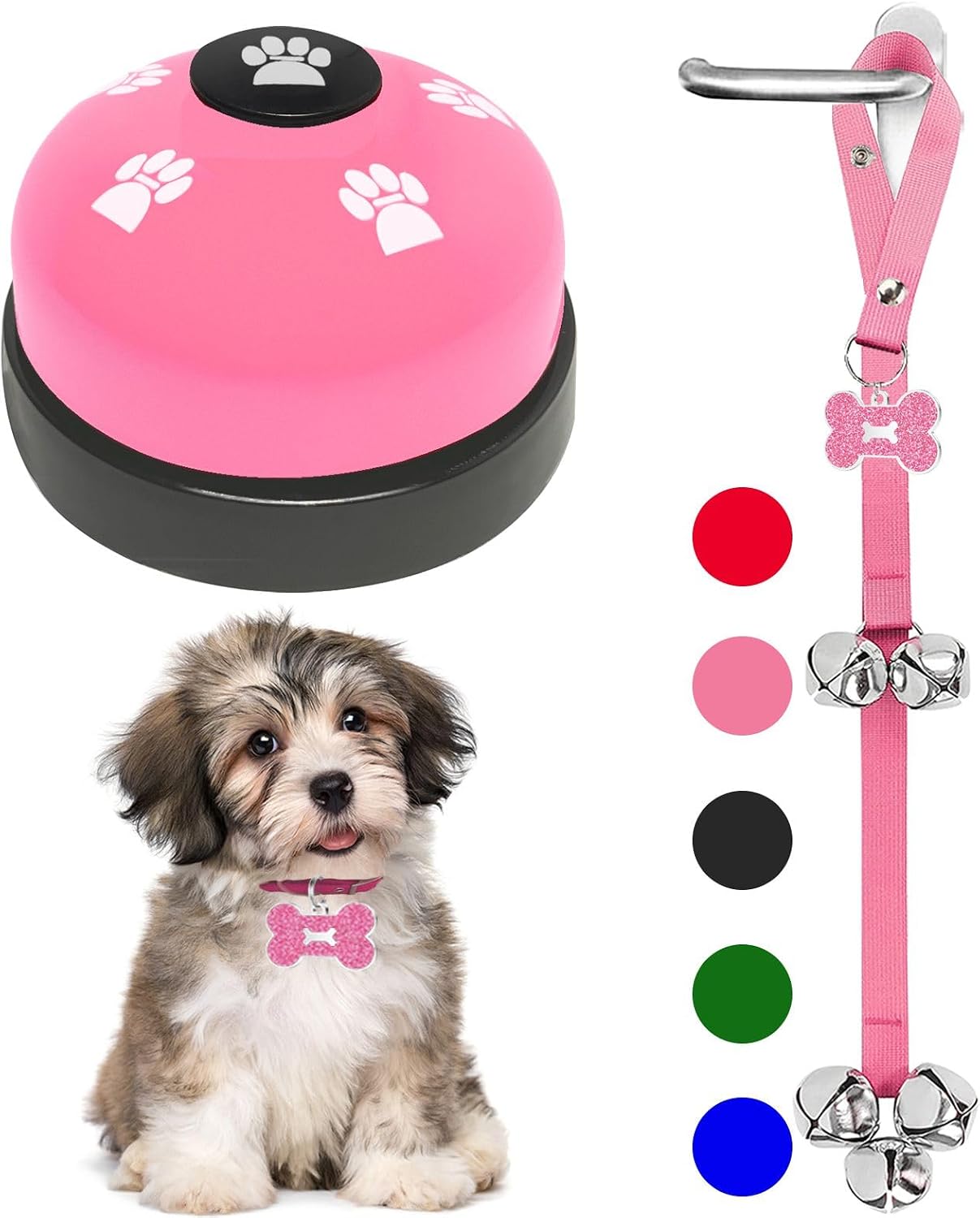 Visit on Amazon → Visit on Amazon →Dog door bells, 2 pack |
Potty communication | From the first week home, once the schedule is set | $8.99 |
What I leave out of the bag
Pee pads, for the reason above. Any collar or remote marketed with a vibration or shock setting for puppies, because there is no version of that I will sign off on, at any age. Training treats the size of a golf ball, because you blow the calorie budget in one session and the puppy is full before the work is finished. And clickers sold without instructions, because a clicker is the cheapest precision tool in dog training and also the most abandoned one in the drawer.
How to fade the bell without losing the signal
Once your puppy rings reliably and actually potties outside, add a verbal cue right before the door opens. Say "outside," wait two seconds, then open. Do that for a week or two. Then start saying "outside" before the puppy rings, and reward the response to your voice instead of the ring. The bell stays on the knob as a backup, but the cue becomes the system. It is the same fade you run with treats: the behavior stays, the prop gets quieter.
Should you buy the Ruffwear Trail Runner bowl?
Yes, if you train anywhere other than your kitchen. It holds 4.2 cups, it collapses flat enough to live in a bag you already carry, and it turns a hot puppy back into a working puppy in about thirty seconds. Rinse it, dry it, and it will outlast the puppy stage entirely. Check current Amazon price.
Should you buy the Vital Essentials minnows?
Start with the 1 ounce bag. It is the cheapest way to find out whether your puppy will work for fish, and if the answer is no you have lost very little. If the answer is yes, buy the 2.5 ounce bag and stop saving the good treats for a special occasion that never arrives. Check current Amazon price.
Should you buy the dog door bells?
Yes, with a condition. Only buy these if you are willing to answer every single ring for the first few weeks, even the annoying ones, even at dinner. The bell does not train the puppy. Your consistency does. If you can commit to that, you get a puppy who tells you when he needs out instead of leaving you a surprise by the couch. Check current Amazon price.