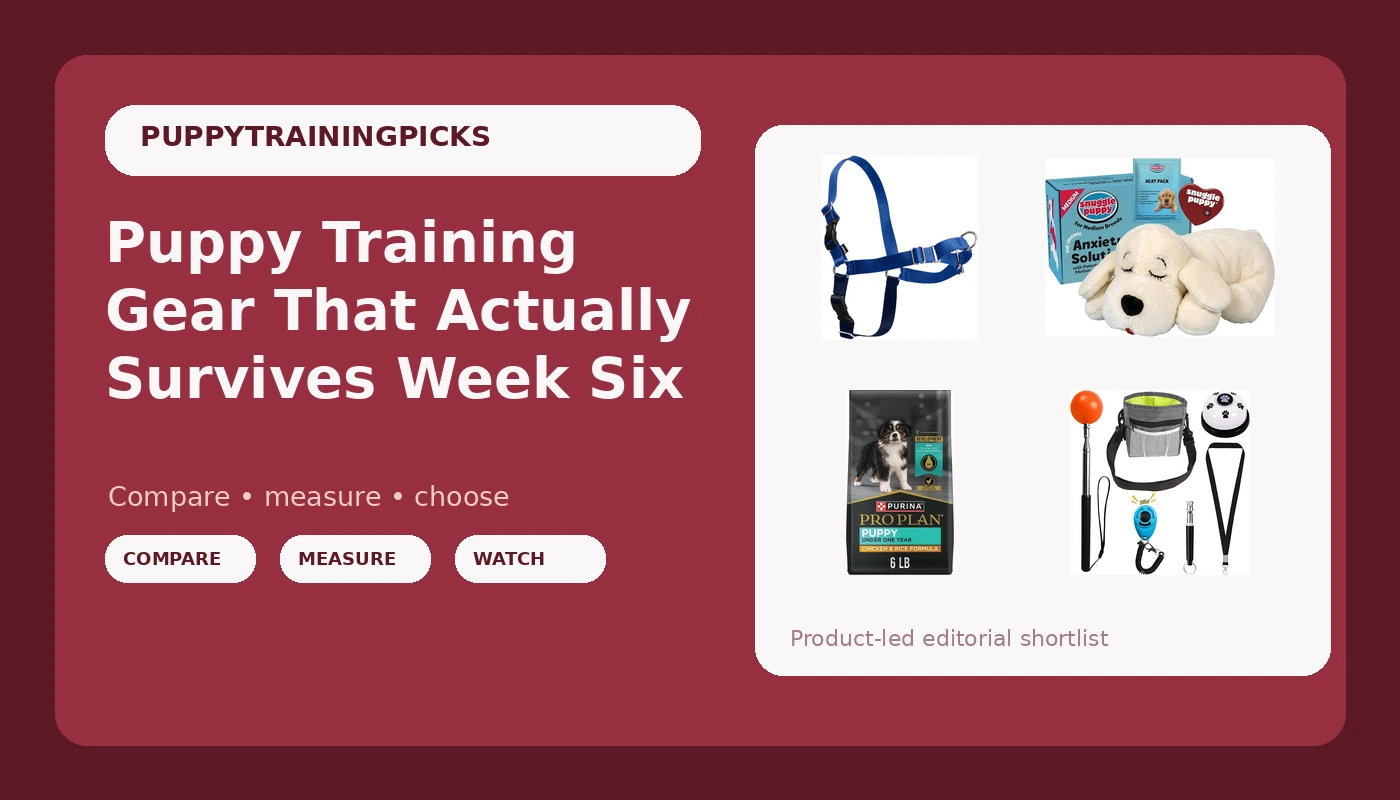
Most puppy training gear fails for a boring reason: it does not match the way a puppy actually learns. A clicker with no plan is a plastic noisemaker. A harness that rubs the armpits raw gets retired by week three. The puppy training gear worth owning is the small set of tools that maps onto what a puppy needs in its first two months: a way to mark correct behavior the instant it happens, a way to walk without choking, a way to settle when it is alone, and food that keeps the reward budget from wrecking dinner. None of this trains the dog for you. All of it makes the part you do yourself easier to repeat.
Related: How to Stop a Puppy From Pulling on the Leash →
Quick answer
Build the kit outward from the marking tools. Start with a clicker and target kit so you can mark behavior accurately, add a front-clip no-pull harness once leash walks begin, use a heartbeat comfort toy if your puppy struggles to settle alone, and pick a puppy food you are willing to hand out one piece at a time. Buy the harness when walks start, not months early, so it gets fitted to the puppy that is actually growing into it.
Four useful options
| Model | Best fit | What stands out |
|---|---|---|
| Pet Training Kit - Target Stick, Training Clicker, Whistle, Bell, Treat Pouch | Owners starting marker training | Puts a clicker, target stick, whistle, bell and treat pouch in one bundle |
| PetSafe Easy Walk Harness, No Pull Dog Harness, Royal Blue, Small/Medium | Puppies who pull on leash | Front-clip no-pull design in a Small/Medium size |
| Snuggle Puppy Heartbeat Toy, Calming Comfort, Medium Breeds - Cream | Puppies who struggle to settle alone | Heartbeat-style comfort toy sized for medium breeds |
| Purina Pro Plan High Protein Dry Puppy Food, Chicken & Rice, 6 lb Bag | Feeding a growing puppy during training | High protein puppy formula, chicken and rice, 6 lb bag |
The marker kit: Pet Training Kit - Target Stick, Training Clicker, Whistle, Bell, Treat Pouch
A kit this broad includes pieces you may not touch for months. The whistle and the bell are useful for recall and for teaching a puppy to signal at the door, but neither matters in week one. The two pieces that earn their place immediately are the clicker and the treat pouch, because the pouch is what makes your hands fast. A treat that takes four seconds to dig out of a pocket is a treat delivered too late to mean anything. If you buy nothing else from this list, buy the marking tool and use it correctly.
The no-pull harness: PetSafe Easy Walk Harness, No Pull Dog Harness, Royal Blue, Small/Medium
Fit is the whole game with any harness. Measure the puppy's girth at the widest point behind the front legs before you order, then check the fit again after every walk for the first two weeks, because a puppy can change shape in that window. You should be able to slide two fingers under every strap, and the chest strap should sit across the breastbone rather than in the armpit. A harness that rubs is not a training problem, it is a sizing problem, and the fix is adjusting straps or exchanging the size, not pushing through. The front-clip design gives you steering on a puppy that has not yet learned where the end of the leash is.
The settling aid: Snuggle Puppy Heartbeat Toy, Calming Comfort, Medium Breeds - Cream
Crate training is not cruel, it is a den, and the cruel version is leaving a puppy loose to eat your drywall while you sleep. What makes the first week hard is not the crate itself, it is the sudden absence of warm bodies. A comfort toy gives the puppy something to press against, and that alone can shorten the whining. Two honest caveats. First, a plush toy is only safe in a crate with a puppy who does not shred fabric, so supervise the first few sessions and remove it if your puppy starts pulling stuffing. Second, no toy replaces a real potty schedule. If a puppy is crying at 2 a.m., the first assumption should be that it needs to go out, not that the toy failed.
The food that funds the training: Purina Pro Plan High Protein Dry Puppy Food, Chicken & Rice, 6 lb Bag
Treats are not bribes, they are payment, and the problem is never that you used them, it is that nobody plans the calorie budget. A puppy eating a full bowl of kibble plus a handful of soft treats every session is a puppy headed for a stomach ache and a weight problem. The workaround is unglamorous: take a portion of the daily food out of the bowl, put it in the pouch, and pay with that. Kibble is a lower-value reward than a soft treat, so keep something stinkier on hand for real distractions. Confirm the actual feeding amount on the bag label and with your vet rather than trusting any number in an article, including this one. A 6 lb bag is a starting size, not a feeding plan.
Prices and availability may change. Product images, names, and retailer links must be matched by verified ASIN. Do not state a current price, rating, stock status, or measured result without current evidence.
Why marking beats correcting
A marker tells the puppy the exact instant it did the right thing. Praise arrives late. By the time you say "good boy," the puppy has already stood up, looked away, or started chewing the rug, and you have just rewarded whatever it happened to be doing at that moment. A click, or a short word like "yes," closes that gap. The tool is 10 percent of training. Timing is the other 90, and a marker is how you buy timing.
Charge the marker before you ask for anything. Click, treat. Click, treat. Ten or fifteen repetitions with no behavior required, until the puppy's head snaps toward you at the sound. That is the whole foundation, and it takes about two minutes.
From there, capture before you shape. Capturing means marking a behavior the puppy offers on its own, like a sit when it wants something, rather than forcing the puppy into position. Shaping means rewarding small steps toward a final behavior, which is how a simple sit eventually becomes go to your bed and lie down. In that order: capture, shape, then fade. Fading is the step everyone skips. You replace food with praise and life rewards gradually, over weeks, not overnight, and you keep paying occasionally so the behavior does not quietly go extinct.
One more concept decides whether any of this works: threshold. Threshold is the distance at which your puppy notices a distraction and stops thinking. Training starts outside that distance, where the puppy can still learn, and closes the gap a few feet at a time. Most puppies labeled stubborn are simply over threshold, being asked to perform in a park when they can only manage a hallway.
How to sequence the first eight weeks
- Charge the clicker in the kitchen. Ten to fifteen repetitions, no expectations, twice a day for the first two days.
- Capture sits and name them. Wait for the puppy to sit on its own, mark it, pay from the pouch. Add the word once the behavior is reliable.
- Fit the harness indoors and let the puppy wear it around the house before you ever clip a leash to it. Ten minutes at a time, with rewards for calm.
- Introduce the crate in short sessions with meals fed near it or inside it, and put the comfort toy in once the puppy is relaxed rather than crying.
- Take the whole routine to a real sidewalk. Start at a distance from the distraction where the puppy will still take food, work for two to five minutes, then leave before it falls apart.
Practical guidance for the first month
- Measure girth before ordering a harness and recheck the fit weekly while the puppy is growing.
- Keep rewards pea-sized. Anything larger than a pea blows the calorie budget in one session.
- Cap sessions at two to five minutes, three times a day. Short and frequent beats one long grind.
- End every session on a success you can pay for, even if that means asking for something easy.
- Supervise any plush toy in the crate until you know your puppy is not a shredder, and check the food label and your vet for feeding amounts.
Which option should you choose?
Choose the Pet Training Kit - Target Stick, Training Clicker, Whistle, Bell, Treat Pouch when you are starting from zero and need the marking tool, a target, and a way to carry rewards without fumbling. Choose the PetSafe Easy Walk Harness, No Pull Dog Harness, Royal Blue, Small/Medium when leash walks have started and your puppy is dragging you toward every smell on the block. Choose the Snuggle Puppy Heartbeat Toy, Calming Comfort, Medium Breeds - Cream when crate training is going fine except for the part where your puppy is alone in the dark. Choose the Purina Pro Plan High Protein Dry Puppy Food, Chicken & Rice, 6 lb Bag when you want a puppy food you can also pull from as training payment.
None of these tools fixes a routine problem. A harness does not teach loose-leash walking, it just stops the pulling from hurting while you teach it. A comfort toy does not replace a potty schedule. A clicker does nothing until it has been charged. And product sizes, formulas, and listings change, so verify the size chart, the ingredient panel, and the current listing before you buy rather than assuming last year's details still apply.
The bottom line
The gear list for a new puppy is shorter than the internet suggests. A clicker and target kit, a properly fitted front-clip harness, a comfort toy for the first nights, and a puppy food you are willing to hand out one piece at a time will carry you through the first two months. Everything else is optional until the basics are automatic. Buy the marking tool first, add the harness when walks start, and spend your remaining energy on the part no product can sell you: showing up for five minutes, three times a day, with payment in your pocket.