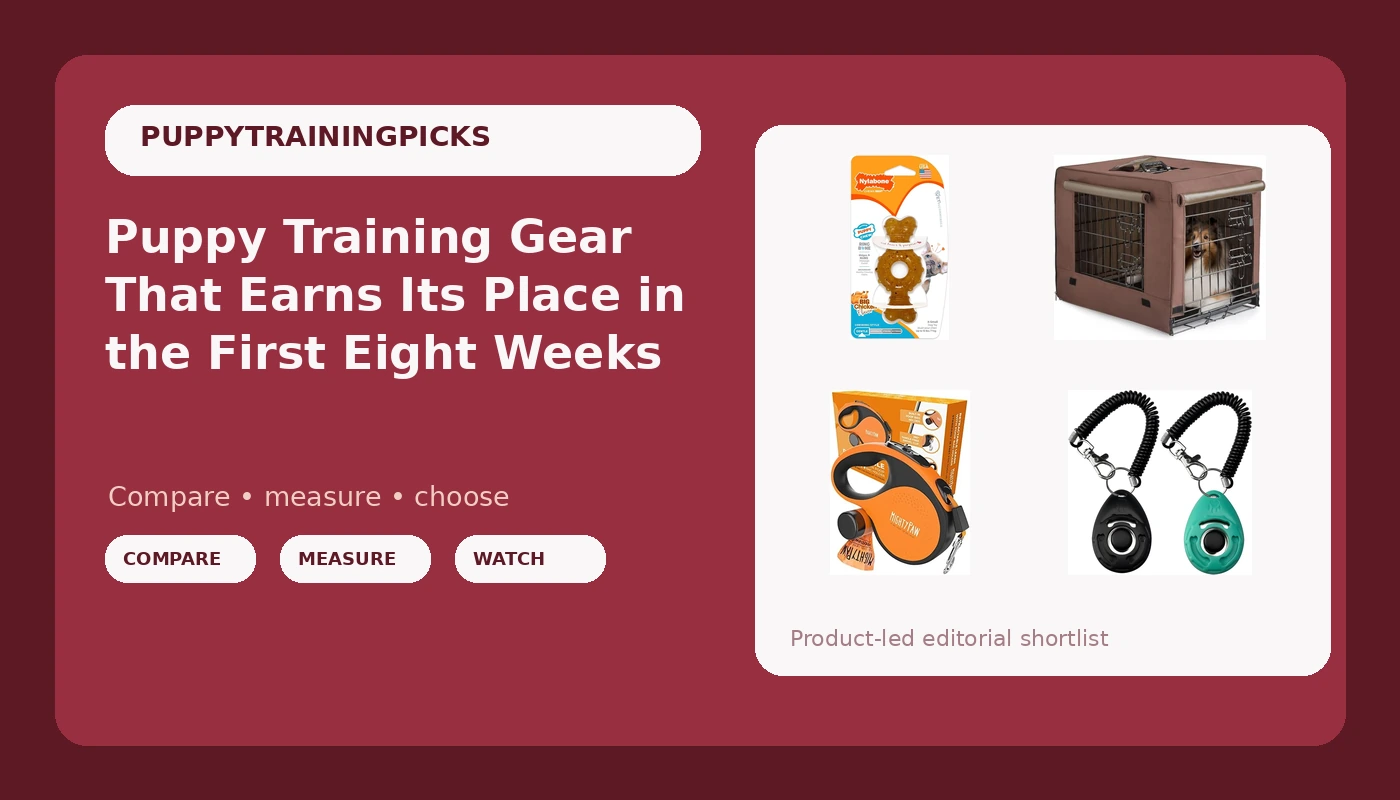
Puppy training gear gets sold as one big pile of gadgets, and most of that pile does not survive contact with a real eight-week-old puppy. The problem is rarely a shortage of products. It is that four different jobs get mashed into a single shopping cart: marking a behavior the instant it happens, keeping the puppy safely contained when you cannot watch him, giving sore gums something legal to chew, and letting a puppy move at the end of a leash without towing you down the sidewalk. Every one of those jobs has a tool that fits it, and a tool borrowed from the wrong job usually makes the next problem worse.
This is an explainer, not a scoreboard. It covers four pieces of puppy training gear, what each one is actually for, and where each one stops being useful. If you are building a first kit, you can put a workable one together without spending much, but only if you buy for the job you have this week rather than the dog you hope to have in a year.
Related: Crate Training a Puppy: The First Two Weeks →
Quick answer
No single item on this list trains a puppy. A clicker marks a behavior at the exact moment it happens, a crate manages the environment when you cannot supervise, a chew toy redirects teething onto something legal, and a long leash gives a puppy room to explore while still attached to you. The clicker and the chew are cheap enough to buy early. The crate should be sized to your puppy's adult weight class, not to how small he is today. The leash on this list is rated for much larger dogs, so it belongs to a later stage than the other three.
Four useful options
| Model | Best fit | What stands out |
|---|---|---|
| ABSONE Dog Clicker for Training with Wrist Strap, Dog Clicker Trainer Tools | Marking behavior the moment it happens | Wrist strap keeps the clicker on your hand between repetitions |
| DONORO Dog Crates for Small Medium Size Dogs Indoor Double Door Dog Kennels & Houses for Puppy and Cats, Collapsible Metal Contour Dog Cages (Brown, 30.0" L x 19.0" W x 21.0" H) | Small and medium puppies at home | Double door layout and a collapsible metal frame |
| Nylabone Puppy Chew Teething Ring Bone Dog Toy, Chicken Flavor, X-Small | Teething puppies who chew everything | X-Small sizing intended for puppy mouths, in a chicken flavor |
| Mighty Paw Retractable Dog Leash, 16 ft, 50-110 lbs, Reflective Nylon Tape | Supervised sniffing and distance work with a bigger dog | 16 ft reflective nylon tape, listed for dogs in the 50 to 110 lb range |
The marker: ABSONE Dog Clicker for Training with Wrist Strap, Dog Clicker Trainer Tools
A clicker is a promise that a specific sound always means a reward is coming, and the entire value of it depends on timing you cannot reproduce with your voice. "Good boy" takes a beat to say. A click is instant. That difference is the whole point, and it is also why so many clickers end up in a drawer by day three. People buy the clicker, click it randomly, never charge it with food, and conclude it does not work.
The wrist strap solves a small but real problem. If the clicker lives in your pocket, you will be reaching for it while the puppy is already walking away from the behavior you wanted to mark. Worn on the wrist, it is available in the half second that matters. This is a marking device, not a remote control, and it does nothing on its own. If you are not prepared to pair every click with a treat for the first week or two, skip it and use a verbal marker instead.
The den: DONORO Dog Crates for Small Medium Size Dogs Indoor Double Door Dog Kennels & Houses for Puppy and Cats, Collapsible Metal Contour Dog Cages (Brown, 30.0" L x 19.0" W x 21.0" H)
A crate is not a cage and it is not punishment. It is the one piece of equipment that lets you stop supervising for twenty minutes without risking your baseboards, your phone charger, or the puppy's digestive tract. The training part is separate: you teach the puppy that the crate is a good place to be, in short sessions, with food, before you ever close the door for a real nap.
The trade-off here is size. At 30 inches long by 19 inches wide by 21 inches high, this crate is aimed at small and medium dogs, which means it can work as a first crate for a puppy who will stay in that range and as a travel or secondary crate for others. If your puppy is a large breed, a crate this size will be outgrown, and the money is better spent on a larger crate with a divider panel that shrinks the space while the puppy is small. Measure your puppy's expected adult length, not his current one, and remember that a crate that is too large for a very young puppy gives him room to soil one corner and sleep in the other.
The chew: Nylabone Puppy Chew Teething Ring Bone Dog Toy, Chicken Flavor, X-Small
Teething is not misbehavior, and treating it like misbehavior is how puppies learn to chew behind the couch. Between roughly three and six months, a puppy's mouth hurts, and chewing is how he manages it. The training move is redirection: the moment teeth touch skin or furniture, you swap in something appropriate. That only works if the appropriate thing is within arm's reach, which is why having two or three chews scattered around the house beats having one perfect chew in a closet.
Two caveats. X-Small chews are sized for small mouths and should be retired as the puppy grows, and any chew should be inspected regularly for wear, cracks, or pieces coming loose. Supervise chewing, especially the first few times, and take the toy away if it starts to break down. A chew toy is also not a substitute for exercise or training. It buys you ten quiet minutes, not a well-behaved adolescent.
The long line: Mighty Paw Retractable Dog Leash, 16 ft, 50-110 lbs, Reflective Nylon Tape
Here is the honest trade-off, and it is the reason this leash is last on the list. A retractable leash keeps constant light tension on the line and rewards a dog for pulling away from you, which is the opposite of what you want while you are teaching loose-leash walking. For most puppies, a plain 6-foot flat leash is the better teaching tool, full stop. The retractable earns its place later, in specific situations: sniff-heavy walks in an open field, or supervised distance work with a dog who already understands where the end of the leash is.
The weight rating reinforces that. At 50 to 110 pounds, this is built for a large adolescent or adult dog, not a twelve-pound puppy. And even with a big dog, a retractable leash belongs in open space, away from roads, cyclists, and other dogs, with your hand ready on the brake. Used that way it is a useful piece of gear. Used on a sidewalk with a puppy who lunges, it teaches exactly the wrong lesson and burns your hand in the process.
Prices and availability may change. Product images, names, and retailer links are matched to verified listings. No current price, rating, stock status, or measured result is stated here without current evidence.
Why timing beats equipment
Every one of these items is a delivery mechanism for information, and information only works if it arrives at the right moment. A click that lands two seconds after a sit is not marking a sit, it is marking whatever the puppy did next. A chew handed over after you have already yelled is not redirection, it is a reward for whatever happened before the yell. A crate introduced as a time-out is not a den, it is a room where good things stop.
This is why trainers talk about the order of operations. First you capture the behavior you want, marking it the instant it appears. Then you shape it, rewarding closer and closer approximations until the finished behavior looks like what you pictured. Then you fade the food reward out and let praise and life rewards take over. Gear supports that sequence. It does not replace it, and no product on this page changes the fact that a puppy learns from repetition and consistency, not from a purchase.
It is also worth being clear about what a marker can and cannot do. A clicker tells the puppy "that, right there, is what pays." It does not tell him what to do next, and it does not work if the food never shows up. Charge the clicker with ten or fifteen repetitions of click-then-treat before you ask for anything. If you skip that step, you have a noise maker.
How to introduce each item without a fight
- Charge the marker first. Click, then treat, ten to fifteen times in a quiet room, until the puppy's head snaps toward your hand at the sound.
- Measure your puppy against his expected adult size before ordering a crate, then decide whether the 30 by 19 by 21 inch footprint is a first crate or a short-term one.
- Feed meals inside the crate with the door open for the first few days. No closing, no drama, just good things happening in that space.
- Keep two or three chews within reach in the rooms where you spend the most time, and swap one in the second teeth touch something they should not.
- Leave the long leash in the closet until your dog walks politely on a 6-foot flat leash. Distance comes after control, never before it.
Fitting the gear into a normal week
- Run three short clicker sessions a day, two to three minutes each. Short and frequent beats one long session every time.
- Track crate time honestly. A young puppy needs out far more often than an adult, and accidents inside the crate set training back.
- Rotate chews instead of leaving all of them out at once. Novelty does a lot of the work for you.
- Practice the marker in low-distraction rooms before you take it to a sidewalk, a park, or a vet lobby.
- Audit your gear every couple of weeks. Outgrown sizes and worn chews are the two most common reasons a training kit quietly stops working.
Which option should you choose?
Choose the ABSONE Dog Clicker for Training with Wrist Strap when you are ready to commit to precise marking and will pair every click with food. Choose the DONORO Dog Crate when you have a small or medium puppy and need a safe place for him during the hours you cannot supervise. Choose the Nylabone Puppy Chew Teething Ring Bone when your puppy is in the thick of teething and needs a legal target within arm's reach. Choose the Mighty Paw Retractable Dog Leash when your dog is grown into the 50 to 110 pound range and you want distance for sniffing in open, low-risk spaces.
A caveat on all four: none of these are substitutes for supervision, and none of them come with a timeline. A puppy who is not progressing usually has an owner who is not practicing, and that is a scheduling problem, not a shopping problem. If a tool is not helping after two weeks of consistent use, the tool is the wrong fit for your puppy, not proof that training does not work.
The bottom line
The clicker and the chew are the cheapest and most immediate wins, and both work best in the first weeks when the puppy is still small and distractible. The crate is the one item worth measuring twice, because a crate sized for the wrong adult weight class is money you will spend again in six months. The retractable leash is a legitimate piece of gear for a grown dog in open space, and a poor choice for leash training a puppy. Buy for the job in front of you this week, practice for three minutes at a time, and remember that the tool is a small fraction of the result.