Most puppy training gear fails the same test, and it fails it in the first week: it assumes the owner already knows what to do with it. A clicker with no instructions is a plastic cricket. A six-foot leash handed to someone who has never taught a loose heel is just a longer rope for a puppy to drag them down the sidewalk with. A potty training book is only useful if it tells you what to do at 2 a.m. on day three, when the plan and the puppy have both fallen apart.
I run a puppy kindergarten that graduates around 30 puppies a month, and I have watched hundreds of owners buy the same four or five things in their first week. The puppy training gear that survives to week six is almost never the fanciest item in the cart. It is the item that does one job clearly: something that marks a behavior the instant it happens, something that explains the potty schedule in plain language, and a leash that matches the developmental stage your puppy is actually in rather than the stage you were hoping for.
So this is an explainer, not a ranking. Below are four items I would point a new owner toward, what each one is genuinely for, and where each one stops being the right answer.
Related: Puppy Crate Training: The First Week, Step by Step →
Quick answer
Cover three jobs early and you can ignore most of the rest of the puppy aisle. First, a way to mark behavior the moment it happens, which is what a clicker does. Second, a potty schedule written down somewhere you will actually read it, which is what a guide is for. Third, a leash that fits the work in front of you, which usually means one length for early training and a different length for everyday walks.
None of these tools trains the puppy. They make your timing and your consistency easier to repeat, and repetition is the part that changes behavior. If you only buy one thing, buy the marker. If you buy two, buy the marker and the guide.
Four useful options
| Model | Best fit | What stands out |
|---|---|---|
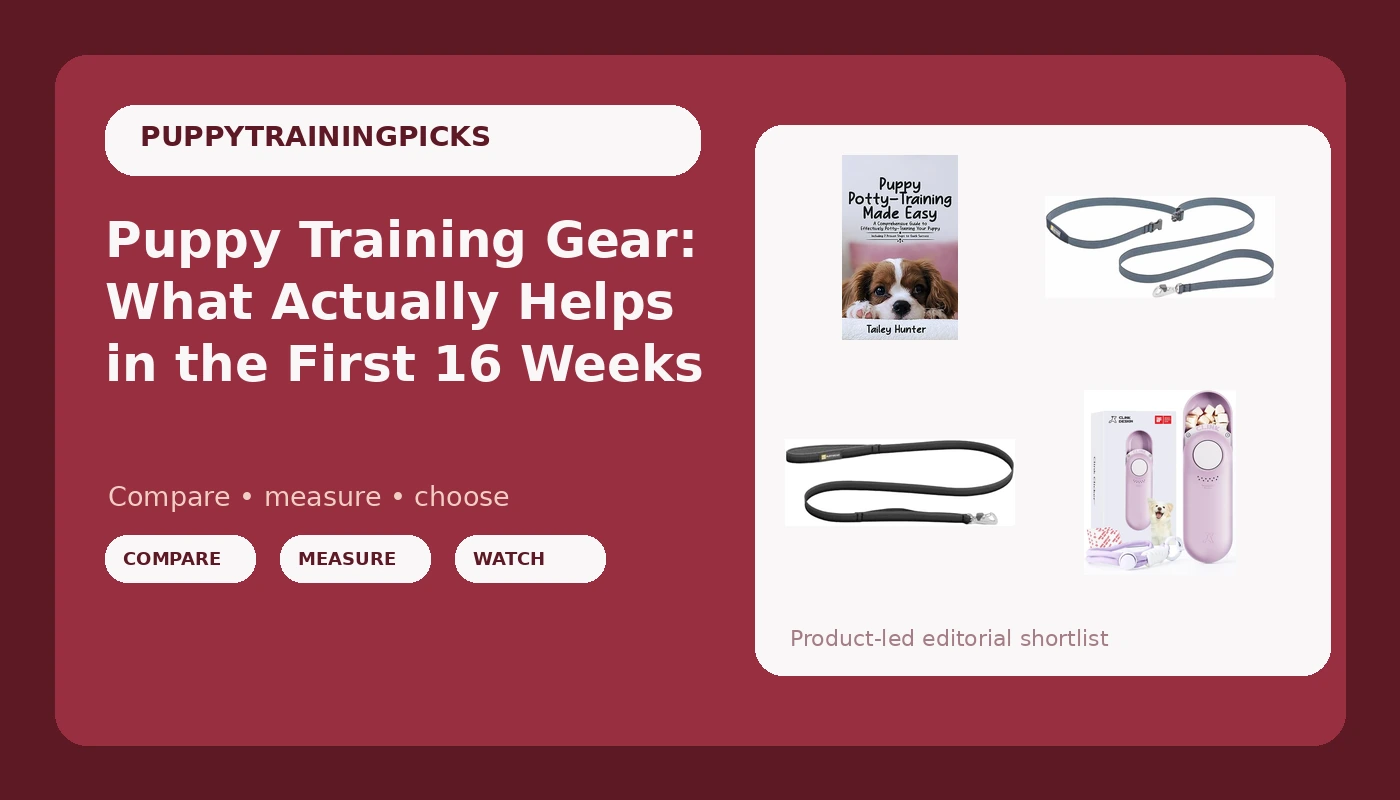
| Clink Design Dog Training Clicker & Dog Clicker with Treat Storage, Purple | Owners who want the marker and the reward in one hand | Combines a training clicker with built-in treat storage in a single purple unit |
| Puppy Potty Training Made Easy: A Comprehensive Guide to Effectively Potty-Training Your Puppy (Including 7 Proven Steps to Quick Success) | First-time owners who need a written potty plan | Book-format guide focused on potty training, structured around a step-based approach |
| Ruffwear, Flagline Dog Leash, Lightweight 6.5 ft Lead, Basalt Gray | Early loose-leash work and more room to move | 6.5 ft length described as lightweight, in Basalt Gray |
| Ruffwear, Front Range Dog Leash, 5 ft Lead, Basalt Gray | Everyday neighborhood walks | 5 ft length in Basalt Gray, from the Ruffwear Front Range line |
The marker: Clink Design Dog Training Clicker & Dog Clicker with Treat Storage, Purple
The reason I push a clicker harder than any other piece of gear is timing. A click is faster and more precise than your voice, and precision is what tells the puppy which exact second earned the payment. Say "good boy" and you have a vague, warm noise that lasts a full second and a half. Click and you have a single, identical sound every time, which is why the puppy can learn from it.
The treat storage is the practical half of the design. Most owners fumble a treat bag, a clicker, and a leash with two hands and lose the moment. One unit in one hand keeps the click and the delivery close together, which is the whole point. Charge the clicker first: click, treat, click, treat, ten or fifteen reps with no behavior attached, until the sound itself means food is coming. Then you can start marking sits, potty finishes, and check-ins. The failure mode is not the clicker. It is the owner who stops clicking on day three because the puppy "already knows sit." Markers get faded last, not first.
The reference: Puppy Potty Training Made Easy
Potty training is a scheduling problem wearing a gear costume. Owners buy pads, sprays, bells, and mats, then wonder why the puppy is still going on the rug. The fix is almost always boring: more trips outside than you think you need, at the times a puppy actually has to go, which is after waking, after eating, after playing, and after every 45 minutes to an hour of awake time in the early weeks.
That is why a written guide is worth having. When you are standing in the kitchen at 2 a.m. with a puppy on your forearm, you do not want to scroll. You want a page that says what to do next. A structured guide also gives you a plan for the setbacks, the week where it all seems to fall apart at four months, which is normal and which most owners read as failure. Read the guide once before the puppy comes home, then keep it somewhere you can grab it with one wet hand. And if your goal is outdoor potty training, skip pee pads entirely. They teach a puppy that indoors is a legal bathroom, and unteaching that costs more weeks than the pads save.
The long line: Ruffwear, Flagline Dog Leash, Lightweight 6.5 ft Lead, Basalt Gray
Leash length is a training decision, not a style decision. The extra foot and a half on a 6.5 ft lead gives a puppy room to sniff, turn, and make choices without hitting the end of the line, and it lets you keep more distance from the things that set him off. Distance is the whole game with a reactive or over-excited puppy. You train outside threshold, which means far enough away that the puppy can still think, and a longer lead makes that easier to arrange.
The trade-off is real. Six and a half feet of leash in a crowded sidewalk is more rope than you can manage with one hand, and a lightweight lead moves easily when a puppy lunges, which is either a feature or a nuisance depending on where you are standing. Use the longer lead for training walks, quiet parks, and practice sessions. Keep your hand low and your arm relaxed, and never wrap the lead around your wrist or fingers. If your puppy is in the stage where every squirrel is a personal emergency, the long line is a practice tool, not a management tool.
The everyday line: Ruffwear, Front Range Dog Leash, 5 ft Lead, Basalt Gray
Five feet is the length most trainers mean when they say "a normal leash." It is short enough that you can keep a puppy close at a curb, in a parking lot, or passing another dog, and long enough that he is not glued to your knee. Less length also means less leverage. When a puppy hits the end of a 5 ft lead, the jolt is smaller and easier to interrupt, which makes it a decent teaching length for a beginner owner whose timing is still developing.
The honest limitation is that five feet is not much room for sniffing or for keeping distance from a trigger. That is why these two leashes are not competitors so much as different stages and different jobs. Early loose-leash work and any reactive-dog practice want the longer line. The daily loop around the block, the vet parking lot, the walk where you need control, want the shorter one. If you own both, keep them separate and grab the right one on purpose instead of defaulting to whichever is hanging by the door.
Prices and availability may change. Confirm current details, including price and stock, on the retailer listing before you buy. This article does not state a current price, rating, or stock status.
How a marker actually works
A clicker is a bridge. It connects the exact instant a behavior happens to the reward that arrives a second or two later. Without a bridge, your puppy has to guess which part of the last three seconds earned the treat, and puppies guess wrong constantly. That is how you end up with a dog who sits beautifully but only when you are holding a bag of chicken.
The sequence is always the same: capture, shape, fade. You capture a behavior the puppy offers on his own, like a sit. You shape bigger behaviors by rewarding small steps toward them, which is how a sit becomes a down and a down becomes a stay on a mat. Then you fade the food, slowly replacing the treat with praise and real-life rewards, and the clicker goes last because it is what held the behavior together while the food thinned out.
Two things break this more than anything else. The first is treat size. If a reward takes four seconds to chew, your session rhythm is gone, and a training session is mostly rhythm. Small, soft, pea-sized pieces keep the reps coming. The second is treating from a bag on the counter. The reward has to arrive where the puppy is, within a second, or the click stops meaning anything.
The potty schedule, the leash, and the 16-week window
Puppies are not being stubborn. They are on a biological schedule that you have not synced with yet, and the fix is a routine, not a gadget. Here is the order that works in my classes.
- Set the schedule before you need it. Write down wake, eat, play, and out. A puppy who just woke up or just ate needs to go outside within minutes, not eventually.
- Mark the finish, not the start. Click or say your marker word the second he finishes outside, then pay. Marking too early teaches him to stop mid-stream for a treat.
- Match leash length to the task. Long lead for training walks and distance work, 5 ft lead for the everyday route where you need control.
- Train outside threshold. Find the distance at which your puppy notices a distraction but can still eat and respond. Start there, not in the middle of it.
- Fade the food on purpose. Fewer treats, same praise, unpredictable rewards. Keep the marker. That is the piece that keeps the behavior alive once the chicken is gone.
Practical guidance
- Take the puppy out after every nap, meal, play session, and training session, plus on a timer during awake hours.
- Keep training sessions to two or three minutes and run several a day. Short and frequent beats long and rare every time.
- Carry the clicker and the treats in the same hand so marking and paying happen in one motion.
- Log potty times for a week. Patterns show up fast, and the log is what tells you whether the problem is the schedule or the supervision.
- Practice in bad weather, on wet grass, and on the sidewalk you actually walk. A puppy who only potties in perfect conditions is not trained yet.
Which option should you choose?
Choose the Clink Design Dog Training Clicker & Dog Clicker with Treat Storage, Purple when you want a marker and a reward in one hand and you are ready to charge the click before you use it on behavior. Choose the Puppy Potty Training Made Easy: A Comprehensive Guide to Effectively Potty-Training Your Puppy (Including 7 Proven Steps to Quick Success) when you are bringing home a puppy and want a written plan you can follow at 2 a.m. instead of improvising. Choose the Ruffwear, Flagline Dog Leash, Lightweight 6.5 ft Lead, Basalt Gray when your work is loose-leash training, distance from distractions, or sniff-friendly practice walks in open space. Choose the Ruffwear, Front Range Dog Leash, 5 ft Lead, Basalt Gray when you need a control-oriented lead for the daily neighborhood loop, curbs, and parking lots.
The caveat is that none of these items trains anything by itself. A clicker with a schedule you never follow is a noisemaker, and a leash length you never practice with is just a strap. There is also no timeline anyone can honestly promise you. Potty training and loose-leash work move at the speed of your consistency, and most of the "seven day" claims you will read online describe a puppy who was already close.
The bottom line
Buy the marker, buy the plan, and buy the leash that matches the stage your puppy is actually in, not the stage you were hoping for. A clicker with treat storage keeps your timing honest, a structured potty guide keeps your schedule honest, and the right leash length keeps your practice honest. Everything else in the puppy aisle is optional until you have those three jobs covered. The tool is maybe ten percent of the outcome. The other ninety percent is showing up tomorrow and doing it again.