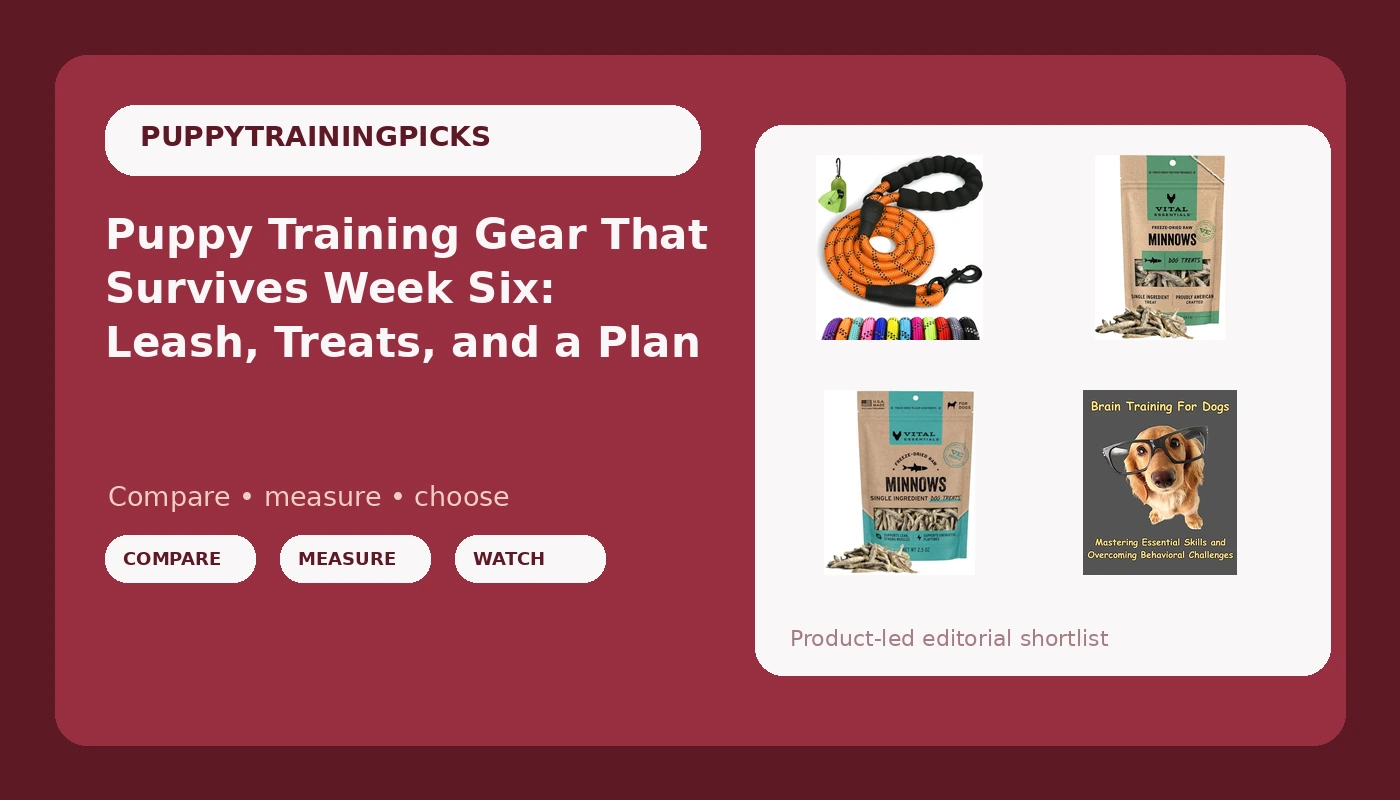
Most puppy training problems do not get solved in the pet store aisle. They get solved on your kitchen floor at 7 a.m., with a leash in one hand and a treat small enough to swallow in a single bite. That is the entire case for keeping your puppy training leash and treats setup boring. The gear should disappear into the routine so that timing, repetition, and consistency can do the actual work.
This explainer covers four products that fill the three jobs a new puppy owner has to solve in the first two months: something to walk on, something to pay the puppy with, and something that tells you what to teach next. None of them replaces practice. Each of them removes one small excuse to skip it.
Related: How to Fade Treats Without Losing Your Puppy's Attention →
Quick answer
For a medium or large breed puppy, start with a 6 ft leash you can hold comfortably for a full walk, a treat small enough to deliver in under a second, and a written training plan so you are not improvising a new lesson every day. The Taglory rope leash covers the walking job, the Vital Essentials freeze dried minnows cover the payment job in either a 1 oz or 2.5 oz bag depending on how often you train, and Brain Training For Dogs covers the curriculum job.
Four useful options
| Model | Best fit | What stands out |
|---|---|---|
| Taglory Rope Dog Leash for Medium Large Dogs, 6 FT Padded Handle, Orange | Daily walks and loose leash practice | 6 ft rope leash with a padded handle, sized for medium and large dogs |
| Vital Essentials Freeze Dried Minnows Dog Treats, 1 oz Bag | Trialing a new treat or training a few times a week | Single 1 oz bag of freeze dried minnows |
| Vital Essentials Freeze Dried Minnows Dog Treats, 2.5 oz Bag | Households training every day | The 2.5 oz bag format of the same freeze dried minnow treat |
| Brain Training For Dogs - Mastering Essential Skills And Overcoming Challenges | Owners who want a structured curriculum | Covers essential skills and working through training challenges |
The everyday leash: Taglory Rope Dog Leash for Medium Large Dogs, 6 FT Padded Handle, Orange
The trade-off with a 6 ft rope leash is simple: you get room to reward a puppy for walking in the right position, and you give up some of the instant control a shorter lead provides in tight spaces. That is usually the right trade for a puppy, because most leash problems are created by a leash that is permanently tight. A 6 ft leash lets the line go slack, and a slack line is what you are actually training toward. Rope is also easier to gather in loops when you need to shorten it up for a crosswalk.
The small bag: Vital Essentials Freeze Dried Minnows Dog Treats, 1 oz Bag
Treat value is not the same thing as treat size. A reward only works if the puppy will work for it, and it only works fast if you can deliver it in about a second. Freeze dried treats are dry, light, and easy to break into smaller pieces, which makes them practical for high-repetition sessions where you might mark and pay ten times in two minutes. The 1 oz bag is the sensible first purchase: it tells you whether your puppy considers a minnow payment or a distraction, without leaving you with a large bag of something nobody wants.
The larger bag: Vital Essentials Freeze Dried Minnows Dog Treats, 2.5 oz Bag
The only real decision between the two bags is volume. A puppy in a structured program might take twenty to forty rewards in a single day of short sessions, and that adds up quickly. Buying the larger bag is not a commitment to using more treats per session; it is a commitment to not running out mid-week, which is exactly when people stop training. Keep the portions the same and let the bag size do the rest.
The plan: Brain Training For Dogs - Mastering Essential Skills And Overcoming Challenges
Prices and availability may change. Product images, names, and retailer links must be matched by verified ASIN. Do not state a current price, rating, stock status, or measured result without current evidence.
Why a 6 ft leash is the length most puppies learn on
Leash length is one of the few gear decisions with a clear logic behind it. A leash that is too short stays tight no matter what the puppy does, which teaches the puppy that pressure on the collar is a permanent condition rather than a signal. A leash that is too long gives a puppy room to build speed before you can respond, and it is awkward on a sidewalk.
Six feet sits in the useful middle. There is enough slack to reward a puppy for drifting back into position next to you, and enough length to step on the line if you need to stop forward motion without jerking the dog. Long lines of 15 or 30 feet belong in fenced parks for recall practice, not on a neighborhood walk.
Two leash details are worth caring about beyond length. The first is the material. Rope tends to sit more comfortably in a closed hand than flat webbing, especially on a warm day or during a long walk. The second is the handle. A padded handle matters most during the adolescent months, when a puppy who was perfectly polite at four months discovers squirrels at seven months and tests the line with real force. Neither detail makes a leash train the dog. Both make it more likely you will actually pick the leash up.
Treats are payment, not bribery
The most common misunderstanding in puppy training is the idea that using treats is cheating. It is not. A treat is payment for a behavior that has already happened, delivered within about a second of the marker word or click. The problem is never that you paid. The problem is that most people never stop paying, or they pay so slowly that the puppy has no idea what the payment was for.
That is where fading comes in. Fading treats means deliberately replacing food rewards with praise and life rewards over time, on a schedule you choose rather than one your puppy forces on you. The sequence looks like this: pay every single repetition while the behavior is new, then every other repetition, then every third, then randomly. A puppy that has been paid randomly for weeks will keep working because the possibility of payment is still live.
Size and speed go together. A treat the size of a golf ball takes several seconds to chew, and those seconds are dead time in a session. Small pieces, delivered fast, keep the rhythm of the session intact and keep the calorie math sane. Freeze dried treats are convenient here because they are dry and easy to break down, and because a dry treat does not turn your pocket into a grease stain.
A five step session you can run today
- Pick one behavior and one room. A hallway or kitchen with the door closed removes about eighty percent of the distractions you would otherwise be fighting.
- Load the marker. Say your marker word or click, then pay, ten times in a row with no behavior required. The puppy is learning that the sound predicts a treat.
- Ask once. Cue the behavior a single time, mark the instant it happens, and pay within a second. If nothing happens in three seconds, make it easier rather than repeating the cue.
- End while the puppy is winning. Three to five minutes is a full session for a young puppy. Stop after a good repetition, not after a bad one.
- Fade on a schedule. Once the behavior is reliable in that room, move to a new room, then to the yard, then to the sidewalk. Raise difficulty in one dimension at a time.
Practical guidance for the first eight weeks
- Pre-portion treats before the walk. You cannot break treats apart while holding a leash and watching traffic.
- Train before meals, not after. A full puppy is a puppy with no reason to work.
- Put the leash on and take it off without going anywhere for the first week. The leash should predict nothing scary.
- Pick one word per behavior and never change it. "Down" for lying down and "off" for jumping is a common collision that confuses everybody.
- Keep sessions under five minutes until the puppy is around sixteen weeks, then build slowly.
- Practice in the places you actually walk, not just the living room. Generalization is a separate skill from learning.
- Track what you worked on. A written plan plus a two-line daily note beats trying to remember what you did last Tuesday.
Which option should you choose?
Choose the Taglory Rope Dog Leash for Medium Large Dogs, 6 FT Padded Handle, Orange when you need a single daily walking leash for a medium or large breed puppy and you want a padded handle for the adolescent months. Choose the Vital Essentials Freeze Dried Minnows Dog Treats, 1 oz Bag when you are still figuring out what your puppy will work for and do not want to commit to a large bag. Choose the Vital Essentials Freeze Dried Minnows Dog Treats, 2.5 oz Bag when the smaller bag already earned its place and you train most days of the week. Choose Brain Training For Dogs - Mastering Essential Skills And Overcoming Challenges when the missing piece is not gear at all, but a sequence of skills to work through instead of improvising.
Nothing on this list trains your puppy by itself. A leash is a piece of rope, treats are food, and a training guide is information. The variable that decides whether any of it works is how often you run short, well-timed sessions and whether you remember to fade the food rewards once the behavior is solid. Gear removes friction. It does not replace reps.
The bottom line
The puppy training gear worth buying is the gear that makes a good habit easier to repeat: a 6 ft leash you will actually pick up every day, a treat small and dry enough to deliver in under a second, and a plan that tells you what to work on next. The Taglory rope leash handles the walking job, the Vital Essentials freeze dried minnows handle the payment job in whichever bag size fits your schedule, and Brain Training For Dogs handles the curriculum job. Buy the three, run five minute sessions, and check the current Amazon price before you commit.