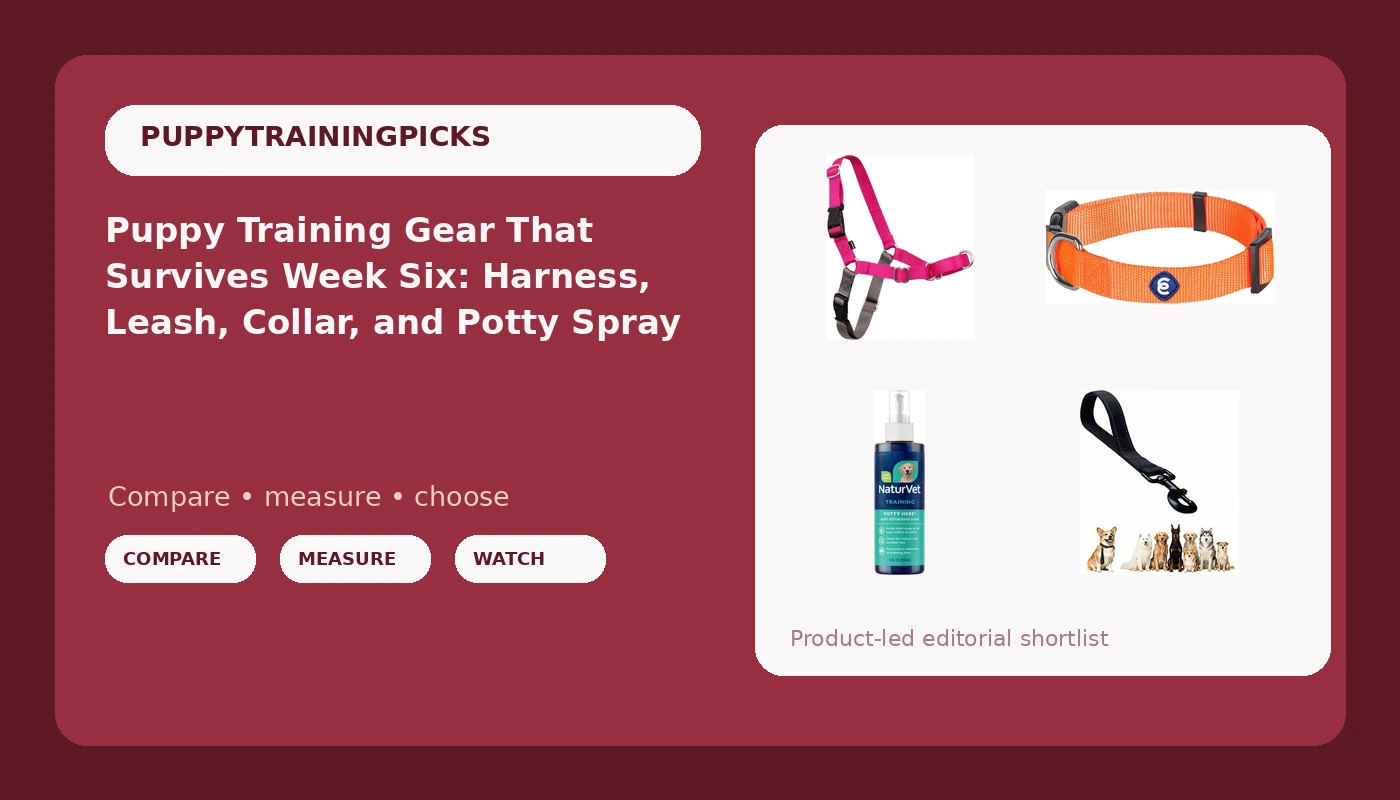
Most puppy training gear fails the same way. It works beautifully in the living room on day two and falls apart on a busy sidewalk in week six, which is exactly when a puppy's confidence outgrows his manners and the gear starts showing its seams. Good puppy training gear does not train the dog. It removes a few obstacles so that your timing, your consistency, and your willingness to actually practice can do the work. The four items below cover the practical basics of loose-leash work, everyday identification, and potty routines, and this guide explains what each one is for, where it fits in a training plan, and where it does not help at all.
Related: How to Stop a Puppy From Pulling on the Leash →
Quick answer
If you are assembling a starter kit, the harness does the most work for loose-leash training on a puppy whose neck is still developing, a short leash is the piece most owners forget to buy, and a properly fitted collar is the everyday baseline. A potty training aid spray is optional and functions only as a scent cue, never as a substitute for a schedule and supervision. Buy gear that fits, introduce it slowly, and treat the equipment as a support for your handling rather than a solution on its own.
4 useful options
| Model | Best fit | What stands out |
|---|---|---|
| PetSafe Easy Walk Harness, No Pull Dog Harness, Medium, Raspberry | Puppies and adolescents who pull against a flat collar | Marketed as a no-pull harness, in size Medium and a Raspberry colorway |
| Short Dog Leash with Padded Handle, Heavy Duty Nylon, Reflective, 360° Rotating Alloy Buckle, Black, 12 Inch | Close-range control work, busy sidewalks, vet visits | 12 inch length, padded handle, heavy duty nylon, reflective construction, rotating alloy buckle |
| Blueberry Pet Essentials Florence Orange Adjustable Nylon Dog Collar for Small Dogs | Small dogs who need a lightweight everyday collar | Adjustable nylon sizing built for small dogs in a solid Florence Orange colorway |
| NaturVet Potty Here Training Aid Spray for Puppies and Dogs, 8 oz | Owners adding a scent cue to an established outdoor potty routine | 8 oz spray bottle formulated as a potty training aid for puppies and dogs |
The anchor: PetSafe Easy Walk Harness, No Pull Dog Harness, Medium, Raspberry
A harness is not a fix. It is a management tool that buys you a few seconds of cooperation while you teach the behavior you actually want. The reason it matters for puppies specifically is anatomy: pressure on a flat collar sits right at the throat, and a puppy who lunges at a leaf pile hits the end of the leash hard. A harness moves that pressure off the neck and onto the body, which is why this site recommends it for dogs whose necks are still developing.
The trade-off is fit. A harness that is too loose slides and chafes, and a harness that is too tight restricts the shoulder. Check under the armpits after every walk for the first two weeks, because a harness that rubs armpits raw will turn your puppy into a dog who dodges the equipment, and that is a much harder problem to undo than a loose leash. Adjust it, check it, and re-check it as your puppy grows. This is also a size Medium listing, so measure your dog before ordering rather than guessing from the photo.
The piece owners forget: Short Dog Leash with Padded Handle, 12 Inch
Here is the honest limitation: a twelve inch leash is not the leash you take on a forty minute walk. There is no room for sniffing, no slack for a loose-leash exercise, and no length for a puppy to make a mistake and self-correct. What it is good at is close control in environments where a longer leash becomes a hazard, and it is genuinely useful for teaching a puppy to walk beside you instead of ahead of you.
The other thing a short leash does is reveal your own handling. When the dog is twelve inches away, you cannot blame the leash for the pulling. That is uncomfortable and it is also the point. Use it in short sessions, five to ten minutes, and pair it with a longer leash for everything else. The reflective construction and rotating buckle are details that matter more in winter than summer, but they are the kind of thing you notice once and then stop thinking about.
The baseline: Blueberry Pet Essentials Florence Orange Adjustable Nylon Dog Collar for Small Dogs
A collar is the least glamorous purchase in this article and the one you should not skip. It carries the tag, it is what a stranger reads if your puppy slips a gate, and it is the piece of gear your dog wears for eighteen hours a day. Because of that, fit matters more than features. You should be able to slide two fingers under it comfortably, and it should not be loose enough to slip over the ears.
For small dogs, the calculus is different than it is for a Labrador. A small dog's trachea is delicate, which is one more argument for walking on a harness rather than clipping a leash to the collar. Keep the collar for identification and for holding tags, and do your leash work on the harness. This listing is sized for small dogs, so if you are buying for a medium or large puppy, this is not the right product.
The optional extra: NaturVet Potty Here Training Aid Spray, 8 oz
Be skeptical here, and be skeptical in a specific direction. Scent cues help a puppy locate a spot he has already learned to use. They do not teach a puppy to hold his bladder, and they do not replace taking him out every hour during the first weeks. If your goal is outdoor potty training, keep the whole routine outdoors, including the accidents you clean up, because a puppy who learns that indoors is a legitimate bathroom is a puppy you will be retraining in three months.
Where this spray earns its place is in consistency. Same door, same spot, same surface, every single time, and the scent marker reinforces that pattern. Used that way, it is a small nudge. Used as a shortcut around supervision, it is a waste of twelve dollars and a week of progress.
Prices and availability may change. Product images, names, and retailer links are matched to verified listings. No current price, rating, stock status, or measured result is stated here without current evidence.
Why the gear is only about ten percent of the job
Owners buy equipment because equipment feels like progress. It arrives in a box, it has a design, and it can be adjusted. Training does not feel like that. Training is standing in the rain at 6:40 in the morning waiting for a puppy to circle twice so you can mark the exact moment he squats, and then doing it again four hours later.
The mechanics are simple and they never change. You capture a behavior your puppy offers naturally, you shape it by rewarding small steps toward the version you want, and then you fade the treats out so the behavior survives without food in your pocket. In that order. Skipping the fade is the single most common mistake owners make, and it produces a dog who sits beautifully at home and stares at you blankly in the park because the payment structure changed.
Gear slots into that framework in one narrow way: it makes the correct behavior easier to reward. A harness makes it easier for a puppy to stay near you, which means more opportunities to mark and pay. A short leash makes it easier to keep the dog in a position you can reward. A collar makes sure he gets home. None of these things produce behavior. They reduce the number of times your puppy gets rewarded for doing the wrong thing.
How to introduce new gear in five steps
- Let your puppy sniff the item on the floor for a few minutes with no pressure and no restraint, and pay him for calm curiosity.
- Put the item on for thirty seconds, feed a few small treats, then take it off. Repeat this three or four times before you ever attach a leash.
- Attach the leash indoors, in a low-distraction room, and reward your puppy for standing still while it dangles.
- Move to a hallway or yard, then to a quiet sidewalk, and only then to a busy park. Change one variable at a time.
- Watch for the threshold, the distance at which your puppy notices a distraction. Train outside that distance, not inside it, and close the gap over weeks rather than minutes.
What to check before you buy anything
- Measure, do not guess. Chest girth for a harness, neck circumference for a collar, and check the manufacturer's size range rather than the product photo.
- Confirm the item is sized for your dog's weight class. Two of these products are built for specific size ranges, and a wrong-size harness is worse than no harness.
- Check the return policy before the first walk. Fit problems show up on day one, not week three.
- Prefer gear you can adjust with one hand while holding a leash in the other.
- Skip anything marketed to puppies that relies on pain, fear, or vibration. There is no version of that which is appropriate for a growing dog.
Which option should you choose?
Choose the PetSafe Easy Walk Harness when your puppy pulls and you need a no-pull option that keeps pressure off a developing neck. Choose the Short Dog Leash when you need close control at curbs, vet visits, and in busy public spaces, and you already own a standard walking leash for everything else. Choose the Blueberry Pet Essentials collar when you have a small dog who needs an adjustable everyday collar for tags. Choose the NaturVet Potty Here Training Aid Spray when you already have an outdoor schedule and a fixed spot, and you want a scent cue to reinforce it.
The caveat is that none of this substitutes for a plan. The harness and leash are handling tools that only work while you are actively teaching, and the spray is a minor cue that only works inside a routine that already exists. If you buy all four and change nothing about how often you practice, you will have spent about fifty dollars and your puppy will pull exactly as hard in November as he does today.
The bottom line
The gear in this guide covers the practical basics: a no-pull harness for leash work on a developing neck, a twelve inch leash for close control, a small-dog collar for identification, and an optional scent spray for an established potty routine. Buy the harness first if your puppy pulls, add the short leash for public spaces, and treat the collar as a non-negotiable baseline rather than an accessory. Then spend the money you have left on treats, because the tool is the small part of the equation and the practice is the rest of it.