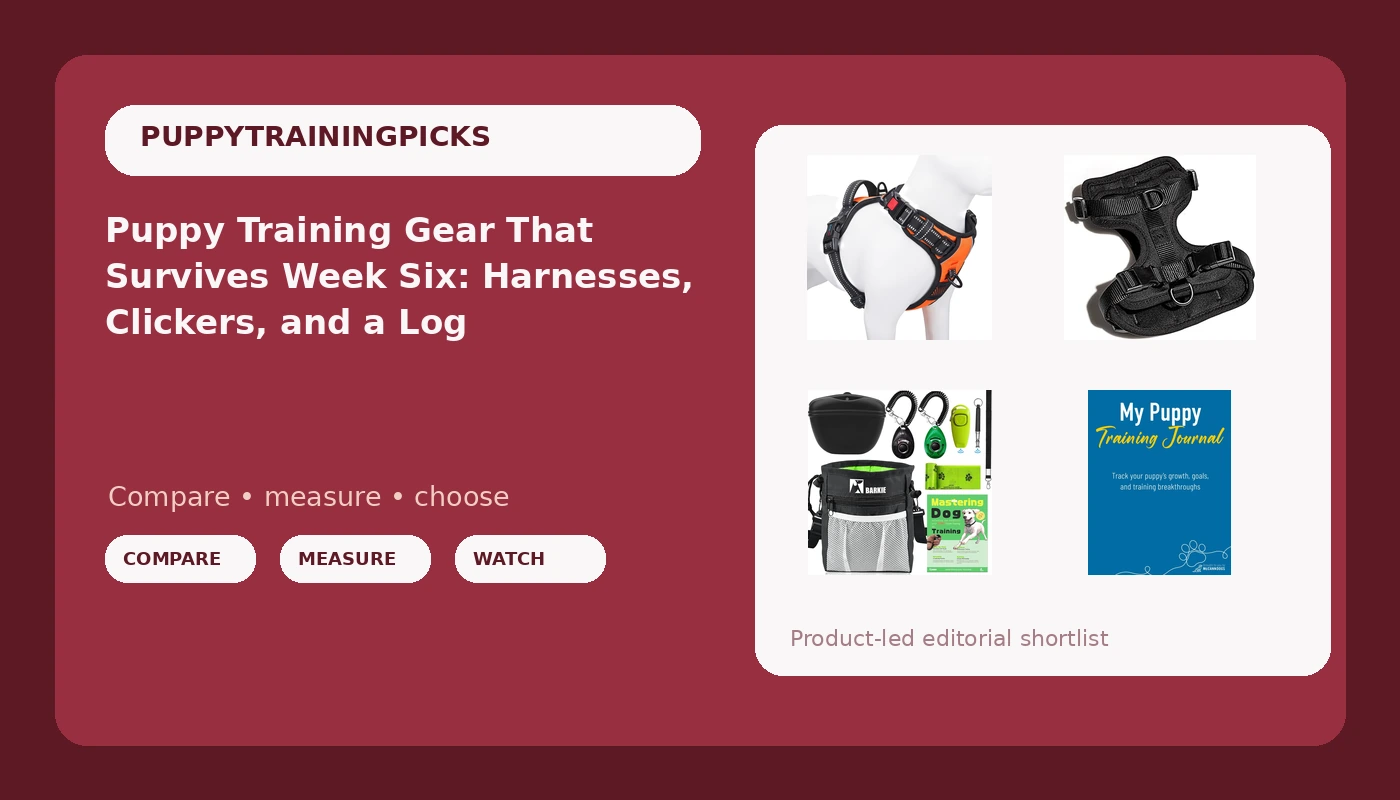
Most puppy training gear fails at the same moment: week six. The first month is easy. Your puppy is small, slow, and delighted to follow you around the kitchen. Then the adolescent brain switches on, the nose hits the sidewalk, and whatever harness, clicker, or treat pouch you bought in a burst of optimism either earns its place or ends up in a drawer next to the puppy toothbrush you used twice.
The gear in this guide covers the two halves of that problem. One half is walking, where a puppy who has learned to lean into the leash needs a harness that steers rather than strangles. The other half is the reward and marking side, where a treat pouch, a clicker, and a written record do more for your training than any gadget with a light on it. This is puppy training gear, not magic. It buys you better mechanics so your timing and consistency can do the actual work.
Related: How to Fade Treats Without Losing Your Puppy's Attention →
Quick answer
If you want one purchase that covers the most training ground, the BARKIE Dog Training Kit bundles a treat pouch, clickers, a whistle, and a guide booklet into a single package. For walking, the decision comes down to fit and how you want to steer: the PHOEPET No Pull Dog Harness uses a reflective front-clip vest with a handle, while the Wild One Dog Harness offers three leash clips and a padded, stretchy vest in size S. The My Puppy Journal is the small addition that keeps a training plan from dissolving into guesswork.
Four useful options
| Model | Best fit | What stands out |
|---|---|---|
| BARKIE Dog Training Kit | Owners who want the marking and reward tools in one box | Treat pouch, two clickers, an ultrasonic silent whistle, a 2-in-1 whistle clicker, a guide booklet, and a poop bag |
| PHOEPET No Pull Dog Harness Medium Reflective Front Clip Vest with Handle | Puppies who pull and owners who want a front clip plus a grab handle | Reflective front-clip vest design with a handle, in medium |
| Wild One Dog Harness, The Original No-Pull, Size S, Black | Owners who want a padded vest harness with more than one attachment point | Three leash clips, adjustable soft padded vest, stretchy fabric |
| My Puppy Journal | Owners who want a written record instead of a memory | Structured tracking of training, routines, and behaviour from the first day |
The all-in-one kit: BARKIE Dog Training Kit - Treat Pouch, Pet Training Fanny Pack, 2 Puppy Training Clickers, Ultrasonic Silent Whistle, 2-in-1 Whistle Clicker, Clicker Training Guide Booklet, Dog Poop Bag (Black)
The kit's real value is that it puts the reward and the marker in the same place. A treat pouch on your hip means you are not digging through a jacket pocket while your puppy loses interest and wanders off, and two clickers give you a spare for the day one disappears under the couch. The guide booklet matters more than it sounds. The most common complaint about clickers is that they arrive with no explanation of when to click, and timing is the entire skill. The whistle is a separate tool for distance work later on, so treat it as a bonus rather than a reason to buy.
The no-pull harness: PHOEPET No Pull Dog Harness Medium Reflective Front Clip Vest with Handle
Front-clip harnesses work by giving you a steering point at the chest. When a puppy surges forward, the clip redirects the body sideways instead of letting the dog lean into pressure, which is exactly what happens with a back-clip harness on a committed puller. The handle is useful for holding a puppy steady at a curb or lifting a small dog over a puddle. Fit is where inexpensive harnesses fail: straps that sit too far back in the armpit will rub a puppy raw on a long walk, so measure chest girth rather than going by weight or breed.
The padded vest harness: Wild One Dog Harness, The Original No-Pull, Pet Harness with 3 Leash Clips, Adjustable Soft Padded Vest, Comfortable, Stretchy, Size S, Black
Three leash clips means three ways to attach a leash: a front point for training walks, a back point for relaxed sniffing, and a third option for however you prefer to double up or secure a long line. The padded, stretchy vest distributes pressure across the chest instead of concentrating it on a thin strap, which matters for a puppy whose ribcage is still developing. Size S is a specific fit, so check the girth measurement before ordering. A harness that is slightly too large will slide, twist, and rub, and a rubbing harness is one your puppy will start dodging at the door.
The training log: My Puppy Journal: Track your puppy's training, routines, and behaviour from the first day
A journal sounds like homework, and it is, but it fixes the most common training failure: nobody remembers what they did last week. Three lines a day, what you practiced, how many repetitions, how your puppy responded, turns a vague sense of progress into something you can actually adjust. It is also where you plan the fade. If you are still paying a treat for every single sit in week five, the log will show it, and you can move to rewarding every third sit instead.
Prices and availability may change. Product images, names, and retailer links must be matched by verified ASIN. Do not state a current price, rating, stock status, or measured result without current evidence.
The marker is the tool, but timing is the skill
A clicker does one thing: it marks the exact instant a behaviour happened. That instant matters because rewards delivered late get attached to whatever the puppy did last. If you ask for a sit, the puppy sits, then stands up, then gets the treat, you have just paid for standing. A click closes that gap. Click, then treat, and the puppy learns that the click predicts payment.
The order of operations for anything new is capture, shape, then fade. Capture means marking a behaviour your puppy offers on his own, like a sit during a pause. Shape means rewarding small steps toward a bigger behaviour, so a nose touch becomes a hand target becomes a recall. Fade means slowly replacing food with praise and life rewards. Almost nobody does the third step, which is why so many puppies look trained at four months and deaf at eight.
Clickers are cheap and boring, which is why they get abandoned by day three. A kit that keeps the clicker attached to the treat pouch removes the excuse.
What a no-pull harness actually does
A harness does not train your puppy. It changes the physics of the walk so your training has a chance. On a flat collar, a pulling puppy feels steady pressure on the throat, leans into it, and gets better at pulling. That is not defiance, it is opposition reflex, and it is how sled dogs are made.
A front-clip harness interrupts that loop. Pressure at the chest turns the puppy's body toward you when he hits the end of the leash, which makes it easier to reward a check-in. A back clip is fine for a puppy who already walks politely or for a long line in an open field. It is the wrong tool for a dog who has learned to tow.
Fit decides whether any of this works. Two fingers should slide under every strap, the front clip should sit at the chest rather than the throat, and the leg openings should clear the armpit. Recheck the fit every few weeks, because puppies change shape fast and a harness that fit in March can rub in May.
- Decide which problem you are actually solving this month: pulling on walks, or marking and rewarding behaviour at home.
- Measure your puppy's chest girth with a soft tape before ordering any harness, and compare it to the size range rather than the breed label.
- Pick the clip point that matches the walk. Front clip for training walks in distracting places, back clip for sniffy decompression walks.
- Set up the reward system before the session, not during it. Pouch loaded, clicker on your wrist, treats cut small enough to swallow in one bite.
- Write down what you did after every session, including the failures, so the next session starts from information instead of memory.
Practical guidance for the first eight weeks
- Introduce the harness slowly, with treats, at home, before you ever clip a leash to it.
- Keep training sessions to three or five minutes and end while your puppy still wants more.
- Reward position, not just the behaviour. A sit that happens three feet away is a different skill than a sit at your left leg.
- Use the front clip for the walk to the park and the back clip for the walk home, so your puppy learns the difference between working and being a dog.
- Log the fade, not just the wins. The week you start paying every other rep is worth writing down.
Which option should you choose?
Choose the BARKIE Dog Training Kit when you are starting from nothing and want the treat pouch, clicker, and instructions to arrive together. Choose the PHOEPET No Pull Dog Harness Medium Reflective Front Clip Vest with Handle when your puppy pulls and you want front-clip steering plus a handle for close-quarters control. Choose the Wild One Dog Harness when you want a padded, stretchy vest with three clip points and your puppy measures into size S. Choose the My Puppy Journal when you want a written record of training, routines, and behaviour from the first day.
None of these tools will train your puppy for you, and none of them should be judged on one session. A harness that works in a quiet living room may still be tested by a busy park, and a clicker that feels natural in week one often gets forgotten by week four. Give each tool a real trial of several weeks before deciding it does not work.
The bottom line
The gear that survives week six is the gear that makes good timing easier: a pouch you can reach without looking, a clicker that is always on your wrist, a harness that steers instead of chokes, and a journal that tells you the truth about what you have actually practiced. Buy for the mechanics, then do the boring part, which is repetition, consistency, and an owner who shows up on the days the puppy is not charming. That last part is the ninety percent no product can sell you.