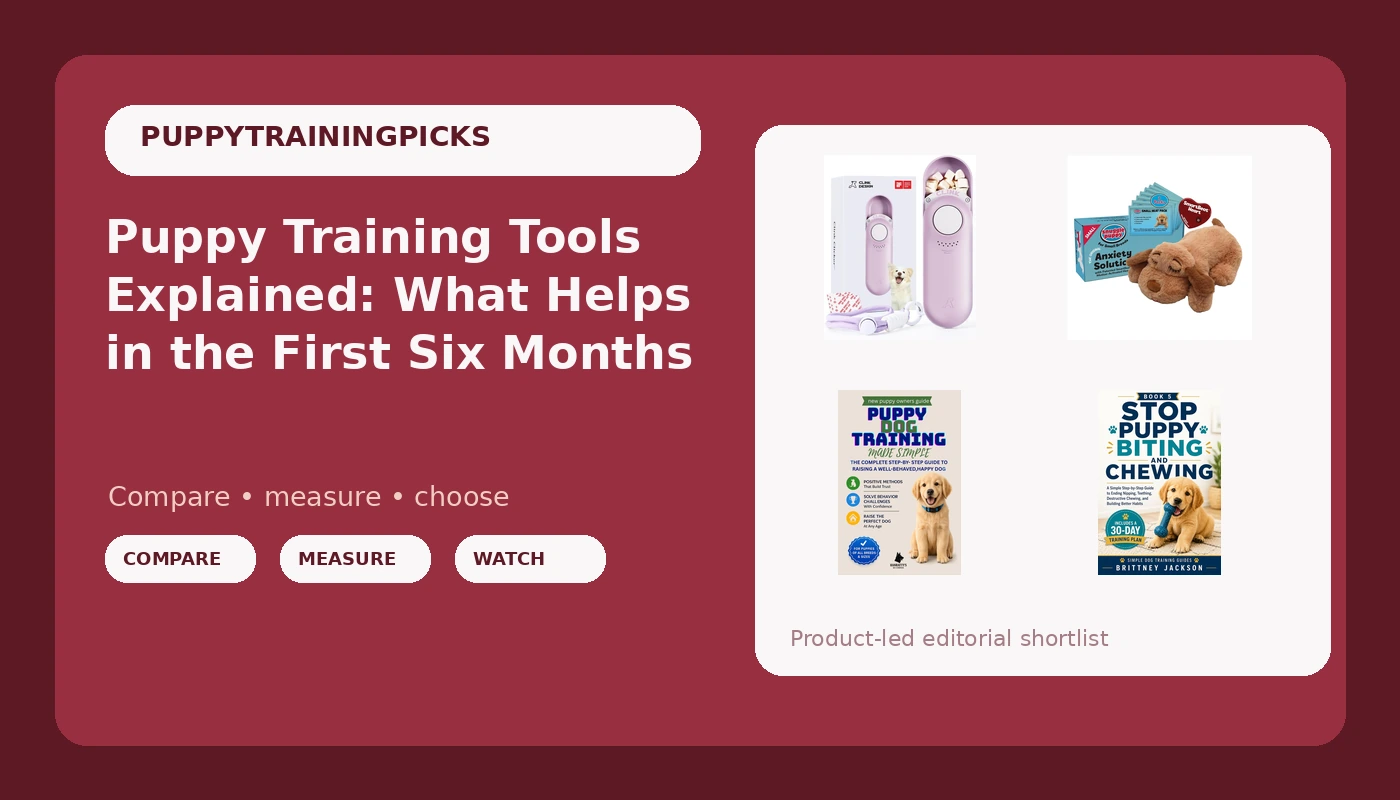
Puppy training tools get sold as if they do the training for you. They do not. In four years of running a puppy kindergarten, I have watched owners buy a clicker, a heartbeat toy, a small library of books, and still end up with a nine-month-old who mouths hands and ignores the word sit. The gear was never the problem. The missing piece was a sequence to follow and about ten minutes of daily practice that most people skip by week two.
That said, the right puppy training tools make a good plan easier to execute. A marker tells your puppy exactly which behavior earned the reward, which is the single hardest thing for a human to communicate in real time. A comfort item makes the first few nights in a crate survivable for a puppy who just left his littermates. A short guide gives a first-time owner a plan instead of a pile of contradictory internet advice.
This explainer covers four options that solve four different problems: marking behavior, settling at night, learning the overall plan, and surviving the teething phase. None of them is a shortcut around practice. All of them work better when you understand what they are actually for.
Related: Best Training Treats for Puppies: What Survives Week Six →
Quick answer
A clicker, a comfort toy, and two short guides cover different parts of the same problem, and none of them replaces daily practice. The Clink Design clicker marks the exact moment a puppy does the right thing. The Snuggle Puppy Junior is built around a heartbeat and heat packs for small-breed puppies settling at night. Puppy Dog Training Made Simple gives a first-time owner one overall plan, and Stop Puppy Biting and Chewing goes deep on the mouthing phase that frustrates nearly every household. Buy the one that matches the problem you have this week, not the one that sounds most impressive.
Four useful options
| Model | Best fit | What stands out |
|---|---|---|
| Clink Design Dog Training Clicker & Dog Clicker with Treat Storage, Purple | Owners learning marker timing | A clicker and treat storage in one handheld unit |
| Snuggle Puppy Junior Heartbeat Toy & 7 Heat Packs, Small Breeds - Biscuit | Small-breed puppies settling at night | Heartbeat toy plus seven heat packs, sized for small breeds |
| Puppy Dog Training Made Simple: A No-Stress Guide for First-Time Owners to Raise a Happy, Obedient Dog | First-time owners who want one plan | Written specifically for first-time owners, with a no-stress framing |
| Stop Puppy Biting and Chewing: A Simple Step-by-Step Guide to Teething, Mouthing, Chew-Proofing, and Building Better Puppy Habits | Households in the teething phase | Step-by-step coverage of teething, mouthing, and chew-proofing |
The marker: Clink Design Dog Training Clicker & Dog Clicker with Treat Storage, Purple
A clicker is the piece of equipment that changes outcomes most for the least fuss, and it is also the one owners abandon fastest. The reason is almost always the same: the owner clicks, the puppy does not instantly sit, and the clicker ends up in a drawer. A click is not a command. It is a marker, a sound that says "that, right there, is what got paid," and its value depends entirely on how close it lands to the behavior.
The trade-off here is simple. Keeping the marker and the reward in the same hand cuts down on fumbling during fast repetitions, which matters when you are trying to mark a behavior within a second of it happening. You will still want a larger supply of rewards within reach, because a session that runs long enough to empty a compartment is a session that has probably already gone past your puppy's attention span. Buy it if you are willing to spend two weeks building the click-then-treat association before you expect it to mean anything.
The comfort item: Snuggle Puppy Junior Heartbeat Toy & 7 Heat Packs, Small Breeds - Biscuit
This is a comfort tool, not a training tool, and it belongs in a different part of your plan than the clicker. A puppy separated from his littermates is losing warmth, rhythm, and company all at once, which is why the first few nights in a crate can go badly even when the crate itself is set up correctly. A heartbeat toy with heat packs addresses the warmth and the rhythm.
Two honest caveats. First, a plush toy with a heartbeat unit inside is still a plush toy, and a determined chewer can get into it, so treat it as something for the crate during settling rather than a leave-alone toy for a puppy in a chewing phase. Second, comfort items reduce distress, they do not replace crate training. If you are not also feeding meals in the crate and building short positive reps during the day, the toy will not do the work for you. It is sized for small breeds, so owners of larger puppies should check the dimensions before buying.
The starter manual: Puppy Dog Training Made Simple: A No-Stress Guide for First-Time Owners to Raise a Happy, Obedient Dog
Most puppy problems I see in class are not obedience problems. They are sequencing problems. The owner is working on sit, stay, leash manners, and crate training all in the same week, the puppy is overwhelmed, and everyone ends up frustrated. A general guide earns its place by giving you an order of operations so you are not teaching four things at once.
The trade-off is depth. A book written for first-time owners will not go as far into leash reactivity, threshold work, or competition-level shaping as a specialist title would, and an owner who has raised three puppies may find it too introductory. It is also only useful if you read it before the behaviors show up, not after. If you want one book that tells you what to do next when you are not sure what to do next, this is that book. If you already have a training plan and a class, spend the money on rewards instead.
The mouthing playbook: Stop Puppy Biting and Chewing: A Simple Step-by-Step Guide to Teething, Mouthing, Chew-Proofing, and Building Better Puppy Habits
Biting is the complaint I hear most often and the one owners handle worst, usually by yelping, pushing the puppy away, and accidentally turning teeth into a game. A narrow guide helps because the fix is a sequence, not a single trick: manage the environment, redirect onto something legal, teach a pause, and wait out the teething window without building a habit you will have to undo later.
The limitation is scope. This book is about biting and chewing, and it will not teach you a recall or a loose-leash walk. It pairs well with a general guide rather than replacing one, and it is best read during the phase it covers, because the useful part is knowing what to do tonight. Owners who want one broad reference should start with the general title and add this one when the teeth arrive.
Prices and availability may change. Product images, names, and retailer links must be matched by verified ASIN. Do not state a current price, rating, stock status, or measured result without current evidence.
How marker training actually works
Marker training has three stages, and they go in order: capture, shape, then fade.
Capturing means marking a behavior your puppy does on his own. You are not forcing a sit. You are waiting for one, clicking the instant his rear hits the floor, and paying. The click is doing the work of telling him which part of that whole-body wiggle earned the reward. Without a marker, you are guessing, and so is he.
Shaping means rewarding small steps toward a finished behavior. A hand touch becomes a nose target, which becomes a spin, which becomes a retrieve. Each step gets marked and paid. This is why a clicker and a book about habits belong in the same conversation: the book supplies the plan, the clicker supplies the precision.
Fading is the stage everyone skips. Once a behavior is reliable, you stop paying for every single repetition and start paying for the best ones, then for the fastest ones, then intermittently. If you never fade, you end up with a dog who only works when food is visible, and the owner concludes that treats do not work. Treats worked fine. The fading never happened.
Two mechanics matter more than the brand of clicker. First, the click always gets paid. If you click, a reward follows, even if you clicked by accident, or the marker becomes noise. Second, the click has to land within about a second of the behavior. A marker that arrives after your puppy has already stood up is marking the standing up.
Threshold belongs here too. Threshold is the distance at which your puppy notices a distraction. Training happens outside that distance, where he can still think. If you are inside it, no marker on the market will help you, because your puppy is not in a state where learning happens.
What the first six months actually look like
The first six months are not one training problem. They are four or five overlapping ones, and the gear should follow the phase.
Weeks one through four are about settling: sleep, potty schedule, crate introduction, and the beginning of name recognition. Weeks five through twelve are the socialization window, when you are exposing your puppy to surfaces, sounds, people, and other dogs at a distance he can handle. Months three and four bring teething and mouthing. Months four through six bring the adolescent preview, where a puppy who reliably came when called starts pretending he did not hear you.
- Build the schedule first. Meals, potty breaks, naps, and bedtime at consistent times do more for house training than any product on this list.
- Pick one marker and one reward. Load the clicker for a week with no cues attached, then start marking behaviors you like.
- Set up the environment before you need it: crate, gates, a rotation of legal chew items, and a way to keep the puppy out of the room you actually care about.
- Train in three-minute sessions, several times a day, always starting outside your puppy's threshold and only moving closer as he stays engaged.
- Fade the reward on purpose. Ask for the behavior, pay for the best rep of the set, then pay intermittently, and keep praise in the mix from the beginning.
Practical guidance for buying training gear
- Buy the marker before you buy anything else. A clicker with no plan is useless, but a plan with no marker is slow.
- Keep rewards small enough to pay ten times in a session without blowing your puppy's daily calorie budget.
- Skip pee pads if your goal is outdoor potty training. They teach a puppy that indoors is a legal place to go.
- Rotate chew items so the legal option stays interesting during teething, and keep anything plush out of the unsupervised rotation.
- Practice in at least five different locations. A sit that only works in your kitchen is a kitchen trick, not a behavior.
- Treat any guide as a sequence to follow, not a guarantee. Training is a timeline, not a promise.
Which option should you choose?
Choose the Clink Design Dog Training Clicker & Dog Clicker with Treat Storage, Purple when you are ready to build marker timing and want the reward in the same hand as the click. Choose the Snuggle Puppy Junior Heartbeat Toy & 7 Heat Packs, Small Breeds - Biscuit when you have a small-breed puppy struggling to settle at night and you want warmth and rhythm in the crate. Choose the Puppy Dog Training Made Simple: A No-Stress Guide for First-Time Owners to Raise a Happy, Obedient Dog when this is your first puppy and you need one overall sequence to follow. Choose the Stop Puppy Biting and Chewing: A Simple Step-by-Step Guide to Teething, Mouthing, Chew-Proofing, and Building Better Puppy Habits when teeth are the problem in your house right now and you want a focused plan for the next few weeks.
One caveat before you buy any of them. The available product information tells you what each item is and what it contains, not how it will perform with your specific puppy. A heartbeat toy that settles one litter may be ignored by the next. A guide that fits one household may feel too basic for another. Buy for the problem you have, expect to adjust, and do not treat any purchase as a substitute for a class, a trainer, or daily reps.
The bottom line
Puppy training tools are multipliers, not solutions. A marker clicker multiplies the accuracy of your timing. A heartbeat toy multiplies the comfort available to a puppy at night. A pair of focused guides multiplies the quality of your plan. Multiply a plan of zero and you still get zero, which is why the owners who get results are usually the ones doing short sessions every day with cheap equipment rather than the ones with the fullest gear shelf.
If you are starting from nothing, buy the general guide and a clicker, and give it two weeks of honest practice before you decide anything else is missing. Add the mouthing guide when teething starts and the comfort toy when the nights are rough. That order matches the phases of a puppy's first six months, and it keeps you from buying for a problem you have not reached yet.