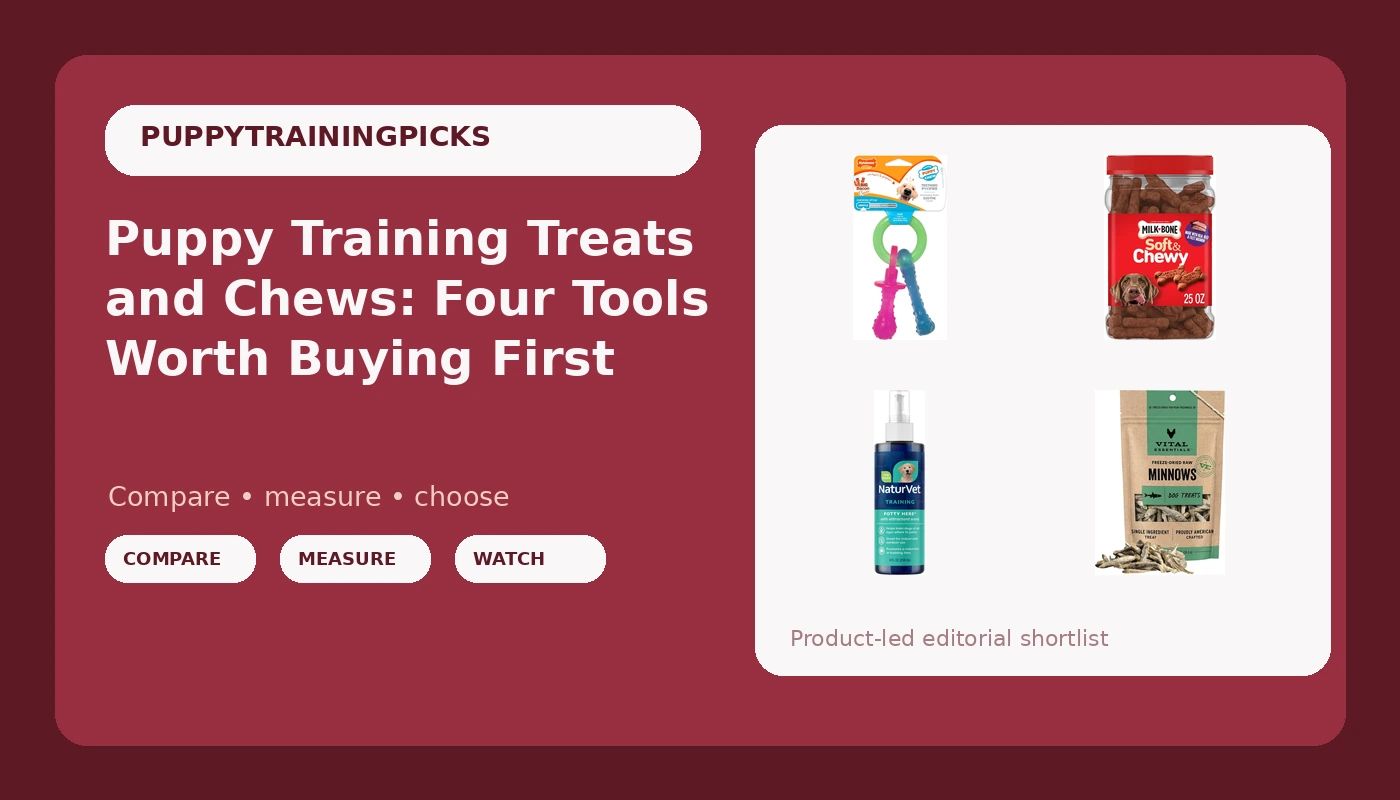
I have run a puppy kindergarten out of a church basement for four years, and I know the exact moment most owners start shopping. It is 2 a.m. in week one, standing in the rain with a nine-week-old who has decided the grass is lava. That is when the cart fills up with puppy training treats and chews, a clicker nobody will touch past Thursday, and a bottle that promises miracles by Sunday. Most of that cart is noise.
The four items in this comparison are not noise. Between them they cover the three real jobs of a new puppy household: paying for behavior you want, surviving teething without losing a baseboard, and getting a puppy to understand where the bathroom is. None of them train your dog. You do that. Each one removes a specific obstacle, and that is the only reason to spend money in month one.
The best first purchase for most puppy households is the Nylabone Puppy Pacifier chew, with the Milk-Bone Soft & Chewy canister as the everyday training reward and the Vital Essentials Freeze Dried Minnows as the jackpot for high-distraction moments. The NaturVet Potty Here spray is the one that either fits your setup or does not, and further down I will tell you which setup that is.
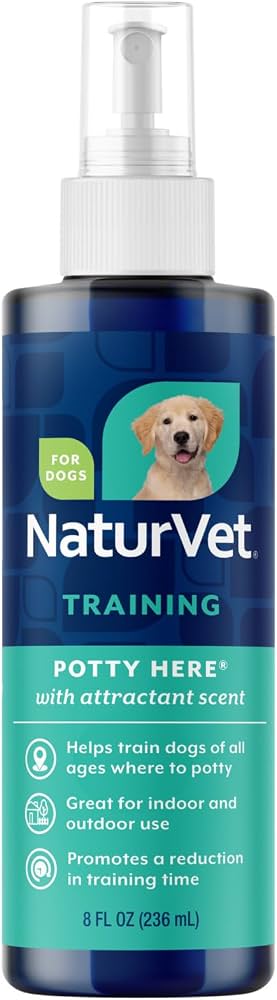
NaturVet Potty Here Training Aid Spray for Puppies and Dogs, 8 oz
Marks one specific potty spot so the puppy stops auditioning the whole yard
It is a scent cue, not a teacher. Without a schedule it changes nothing
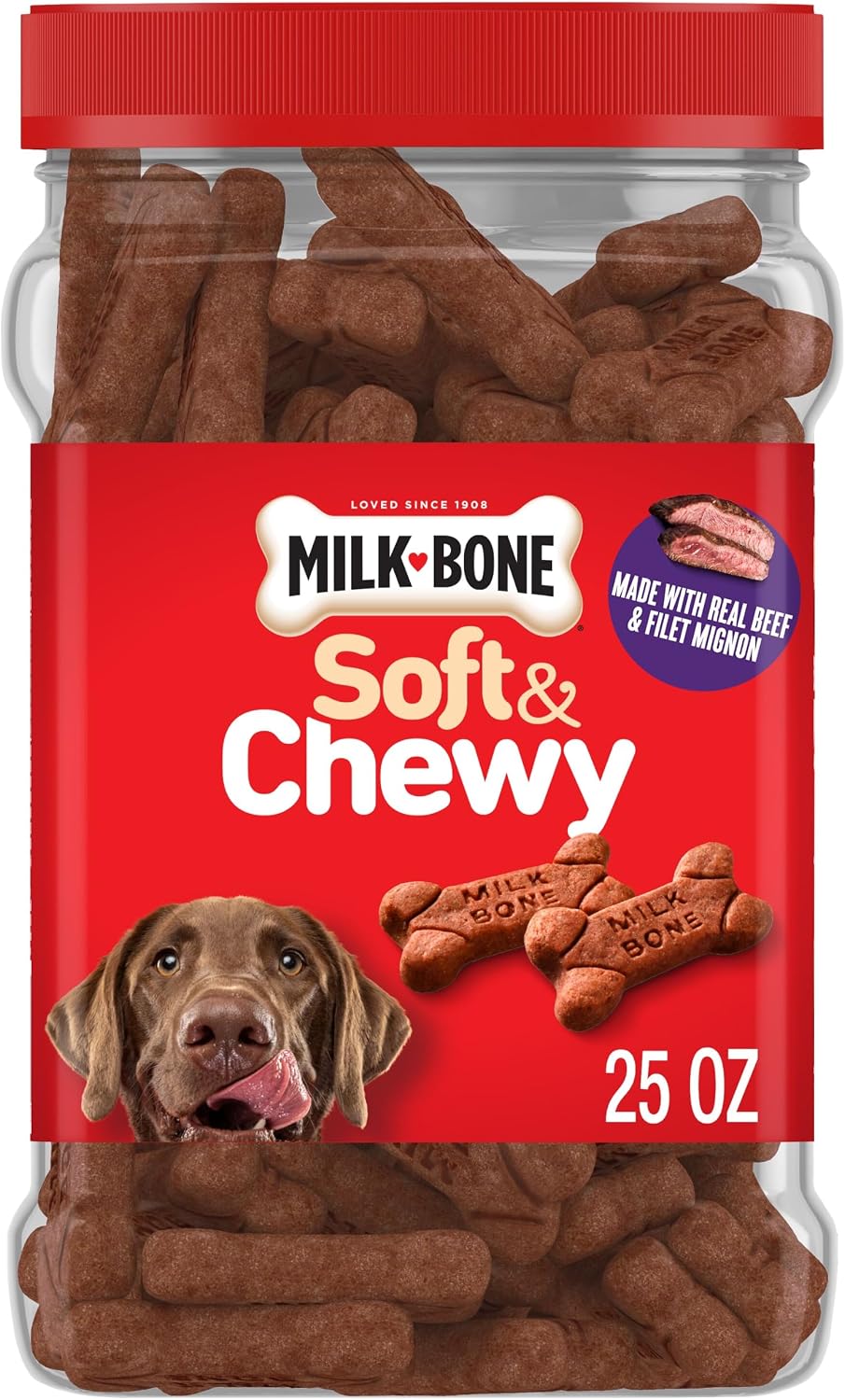
Milk-Bone Soft & Chewy Dog Treats, 25 Oz. Canister
Soft enough to tear into smaller pieces, and the canister lasts a whole puppy class
Pieces are bigger than ideal training size, so you are paying in calories unless you break them
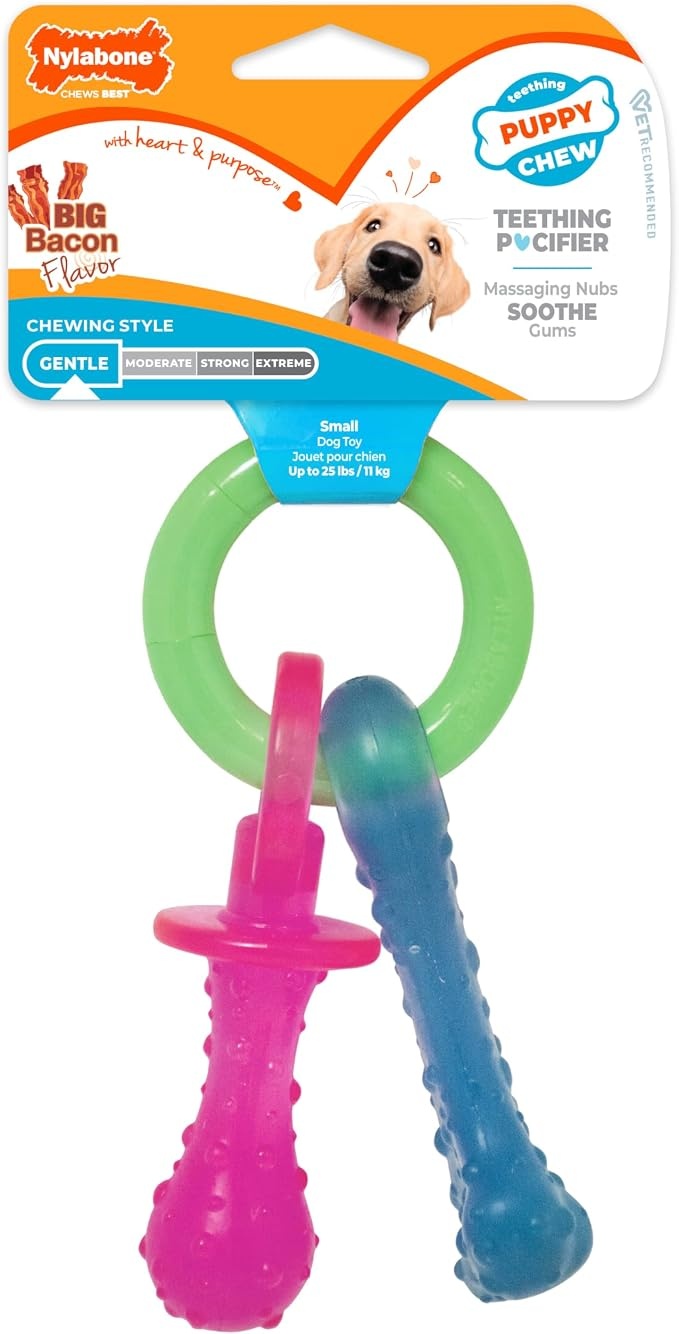
Nylabone Puppy Pacifier Chew Toy, Teething Toys for Puppies up to 25 lbs
A legal target for puppy teeth, sized for a puppy mouth instead of a full-grown jaw
It is management, not training. It will not teach a single behavior
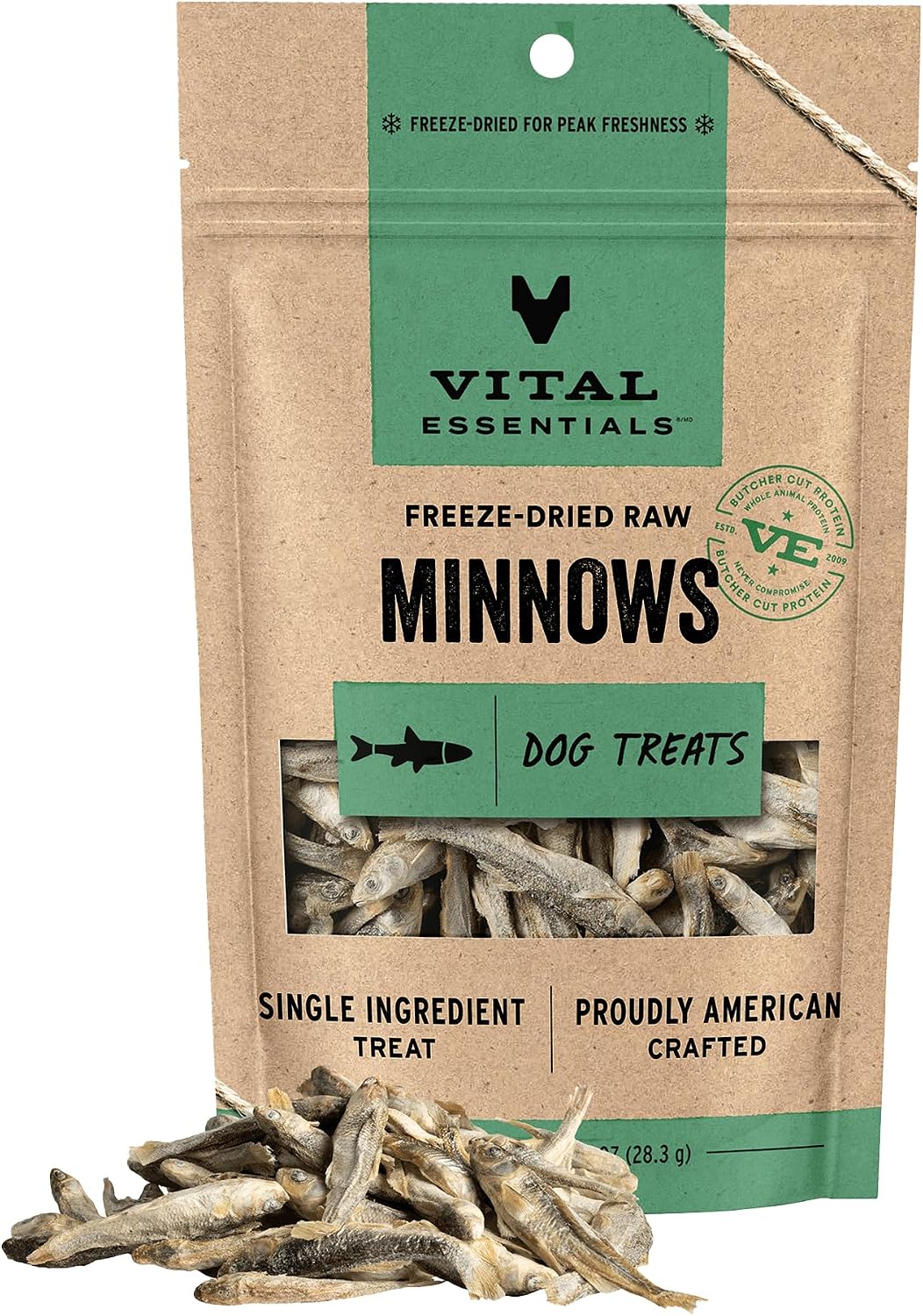
Vital Essentials Freeze Dried Minnows Dog Treats, 1 oz Bag
Single ingredient, tiny, and high value enough to beat a squirrel at ten feet
One ounce disappears fast, and the fish smell lives in your treat pouch
Prices and availability were captured from Amazon Creators API and may change.
Start with the job, not the product
The mistake I see in almost every new puppy cart is four items that do the same job. Two bags of treats, a chew, and a puzzle toy that is really another chew. Then the puppy gains weight, the treats stop working in the yard, and the owner decides positive training does not work. It worked. It was just applied with the wrong tool at the wrong moment.
So separate the jobs before you buy anything.
Treats are payment. You hand one over after a behavior you want to see again. Chews are management. They keep a teething puppy busy so he is not busy with your coffee table. A potty cue is environmental. It tells the puppy where, not what, and only after you have done the schedule work.
If you mix those up, you end up waving a chew toy at a puppy who just peed on the rug. That teaches nothing and frustrates both of you.
Treats are payment, not bribery
The criticism I hear most is that treats are bribes. They are not, as long as you fade them. You pay for repetitions early, when the behavior is fragile, and you thin the payments out as the behavior gets strong. Praise and life rewards take over. The people who end up with a dog who only listens when food is visible are the people who never faded. That is a technique problem, not a treat problem.
Two more rules I repeat every single class. First, size: a training reward should be pea-sized or smaller. Second, rate: in a brand new behavior you are paying often, sometimes every few seconds. Both of those rules point at the same requirement. Your treats have to be small and soft enough to break, or your calorie budget is gone by Tuesday.
Milk-Bone Soft & Chewy: the everyday currency
This is the canister that lives in my supply bin, and the reason is volume. Twenty-five ounces of soft treats is enough to run a lot of repetitions, and soft means you can pinch a piece in half or thirds with one hand while your other hand is on a leash. When you are working on a name response in the kitchen, this is the treat you can afford to hand out forty times in ten minutes.
The honest downside: the pieces are bigger than training size out of the can. If you hand them over whole, you are not training, you are feeding a second dinner in installments. Break them. Also expect a soft treat to crumble in a pocket, so keep them in a bag or a pouch, not loose in a jacket.
Vital Essentials Freeze Dried Minnows: the jackpot
Every puppy has a price, and for a lot of them the price goes up outdoors. This is the treat I reach for at threshold, meaning the distance where your puppy notices the distraction but can still think. Whole freeze dried minnows are one ingredient, they are small, and they smell like the ocean, which is exactly why a puppy will turn his head away from a passing dog for one.
The downside is arithmetic. A one ounce bag is a jackpot supply, not a daily supply. Use these for the hard reps: the first loose-leash steps on a busy sidewalk, the first recall in a park, the first calm moment in a vet lobby. If you use minnows for everything, you will be ordering them weekly and your puppy will be unimpressed by week three. The other caveat is the smell. If fish turns your stomach, this is not your treat.
Chews are management, not training
A chew toy is not a reward and it will not teach sit. What it does is buy you the fifteen minutes when accidents and chewed baseboards actually happen, which is the stretch while you are cooking dinner or on a work call. A tired, occupied puppy is a puppy who is not rehearsing bad habits.
The Nylabone Puppy Pacifier is built for the mouth it is going into. The product name says puppies up to 25 lbs, and that matters, because the chew I see most often in new homes is a full-size bone for an adult dog that a nine-week-old cannot get a grip on. This one gives puppy teeth something to do.
How I use it in class: any time a puppy starts mouthing hands, the chew goes in the mouth instead, and the hand goes away. That is redirection, and it is the fastest fix for puppy biting that exists. It is also the reason I put this at the top of the list. Teething is the thing that makes owners quit training in week five.
Where it loses points: it is not food, so it does nothing for a puppy who is not in a chewing mood. Some puppies need the chew introduced as a game, held and wiggled, before they care. And like every chew, it belongs in the supervised category. Check it for wear and replace it when the texture goes smooth.
The potty spray is a cue, not a cure
Here is the plain version. The NaturVet Potty Here spray is a scent marker. You put it on the patch of grass you want your puppy to use, and it helps him understand that this square of the world is the bathroom. That is the entire job, and it does that job well.
It is not a housebreaking program. Potty training is a schedule, supervision, and a party every time the puppy gets it right outside. An eight ounce bottle cannot replace any of those, and a spray that says "go here" while you also leave pee pads by the back door is sending two contradictory messages. If your goal is outdoor potty training, pick one location and be boringly consistent about it. That is where this earns its shelf space: apartment balconies, small yards, and any home where you want one potty patch instead of a lawn dotted with surprises.
Where it loses points: it does not clean up an indoor accident, and it does not teach a puppy to hold it. That is a different product and a different skill.
The trade-offs nobody puts on the label
The pattern across all four of these is the same. The tool handles the easy part, and the owner handles the hard part. The chew gives the puppy something legal to bite, and you still have to redirect every single time he chooses your hand. The canister gives you cheap repetitions, and you still have to break the pieces and fade them. The minnows give you a weapon against distraction, and you still have to train outside the threshold before you train inside it. The spray marks the spot, and you still have to set an alarm and go out at 2 a.m.
Where people go wrong is buying the tool and skipping the work, then blaming the tool. I have watched it happen with every category of puppy gear on the market, and I will keep saying it until it stops: the tool is ten percent. Timing, consistency, and practice are the other ninety.
The order I would buy them in
If you are building this cart over eight weeks instead of all at once, this is the sequence I would use with a new puppy.
Weeks one and two: the chew and a soft treat you can break small. Your only goals are name recognition, potty trips on a schedule, and redirecting teeth onto something legal. No fancy behaviors yet.
Weeks three and four: add the high-value jackpot treats. This is when you start taking the show outside, where grass, wind, and other dogs compete with you. Keep the everyday treats for easy reps indoors and save the special ones for the hard reps.
Weeks five and six: this is the week that breaks most puppies and most owners. The puppy is bigger, bolder, and suddenly not interested in your cheap treats. Keep the jackpot supply stocked, and if your potty spot has been wandering around the yard, that is when the spray earns its place by pinning one location down.
Weeks seven and eight: fade. Start paying with praise for the behaviors your puppy knows cold, and keep food for anything new or anything difficult. If you never get here, you will be the person at the park with a pocket full of treats and a dog who only sits when he sees them.
What I would skip entirely
Anything that vibrates, shocks, or startles a puppy. There is no version of that I would put on a dog of any age, and there is certainly no version I would put on a twelve-week-old.
Clickers sold without any instructions, because a clicker is only useful if you know what you are marking and when.
Treats the size of golf balls marketed as training rewards. You will either overfeed your puppy or spend your whole session breaking food apart instead of watching your dog.
And pee pads, if your goal is outdoor potty training. They teach a puppy that indoors is a fine place to go, and then you have to unteach it. That is a harder job than the one you started with.
What I am testing next
I am in the middle of a 2026 treat and leash run with eight brands and thirty puppies in class, plus a distraction test at a busy park that has already embarrassed two products I expected to like. Most of what I am testing fails by session two, usually on size or on value. The four items on this page are the ones that stay in the bin while the rest of the box gets retired, and I will update the list as the new data comes in.
Start with the job. Then buy the tool. Then do the work, which is the part no one can sell you.