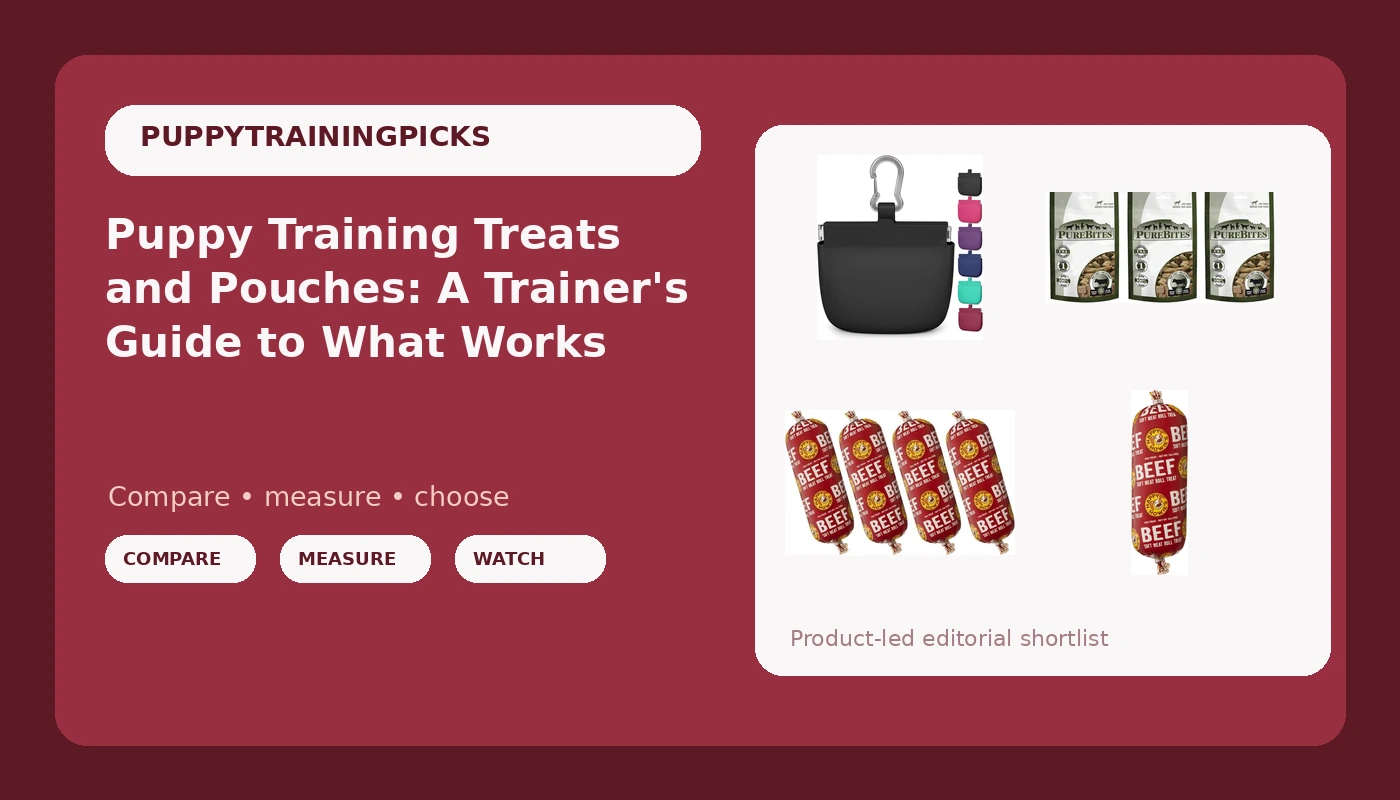
Most of the puppy training problems that land in my inbox are not obedience problems. They are logistics problems. The owner knows the cue, the puppy is willing, and then the reward is buried in a zippered jacket pocket, the puppy has spotted a dropped french fry two driveways away, and the teachable moment is over before it started. Puppy training treats and pouches are the unglamorous half of that equation. The treat determines whether your puppy thinks the work is worth doing, and the pouch determines whether you can actually pay on time.
This is an explainer, not a ranked list. There is no single correct combination, because a four-month-old Labrador and a four-month-old Papillon do not have the same reward budget or the same mouth. What follows is how to think about treat format, treat value, and the container that keeps both within reach during a real session, plus four products that cover the categories most owners end up needing.
Related: How to Fade Training Treats Without Losing Your Puppy's Attention →
Quick answer
For most puppies in a group class or on a sidewalk, the workable setup is a soft treat broken or cut into pea-sized pieces, carried in a pouch you can open and reach into with one hand while the other hand manages the leash. Freeze dried liver and soft meat rolls both fit that description, and a silicone pouch with a leash or belt attachment is what makes either format practical. Buy the smallest bag or roll you can to test acceptance before committing to a bulk pack.
Four useful options
| Model | Best fit | What stands out |
|---|---|---|
| 1Cup Silicone Dog Training Treat Pouch for Leash or Belt Loop(Black) | One-handed reward delivery on walks and in class | Silicone body, one cup capacity, leash or belt loop attachment |
| (3) PureBites Beef Liver Freeze Dried Dog Treats 4.2oz Bags. Total 12.6oz | High-value rewards that stay light in a pouch | Freeze dried beef liver, three 4.2 ounce bags, 12.6 ounces total |
| Happy Howie's Soft Meat Roll Treat, High Protein, Beef, 12 Oz (Pack of 4) | Multi-puppy households and ongoing classes | Four 12 ounce soft rolls, slice to your own size, beef |
| Happy Howie's Soft Meat Roll Treat, High Protein, Beef, 12 Oz (Pack of 1) | Testing acceptance before buying in bulk | One 12 ounce soft roll, same product in a single unit |
The delivery system: 1Cup Silicone Dog Training Treat Pouch for Leash or Belt Loop(Black)
The pouch is the least exciting purchase in this article and the one that changes the most sessions. Timing is the whole game in reward based training, and timing collapses when you are unzipping a jacket, digging past keys, and pulling out a bag that crinkles loud enough to reset your puppy's brain. A pouch that lives on your hip or your leash keeps the reward at hand height. One cup is a real session's worth of pea-sized pieces for a single puppy, which is the right size for a walk or a 45 minute class. If you run a multi-dog household or a group class, one cup will need refilling between dogs, so plan for that. Silicone wipes and rinses easily, which matters more than you would think once you have carried oily meat roll pieces around in August.
The high value option: (3) PureBites Beef Liver Freeze Dried Dog Treats 4.2oz Bags. Total 12.6oz
Every trainer keeps a reward that outranks everything else in the environment, and for a lot of puppies freeze dried liver is that reward. It is light, it does not turn a pouch into a grease trap, and it breaks apart so you can control the size of each payment. That last point is the one owners underestimate. A reward the size of a nickel and a reward the size of a pea do the same job in terms of learning, but the pea lets you run five times as many repetitions before your puppy's calorie budget for the day is gone. The trade off with freeze dried formats is texture. Pieces crumble, and the crumbs at the bottom of the bag are still perfectly usable, just not as something you can hand over cleanly. Because liver is a rich food, keep individual pieces small and count them against the day's overall food intake rather than treating them as free.
The bulk format: Happy Howie's Soft Meat Roll Treat, High Protein, Beef, 12 Oz (Pack of 4)
Roll formats solve a problem that bagged treats cannot: you decide the geometry. A roll can be sliced into training cubes, into slightly larger jackpot pieces for a big breakthrough, or into thin coins for a puppy who is still figuring out how to chew. That flexibility is why so many class instructors keep rolls in the fridge. Four rolls at 12 ounces each is a lot of sessions, which makes the multi-pack a sensible choice for a household with more than one dog, a puppy kindergarten regular, or anyone who has already confirmed their puppy will work for this food. Storage is the thing to check on the label, since soft meat products generally behave differently after opening than dry biscuits do. Slice what you need for the week and keep the rest handled the way the packaging directs.
The try-it size: Happy Howie's Soft Meat Roll Treat, High Protein, Beef, 12 Oz (Pack of 1)
Puppies are individuals, and treat acceptance is one of the places that shows up fastest. Some puppies will take a soft beef roll on day one and never look back. Others will sniff it, walk away, and hold out for the liver. Buying a single roll first is the cheap way to find out which puppy you have, and a single 12 ounce roll is still enough for weeks of short sessions at pea-sized portions. The obvious trade off is cost per ounce, which is typically higher on a single unit than on a four pack. That math only works in your favor if your puppy actually eats the food, which is exactly why the try-it size exists.
Prices and availability may change. Product images, names, and retailer links are matched to verified listings. No current price, rating, stock status, or measured result is stated here without current evidence.
Why reward size does more work than reward brand
A training session is a series of payments. Sit earns a piece, eye contact earns a piece, four steps of loose leash walking earns a piece. If each piece is the size of a marble, a fifteen minute session turns into a meal, your puppy's motivation drops as the stomach fills, and the last five minutes of the session are the worst five minutes. Cut the same food into pea-sized pieces and the same fifteen minutes delivers several times the repetitions at a fraction of the calories. Repetitions are what build behavior. This is the single most useful thing an owner can change without buying anything at all.
Value matters too, and it is situational rather than fixed. A reward that is exciting in your living room is often not exciting enough on a sidewalk with traffic noise, other dogs, and a discarded chicken wing. That is the case for keeping two tiers of reward on hand: an everyday tier for easy environments and a high tier for the places where your puppy's attention is genuinely contested. Freeze dried liver usually lands in the high tier. Soft meat roll pieces can be cut small enough for the everyday tier and large enough to serve as a jackpot when something clicks.
How to build a reward plan that survives week six
- Pick two reward tiers before your next session, one everyday food and one high value food, and keep them in separate compartments so you can switch without thinking.
- Cut or break everything to pea size the night before, not in the moment. Pre-cut rewards are the difference between a clean session and a fumbled one.
- Mark the behavior first with a word or a click, then pay. The marker tells the puppy which exact thing earned the reward, and it has to land within a second or so of the behavior.
- Vary the value across repetitions. Same behavior, sometimes everyday food, sometimes the high value food, occasionally a small jackpot of three pieces. Predictable paychecks produce flat effort.
- Fade by raising the criteria and lowering the rate, not by quitting cold. Ask for a slightly harder version of the behavior for the same reward, then start paying every other repetition, then every third, while praise and access to the world fill the gaps.
Practical guidance for treat handling
- Load the pouch before you put the leash on, not after your puppy is already bouncing at the door.
- Keep the high value food in the compartment closest to your dominant hand so the reach is short and quiet.
- Do not mix kibble and liver loose in the same compartment unless you want everything to smell like liver.
- Rinse a silicone pouch after sessions with greasy or soft foods, because residue builds up in the corners and turns rancid.
- Count training rewards against the day's food, and reduce the bowl accordingly, especially with rich foods like liver.
- Carry more than you think you need for a new environment, since a distracted puppy earns far more rewards in the first ten minutes than a calm one does.
Which option should you choose?
Choose the 1Cup Silicone Dog Training Treat Pouch for Leash or Belt Loop(Black) when your rewards currently live in a pocket or a bag and your timing suffers for it. Choose the (3) PureBites Beef Liver Freeze Dried Dog Treats 4.2oz Bags. Total 12.6oz when you need a high value reward for distracting environments and want a format that breaks down to whatever size you pay with. Choose the Happy Howie's Soft Meat Roll Treat, High Protein, Beef, 12 Oz (Pack of 4) when you have already confirmed your puppy works for soft beef rolls and you want the per-ounce math to lean your way. Choose the Happy Howie's Soft Meat Roll Treat, High Protein, Beef, 12 Oz (Pack of 1) when you want to find out whether your puppy will work for that food before buying four rolls of it.
One caveat that applies to everything above: food motivation is not universal. Some puppies are toy motivated, some are environmental, and some need a behavior plan before treats will do much of anything. Treat format and pouch placement are logistics, and logistics make a good training plan easier to execute. They do not replace the plan, and they do not replace a trainer if your puppy is struggling with something beyond basic manners.
The bottom line
The treat is payment and the pouch is the payroll system. Get both right and your sessions get faster, cleaner, and shorter, which is what a puppy actually needs. A silicone pouch with a leash or belt attachment solves the reach problem for a few dollars. A breakable high value food like freeze dried liver covers the situations where ordinary kibble will not hold your puppy's attention. A soft meat roll covers the everyday repetitions and gives you total control over piece size. Start with the smallest quantity of any new food, confirm your puppy will work for it, then scale up to the multi-pack once you know it earns its shelf space.