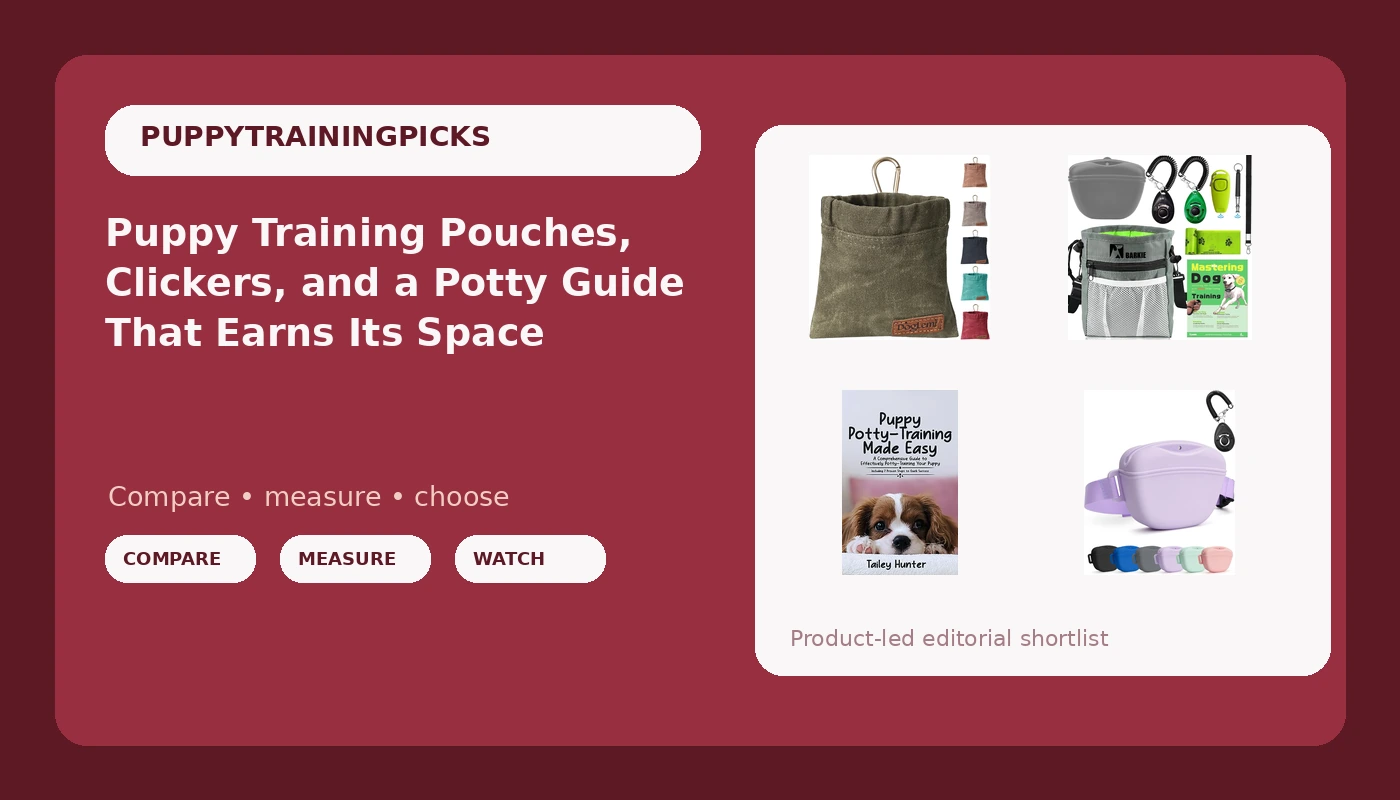
Nobody buys a puppy training treat pouch because it is exciting. You buy one because you spent a week walking the block with a fistful of kibble sweating inside a ziplock bag, and your puppy learned that the crinkle means food and the food means he can stop paying attention to you. A pouch earns its place when it does three boring things well: it opens when you need it, closes when you do not, and stays on your body while both hands are busy with a leash, a clicker, and a four-month-old who just spotted a squirrel.
This is an explainer, not a scoreboard. The four items below solve four different problems: two treat pouches, one full training kit, and one book. None of them will train your puppy. All of them can make the training you already do easier to repeat, which is the only thing that actually moves a puppy forward.
Related: How to Fade Treats Without Losing Your Puppy's Attention →
Quick answer
For most first-time owners the practical order is a wearable pouch first, a marker second, and a written plan third. A pouch keeps rewards accessible so your timing stays fast, a clicker or whistle marks the exact moment your puppy got it right, and a structured guide keeps you honest about the schedule when progress feels slow. If you want the smallest purchase that changes your daily routine, start with a pouch that closes on its own so you are not fumbling with a zipper while your puppy is mid-stand.
Four useful options
| Model | Best fit | What stands out |
|---|---|---|
| heouvo 1.67 Cup Dog Treat Pouch with Training Clicker (Violet) | Owners who want treats and a marker in one place | Stated 1.67 cup capacity with a training clicker bundled in the same unit |
| BARKIE Dog Training Kit - Treat Pouch, Pet Training Fanny Pack, 2 Puppy Training Clickers, Ultrasonic Silent Whistle, 2-in-1 Whistle Clicker, Clicker Training Guide Booklet, Dog Poop Bag (Grey) | New owners starting from zero gear | Multiple markers, a guide booklet, and a waste bag included in one kit |
| ETIAL Dog Treat Pouch,Portable Puppy Dog Training Treat Bag,Hand Free Dog Walking Bag,Auto Closing Pet Feed Snack Reward Pocket,Dog Food Dispenser for Pet Puppy Travel or Outdoor Use | Walks where you want hands free and fast access | Auto closing opening built to keep kibble contained between rewards |
| Puppy Potty Training Made Easy: A Comprehensive Guide to Effectively Potty-Training Your Puppy (Including 7 Proven Steps to Quick Success) | Households fighting the potty schedule | A book-length plan that includes a numbered seven step sequence |
The everyday carry: heouvo 1.67 Cup Dog Treat Pouch with Training Clicker (Violet)
The case for a combined pouch and clicker is mechanical, not sentimental. Good training depends on the gap between the behavior and the marker, and that gap gets longer every time you dig in a pocket. If the clicker lives on the pouch, your hand is already there. The trade-off is that you are committing to one marker and one treat supply in the same place, so if the clicker is lost or the pouch is in the wash, both are gone. Owners who like to train with a whistle in the yard and a clicker indoors will eventually want them separate.
The full kit: BARKIE Dog Training Kit - Treat Pouch, Pet Training Fanny Pack, 2 Puppy Training Clickers, Ultrasonic Silent Whistle, 2-in-1 Whistle Clicker, Clicker Training Guide Booklet, Dog Poop Bag (Grey)
Two clickers is more useful than it sounds, because clickers are the item people lose first and the item that gets left in a jacket pocket. The ultrasonic whistle deserves a plain warning: an ultrasonic whistle is a sound cue, not a shortcut. It can startle a puppy if you blow it before you have paired it with food, and a startled puppy is not a trained puppy. Charge it the same way you charge a clicker, one quiet pip followed immediately by a treat, and only then use it at distance. If your puppy flinches, back up and go slower.
The lightweight spare: ETIAL Dog Treat Pouch,Portable Puppy Dog Training Treat Bag,Hand Free Dog Walking Bag,Auto Closing Pet Feed Snack Reward Pocket,Dog Food Dispenser for Pet Puppy Travel or Outdoor Use
The auto closing opening is the feature worth thinking about, because the alternative is a pouch that either dumps kibble on the sidewalk or requires two hands to open while your puppy is pulling. Where this style of pouch gives something up is structure. Fabric pouches with flexible openings collect crumbs and treat dust, and soft treats will smear the lining. Plan on emptying and rinsing it regularly, and do not leave cheese in it overnight unless you enjoy a pouch that smells like a gym bag.
The reading: Puppy Potty Training Made Easy: A Comprehensive Guide to Effectively Potty-Training Your Puppy (Including 7 Proven Steps to Quick Success)
Potty training is the one area where gear matters least and scheduling matters most. A book helps because the failure mode is almost never a puppy who cannot learn, it is an owner who takes the puppy out at inconsistent times and then blames the puppy. One caution that applies to every potty resource: if your goal is outdoor potty training, skip pee pads entirely. Pads teach a puppy that indoors is an acceptable bathroom, and that is a lesson you will spend months undoing.
Prices and availability may change. Product images, names, and retailer links are matched to verified listings. No current price, rating, stock status, or measured result is stated here without current evidence.
Why the pouch matters more than the treat
Reinforcement is a timing problem. A reward delivered two seconds after the behavior is teaching something, just not the thing you intended. The pouch exists to shrink that gap to something close to a second. That is the entire job description.
This is also why treat size matters more than treat brand. A reward the size of a pea can be delivered fast and repeated thirty times in a session. A reward the size of a golf ball takes two hands, takes several seconds to chew, and blows through a puppy's daily calorie budget before you have finished teaching one behavior. Cut or break treats down. If you are using kibble, set aside part of the daily ration as training currency so you are not adding food on top of meals.
And treats are payment, not bribery. The mistake is not using food. The mistake is never fading it. Start with a reward every correct repetition, then move to every other, then every third, then surprise rewards on the best reps. Praise and play take over more of the load as the behavior gets solid. If your puppy only works when food is visible, that is a fading problem, not a stubbornness problem.
Markers: clicker, whistle, and the word you actually use
A marker is a sound that means "that exact thing, right there, is what pays." A clicker is precise and consistent, which is why it beats a spoken word for new behaviors. A spoken word works fine once a behavior is learned, and it is the marker you will still have when the clicker is in a drawer.
Two rules keep markers honest. First, the marker always gets paid. If you click, a treat follows, even if you clicked by accident. Second, the marker comes before the reward, never after. Click then treat. Say the word then treat. The order is the whole mechanism.
- Charge the marker: ten reps of click, treat, click, treat, with no behavior required, so the sound predicts food.
- Pick one behavior and one marker for the session, and decide what counts as a correct rep before you start.
- Keep sessions short, three to five minutes, and end while your puppy still wants more.
- Train outside your puppy's threshold, meaning far enough from the distraction that he can still notice you and eat.
- Fade the food on a schedule you chose in advance, and keep surprise rewards for the best reps.
Practical guidance
- Wear the pouch on the side opposite your leash hand so the treat hand and the leash hand never compete.
- Pre-load the pouch with the day's cut treats before you leave the house, not while standing on the sidewalk.
- Keep two tiers of reward: everyday kibble for easy reps, something better for distracting environments.
- Empty and rinse the pouch after sessions with soft or smelly treats, and let it dry fully before the next use.
- Practice the mechanics with no puppy present: open, grab, deliver, close. Your hands should know the sequence before your puppy tests it.
- If a marker startles your puppy, stop using it and rebuild the association with food before you try it again.
Which option should you choose?
Choose the heouvo 1.67 Cup Dog Treat Pouch with Training Clicker (Violet) when you want treats and a marker in one unit and you mostly train at home or on short walks. Choose the BARKIE Dog Training Kit - Treat Pouch, Pet Training Fanny Pack, 2 Puppy Training Clickers, Ultrasonic Silent Whistle, 2-in-1 Whistle Clicker, Clicker Training Guide Booklet, Dog Poop Bag (Grey) when you are starting with nothing and want spare markers plus written instructions in the same box. Choose the ETIAL Dog Treat Pouch,Portable Puppy Dog Training Treat Bag,Hand Free Dog Walking Bag,Auto Closing Pet Feed Snack Reward Pocket,Dog Food Dispenser for Pet Puppy Travel or Outdoor Use when you want a hands free bag for walks and travel and you already own a clicker you like. Choose the Puppy Potty Training Made Easy: A Comprehensive Guide to Effectively Potty-Training Your Puppy (Including 7 Proven Steps to Quick Success) when the problem in your house is not gear at all, it is an inconsistent schedule.
One caveat that applies to all four: nothing here has a guaranteed timeline. Puppies mature at different rates, and a house-trained twelve-week-old and a house-trained six-month-old are both normal outcomes. Buy the tool that removes friction from the routine you can actually keep.
The bottom line
The pouch is 10 percent of the job and the routine is the other 90. Buy one that opens fast and closes on its own, keep the treats small, mark the moment your puppy gets it right, and pay for good reps until the behavior holds without food. If potty training is your current bottleneck, spend the money on a plan instead of another gadget, because no pouch has ever taught a puppy where to pee.